
Thanks Hope! I just came across your related work with the CSS team at Microsoft- I'd love to chat about it sometime if you're free 🙂
11.02.2025 23:20
👍 1
🔁 0
💬 0
📌 0
Thanks Hope! I just came across your related work with the CSS team at Microsoft- I'd love to chat about it sometime if you're free 🙂
Hi Daniel- thanks so much. The preprint is dependable, though missing a little additional discussion that made it into the camera-ready. I can email you the camera ready and will update arxiv with it shortly. Thank you!
NEW blog post: Do modern #LLMs capture the conceptual diversity of human populations? #KempnerInstitute researchers find #alignment reduces conceptual diversity of language models. bit.ly/4hNjtiI
Many thanks to my collaborators and @kempnerinstitute.bsky.social for helping make this idea come to life, and to @rdhawkins.bsky.social for helping plant the seeds 🌱

(9/9) Code and data for our experiments can be found at: github.com/skmur/onefis...
Preprint: arxiv.org/abs/2411.04427
Also, check out our feature in the @kempnerinstitute.bsky.social Deeper Learning Blog! bit.ly/417WVDL
(8/9) We think that better understanding such tradeoffs will be important to building LLMs that are aligned to human values– human values are diverse, our models should be too.
(7/9) This suggests a trade-off: increasing model safety in terms of value alignment decreases safety in terms of diversity of thoughts and opinion.


(6/9) We put a suite of aligned models, and their instruction fine-tuned counterparts, to the test and found:
* no model reaches human-like diversity of thought.
* aligned models show LESS conceptual diversity than instruction fine-tuned counterparts

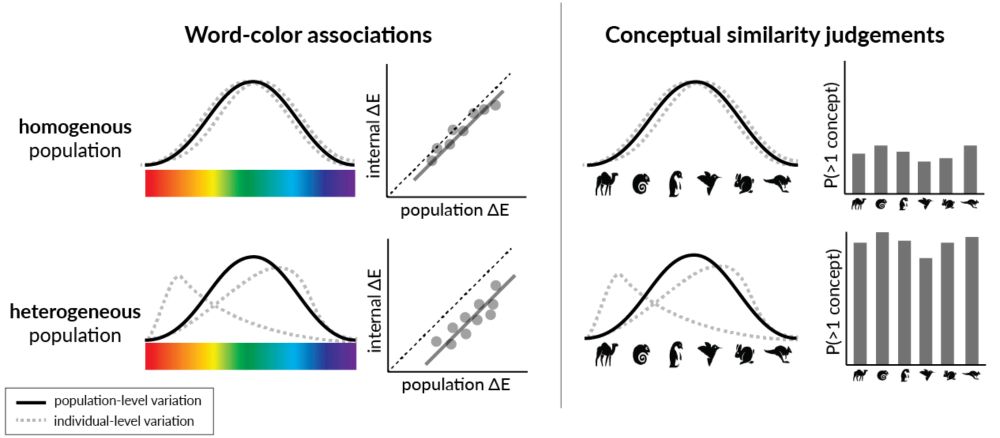
(5/9) Our experiments are inspired by human studies in two domains with rich behavioral data.

(4/9) We introduce a new way of measuring the conceptual diversity of synthetically-generated LLM "populations" by considering how its “individuals’” variability relates to that of the population.
(3/9) One key issue is whether LLMs capture conceptual diversity: the variation among individuals’ representations of a particular domain. How do we measure this? And how does alignment affect this?
(2/9) There's a lot of interest right now in getting LLMs to mimic the response distributions of “populations”--heterogeneous collections of individuals– for the purposes of political polling, opinion surveys, and behavioral research.

(1/9) Excited to share my recent work on "Alignment reduces LM's conceptual diversity" with @tomerullman.bsky.social and @jennhu.bsky.social, to appear at #NAACL2025! 🐟
We want models that match our values...but could this hurt their diversity of thought?
Preprint: arxiv.org/abs/2411.04427