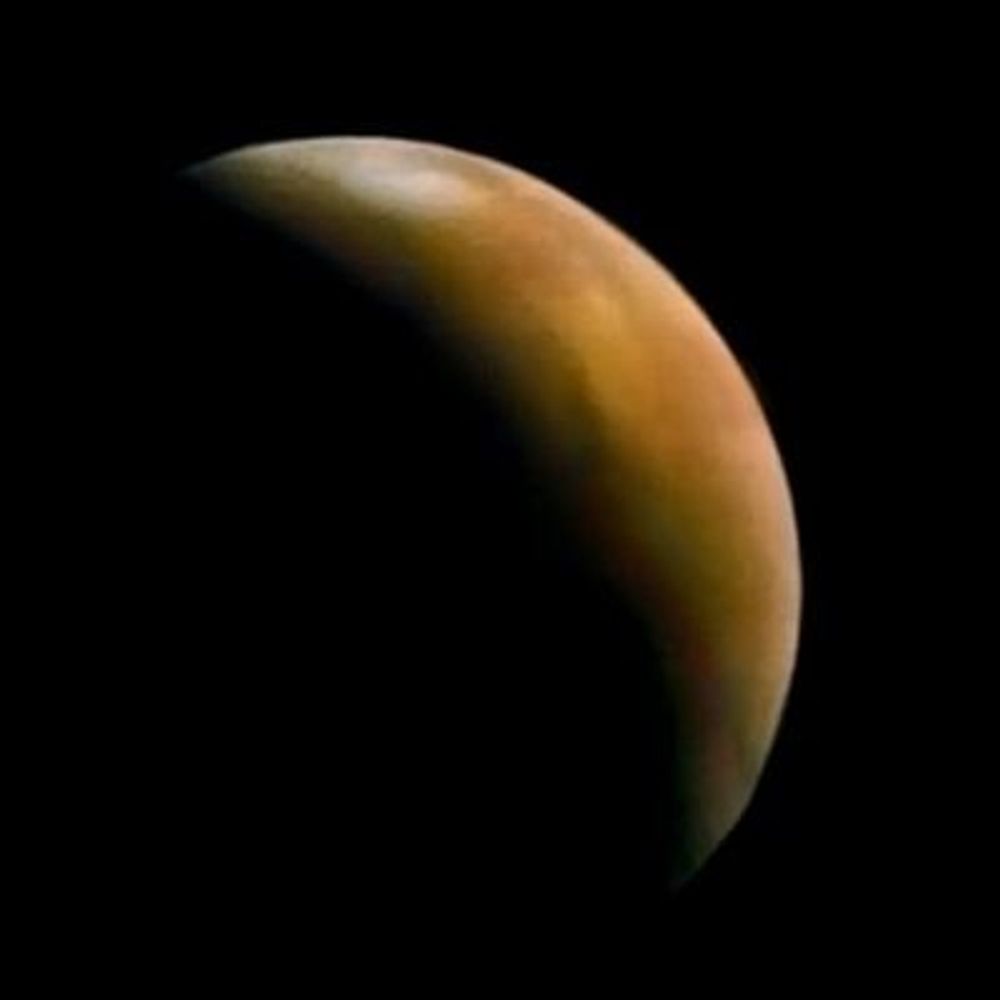

My bombshell discovery! 😃
06.03.2026 23:41
👍 4
🔁 0
💬 0
📌 0
My bombshell discovery! 😃

Galileo’s handwritten notes found in ancient astronomy text Discovery sheds new light on how famed astronomer came to lead a scientific revolution
A historian has discovered that a 16th century printing of The Almagest—a highly influential ancient astronomy text—contains extensive annotations from Galileo Galilei, the astronomer who later overthrew that text’s conception of a geocentric cosmos.
Learn more: https://scim.ag/4aMAwRm

As long as they continue to employ Loeb, there is nothing wrong with mocking anyone who really thinks that working at or going to Harvard is an honor. It's just a way of saying you're an egomaniac who has been accepted into the egomaniac club. avi-loeb.medium.com/the-non-grav...

A long scan of the lunar surface centered on the Catena Davy crater chain.
The Davy crater chain (Catena Davy) from Luna 22, which orbited the moon in 1974.

The moon in the clouds setting into the trees.
No eclipse this morning, but the moon in the clouds with a nice little jet contrail over was nice.
Thanks!

The eclipsed Moon among the trees.
The only decent shot I got of the lunar eclipse before clouds rolled in. Taken from my front yard in Powell, Tennessee. This is from my phone . I started setting up the camera, and when I looked back up the moon was in the clouds.

Clouds above the horizon showing where the eclipse should be
What a lovely eclipse.

Jupiter, with the great red spot and the shadow of Io, from Pioneer 10

Jupiter from Pioneer 10 near closest approach. Radiation caused the scanning photometer that built up this image to shift several times.

Ganymede from Pioneer 10

Jupiter and Io from Pioneer 10 as it left the Jovian system behind.
Today in 1972, Pioneer 10 was launched, becoming humanity's first spacecraft to cross the asteroid belt, encounter Jupiter, and leave the planetary system.

A cool thing in these JWST 🔭 Uranus infrared images -- ASIDE from the (artificially-blue) polar cap & the dynamic bright clouds -- is the imaging of the aurora! It is the reddish glow extending above the clouds (e.g. 10 o'clock in the image on the right) www.scientificamerican.com/article/new-...
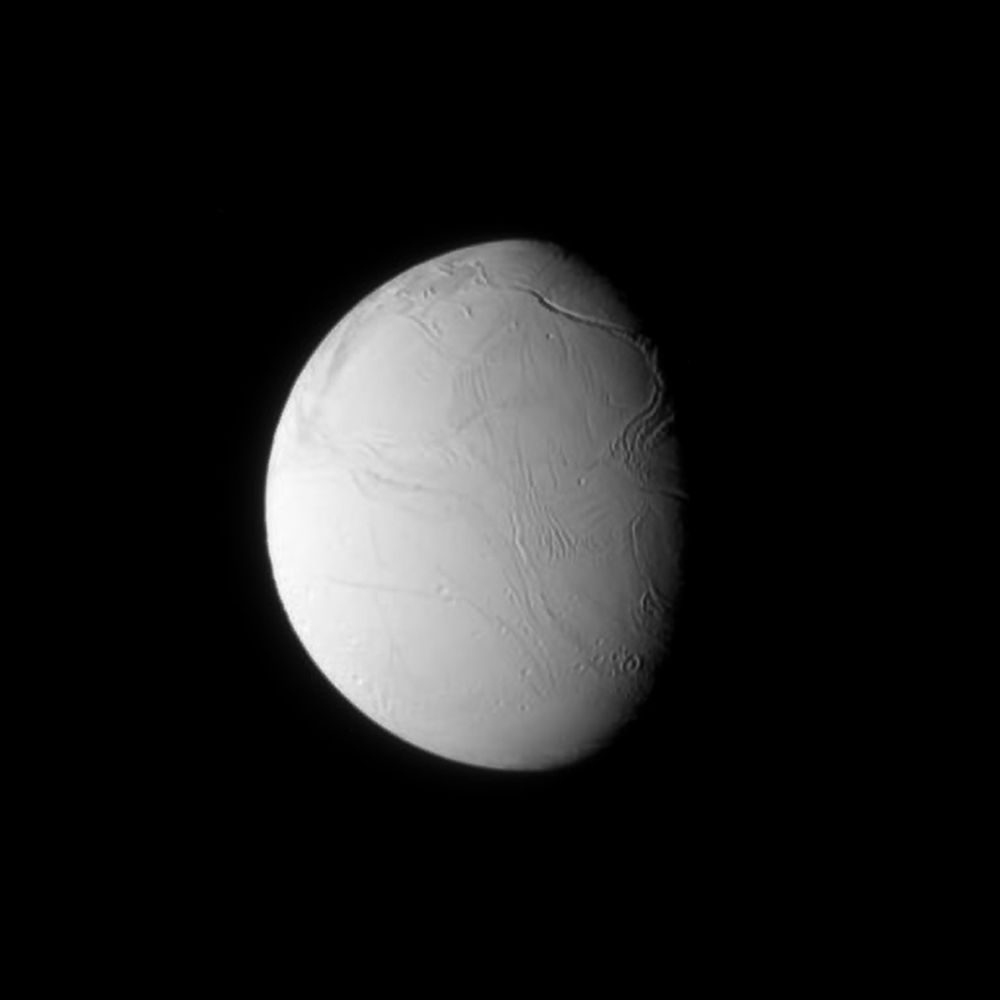
The smooth surface of Enceladus.
Enceladus, moon of Saturn, from the Cassini spacecraft on November 4, 2016. It is still odd not having views like this anymore. The run between 2004-2017 made it feel normal. I hope JUICE and Clipper, both in the Jovian system, have a similar effect.

All Members of the Solar System Beyond Saturn and Smaller Than 80 Kilometers In Diameter for Which We Have Disk-Resolved Imagery shown at 1 km/pixel (at least in the original version, Bluesky may alter the scale). Data for Pluto’s Moons (Styx, Nix, Kerberos, Hydra) and Arrokoth from New Horizons Courtesy NASA/SWRI/APL. Data for Naiad (Neptune), Belinda (Uranus), and Cordelia (Uranus) from Voyager 2 Courtesy NASA/JPL
These little worlds are fascinating. Given the little swarms around Uranus and Neptune, plus the whole host of KBO objects, it is enough to wet one's appetite, but our datasets are so limited.
I'd rather set money on fire.
Luna 16 landed at night but took some imagery in earthshine. According to accounts at the time, it showed some detail. However, these panoramas have never surfaced. Luna 24 did not carry a camera.

The sampling arm of Luna 20 in two different positions. I am not sure the actual order in which this sequence was taken.
In February of 1972, Luna 20 was on the moon in the Apollonius highlands, with its sampling arm hard at work finding a place to drill and then burrowing into the surface. This would be the only one of the three successful Soviet sample return missions to photograph the surface...maybe...
And yes, @rocher.lc, a lot of those "savings" would go into more bureaucracy to keep the system going.
Online could just divide into lots of small sections so that students didn't realize how many people their supposed professor was "teaching." That would be harder to do in-person.
Not to mention that I could give a thousand students the feedback volume I give my current students with AI. It would be utter shyte, but at a glance it would look thorough. So they could get rid of most faculty without, they think, students noticing much, particularly online.

A heart shaped volcanic feature on Io from Voyager 1.
The deposits around the volcano Pele on Io looked like a heart as Voyager 1 approached in March of 1979. For today, I rotated it around to emphasize that. By the time Galileo saw it in 1996, the indentation at the top of this image was mostly gone. Happy Valentine's Day!
It all depends on one's definition of true
It's more knowing more about light than most people do
By definition calling something a color means it doesn't absorb that hue
Wow, I didn't know that Einstein was the first to recognize him!
Sometimes you will see someone who describes themself as a "visionary" in their bio. If it is ironic or sarcastic, they're fine. But if not, it's very important that you do not follow that person. They have nothing to offer.

Three progressively more distant views of Mercury from Mariner 10.
Mariner 10 receding from humanity's first encounter with Mercury in March of 1973. New features slowly rotate into view, including the large crater "Mozart" just below the center of the terminator.
The scientific term for what they are doing is "making shit up," Simon.

The Uranian rings silhouetted against the planet.

Verona Rupes, a large escarpment on Miranda's terminator in Voyager's imagery.

The surface of Ariel

An impact basin on Titania's terminator.
I hope you enjoyed the 40th anniversary tour of the Uranian system. I hope we see this it again as soon as possible.

The volcanic surface of Io.
Io, moon of Jupiter, from the Galileo spacecraft on April 4, 1997. The dark spot surrounded by the red circle is Pele, a large volcano. The caldera Loki can be seen as a black spot with an island in the middle near the terminator.

I created a Substack. I have no immediate plans to use it to do anything but read, but if any of you write on there, feel free to connect with me so I can follow you. tedstryk.substack.com/p/hello-subs...

This is my image processing work, as my bio makes clear - that's what I use this account for. And I am very familiar with historical image sets. So anyway, just so you are aware, you aren't hot about anything here, you're just really, really lazy.

A high resolution view of a crescent Io with mountains near the terminator.
Io from the Juno spacecraft on February 3, 2024. The night side can be seen in reflected light from Jupiter. The quality of this dataset is truly stunning.

The lunar surface at a high illumination angle.

The lunar surface at a high illumination angle.

The lunar surface at a high illumination angle.

The lunar surface at a high illumination angle.
Sixty years ago today, on February 3, 1966, Luna-9 was the first spacecraft to survive landing on the surface of another world. It is wild to think that the Space Age is so young that there are still millions alive now who were adults when this happened.