

Really enjoying sunny San Diego so far.
17.12.2025 20:23
👍 10
🔁 0
💬 1
📌 0
Really enjoying sunny San Diego so far.


Some news. Exciting new challenges and opportunities ahead.
Sorry I missed you

Have you seen the latest result from the Julius lab showing mitochondrial electron transport chains tuning as an intrinsic cellular strategy protecting nociceptors against excitotoxicity? Check out this #EditorsPick from @alexchesler.bsky.social now! bit.ly/46jodto #PRF
My editor’s pick:
painresearchforum.org/paper/mitoch...
“...the findings suggest that nociceptors have evolved to “dial down” the ETC pathway, enabling them to be unusually resilient to oxidative and other intracellular stresses.“

The latest papers published in pain research are now on PRF! Dr. Alex Chesler provides a curated list for Aug. 22-28, 2025 and a commentary on his pick for Paper of the Week! painresearchforum.org/paper @utdpaincenter.bsky.social @nyupainresearch.bsky.social @iasp.bsky.social @usasp.bsky.social
Agree this is an amazing paper. Adding a shout out to my NIH intramural colleagues Nick Ryba (the last author) and Mark Hoon (the second author) for this landmark study.

Some very nice 50 year old immunostaining that showed for the first time that Substance P was in sensory neurons and their central terminals. Only three pictures, published in Science! www.science.org/doi/abs/10.1...
Sort of last minute but my group is looking to recruit a a recent college grad as postbac to start this summer and work on PIEZO channels. Project involves cell based assays, patch clamp recording, and imaging.
Info on the NIH program can be found here: www.training.nih.gov/research-tra...
Say hi for me. And don’t let him talk you into trying Surströmming.

The last 2 weeks have been a blur, but sadly I'm no longer at the NIH. Working for #painresearch at the NIH was a great honor and the best job of my life. As part of this amazing team, I'm proud to have worked on the HEAL 2025 Annual Report - pls share! heal.nih.gov/about/nih-he...

PRF 14 May 2025.png
Read this #PapersoftheWeek #EditorsPick from Ghitani et al. and @Nature.com demonstrating that nociceptor activity is both necessary and sufficient for inflammatory tactile allodynia bit.ly/4mcTuV4 #PRF

The feeling of a hug comes from the pressure and vibration of millions of nerve endings.

Happy “May the 4th” or as I like to call it “Piezo Day”.
Here’s just the most recent of the many NCCIH studies of #pain (from colleague @alexchesler.bsky.social published last week in Nature). Nearly 50% of NCCIH funding goes to studying pain, with a focus on nonpharmacological treatments and mechanisms. The proposed budget eliminates NCCIH.
I am looking for postdocs to join my group at NIH. Are you interested in Development, Evolution, Genetics, Genomics, and Human health? Please apply! www.training.nih.gov/jobs/pdf-mb-...


Four old men from NYC. Reunited to see a punk band that I last saw live at CBGBs in high school. Friends for four decades.

Nice article in NY Times today about AgRP neurons, GLP1s, and hunger. By Gina Kolata. www.nytimes.com/2025/04/26/h...
However, my guess is the discrepancy w/ Qi et al arise because in that study, they record from the entire MrgB4 lineage, which we show includes brush sensitive cells (Extended Data Fig. 3D).
Qi et al were more controlled in their force application as they were seeking to determine precise mechanical activation thresholds. Thus, we may have overlooked small differences in mechanosensitivity by using naturalistic soft brushing and pinching.
Some clarification: Because our findings were not what we expected, we went to great lengths to verify them. We imaged both TG (Figs 1-2) and lumbar DRG (Ext Fig 3d). To definitively ID cells, we used two methods: post-hoc in situ (Fig 1, Ext Fig 2) + the Cre-tdT line from earlier studies (Fig 2).

co-author @dimacd.bsky.social pointed out that the link was truncated in my post. Hope this works: www.nature.com/articles/s41...
An example of what we in the NIH Intramural program can accomplish. Excited to share our latest paper in close collaboration with Nick Ryba's group. We examined how inflammation transforms representation in somatosensory neurons to cause pain. Lots of surprises here: www.nature.com/articles/s41...
Huge congratulations to the always amazing, truly brilliant @clairelepichon.bsky.social who just received TENURE from our NIH intramural program.
And a teaser… stay tuned. This work is the appetizer to his major work, which we hope to wrap up soon.
Another write up of the work led by @dimacd.bsky.social. We debated a long time whether and how to report his largely negative results.
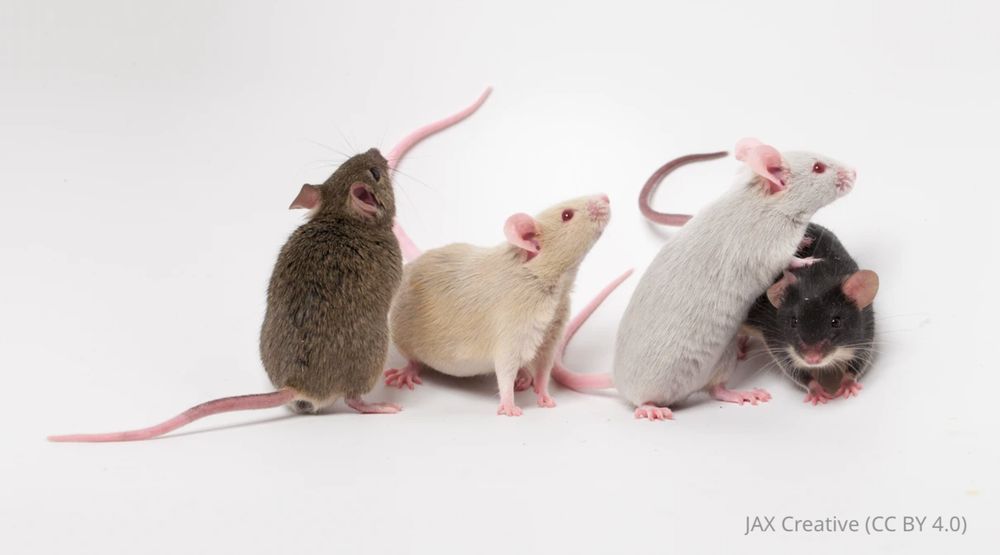
different coloured mice on a white background
Turns out, two of pain’s most famous messengers — Substance P and CGRPα — might not be so essential after all. Mice missing both still felt pain just fine, challenging decades of assumptions about how pain signals travel.
buff.ly/ypISrtx
