Shift to Stem subjects means kids could be moving right
Youngsters are ditching arts and humanities out of economic necessity — it both reflects and informs their politics
Our @wepsocial.bsky.social paper (with @nspmartin.bsky.social and @rolandkappe.bsky.social) on the effects of school subjects on political party support is the focus of @jkirkup.bsky.social's @thetimes.com piece today
20.02.2026 14:43
👍 7
🔁 4
💬 1
📌 0
Interesting column discussing the implications of our work on school subjects and party choice among teenagers 📊👩🏫@ralphscott.bsky.social @rolandkappe.bsky.social www.thetimes.com/comment/colu... I wonder if the hype about humanities in an AI-era labour market will swing things back the other way
20.02.2026 13:13
👍 5
🔁 1
💬 1
📌 0
8/ Education anchors contemporary cleavage politics, but what *kind* of education? @nspmartin.bsky.social @ralphscott.bsky.social and @rolandkappe.bsky.social show the specific subjects British adolescents take in secondary school shape their voting behavior as adults.
bsky.app/profile/ralp...
07.10.2025 11:27
👍 12
🔁 2
💬 1
📌 0
@dpzollinger.bsky.social and I are thrilled "Cleavage Politics in Western Democracies" is out as an SI at @wepsocial.bsky.social!
Its papers explore the foundations of the cleavage pitting new left against radical right parties, and how it compares to the classic cleavages of Lipset & Rokkan:
🧵⬇️
07.10.2025 11:27
👍 118
🔁 57
💬 4
📌 8
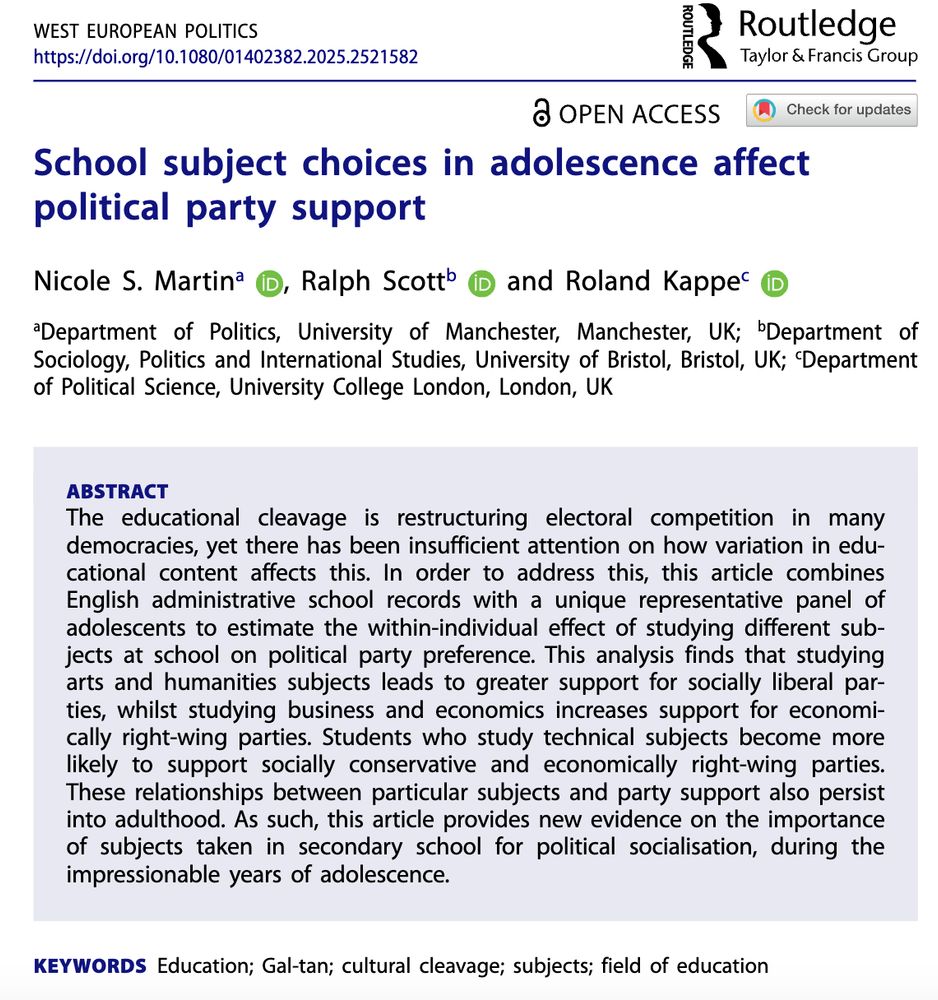
Article abstract, which says:
The educational cleavage is restructuring electoral competition in many democracies, yet there has been insufficient attention on how variation in educational content affects this. In order to address this, this article combines English administrative school records with a unique representative panel of adolescents to estimate the within-individual effect of studying different subjects at school on political party preference. This analysis finds that studying arts and humanities subjects leads to greater support for socially liberal parties, whilst studying business and economics increases support for economically right-wing parties. Students who study technical subjects become more likely to support socially conservative and economically right-wing parties. These relationships between particular subjects and party support also persist into adulthood. As such, this article provides new evidence on the importance of subjects taken in secondary school for political socialisation, during the impressionable years of adolescence.
📣 NEW PAPER ALERT! 🚨
"School subject choices in adolescence affect political party support"
Just published in @wepsocial.bsky.social with @nspmartin.bsky.social and @rolandkappe.bsky.social.
doi.org/10.1080/0140...
🧵👇
14.07.2025 13:13
👍 80
🔁 45
💬 5
📌 4

Abstract of the article "School subject choices in adolescence affect political party support" by Nicole S. Martin, Ralph Scott and Roland Kappe. Published online first in West European Politics. Part of the forthcoming Special Issue "Cleavage Politics in Western Democracies", edited by Delia Zollinger and David Attewell.

Figure 1, displaying the effects of choosing a school subject for the General Certificate of Secondary Education on vote intention in adolescence.

Figure 2, displaying the effects of choosing a school subject for A-Levels on vote intention in adolescence.

Figure 5, displaying the effects of choosing a school subject for the General Certificate of Secondary Education on vote intention in adulthood. This time displayed for specific parties in the UK.
Online first: "School subject choices in adolescence affect political party support" by @nspmartin.bsky.social @ralphscott.bsky.social & @rolandkappe.bsky.social
doi.org/10.1080/0140...
Part of the Special Issue "Cleavage Politics in Western Democracies"
11.07.2025 06:02
👍 42
🔁 9
💬 0
📌 2

Sign Up – EPSS
© 2025 – European Political Science CIC
1.3K followers & counting. Thank you all for your incredible support!
The EPSS journey is just getting started & we couldn’t do it without you.
Thank you for so many of you who already joined EPSS! If you haven't already, please join: epssnet.org/sign-up/#join
Let’s do this together.
29.06.2025 10:16
👍 39
🔁 20
💬 2
📌 2
Political volatility has been taking us by surprise for a while now. Here’s little exercise to illustrate. Rewind two years and take a look at where the polls were, what people expected, and what they failed to anticipate. You have to go back a while before politics is predictable even 2 yrs out 1/
11.06.2025 06:48
👍 85
🔁 26
💬 3
📌 5
and here is the German election forecasting symposium in @pspolisci.bsky.social
bsky.app/profile/pspo...
including @marystegmaier.bsky.social and others...
26.02.2025 12:13
👍 2
🔁 0
💬 0
📌 0

How good were the German election forecasts? @zweitstimme.bsky.social team already posted an evaluation of their prediction online here (in German):
zweitstimme.org/posts/blog/e...
#bundestagswahl #btw2025
26.02.2025 12:13
👍 4
🔁 0
💬 1
📌 0
Fantastic thread by @anjaneundorf.bsky.social explaining that German election map #btw25
25.02.2025 11:00
👍 0
🔁 0
💬 0
📌 0
In just one week, Germany will head to the polls for one of its most crucial elections in decades. At @zeitonline.bsky.social, we analyze the results of all federal elections since 1949 within current constituencies. Use our interactive tool to explore trends over time!
www.zeit.de/politik/deut...
16.02.2025 08:37
👍 64
🔁 18
💬 1
📌 1
The final vote fails despite the AfD voting with FDP & CDU. Results aren’t online yet, but looks like a substantial intra-party rebellion this time around. Thanks to everyone who wrote to their MP, went out in cold temperatures, spoke out etc. Pressure does work! Concede nothing.
31.01.2025 16:50
👍 64
🔁 14
💬 1
📌 3

With the joint majority of AfD and CDU, the "firewall" (Brandmauer) is becoming a central issue in the Bundestag election campaign. In a new study (with @christinajuen.bsky.social & @martingross.bsky.social), we examine how voters react to CDU candidates' varying positions on issues & firewall. 🧵
31.01.2025 12:37
👍 48
🔁 15
💬 1
📌 0

Merz was cruising to become Chancellor with very little movement in the polls. I wonder whether this was not only a historic norm violation but also a spectacular own goal.
29.01.2025 19:26
👍 0
🔁 0
💬 0
📌 0
Breaking this taboo - and his own word from only weeks ago - also invites questions of whether he might rely on AfD support after the election. This should provide a powerful argument for the SPD and Greens, and focusing the election campaign on immigration issues likely benefits the AfD.
29.01.2025 19:26
👍 0
🔁 0
💬 1
📌 0
Historic day in Germany where the CDU passes a motion with the support of the far-right AfD - violating the post-war cordon sanitaire. The actual motion is largely symbolic, but the measures demanded such as permanent border controls would likely break European law.
29.01.2025 19:26
👍 0
🔁 0
💬 1
📌 0
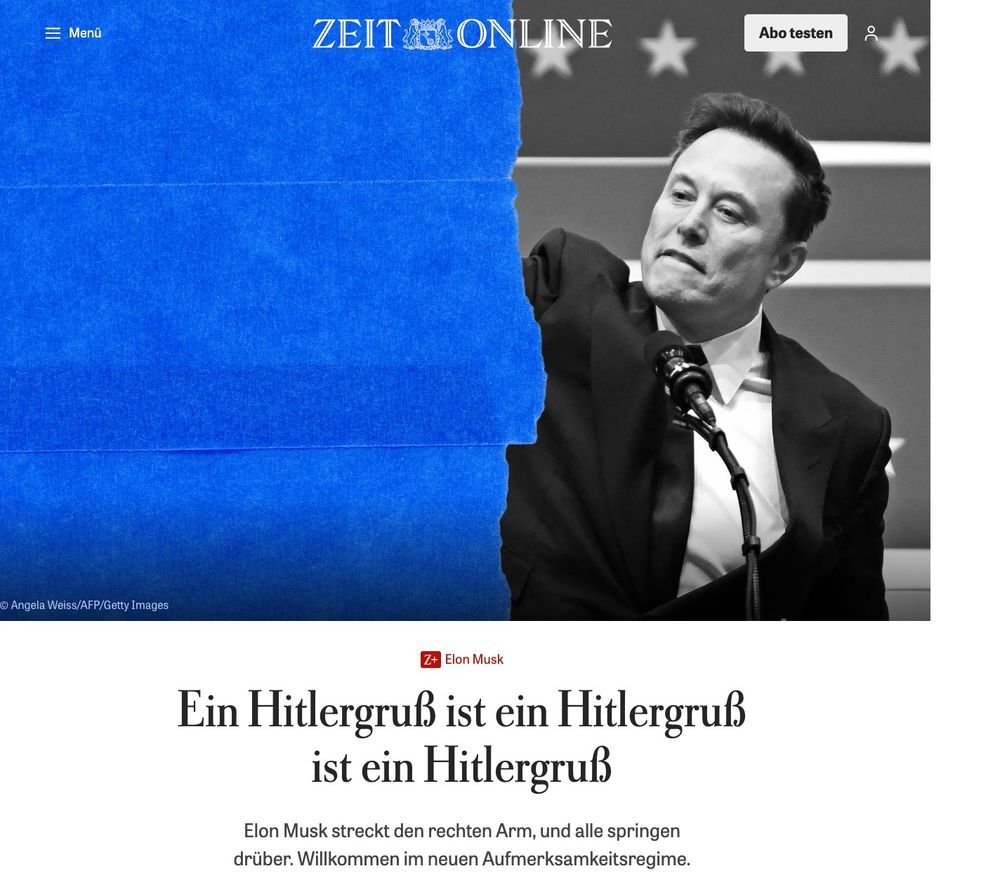
screengrab of Die Zeit story on Elon Musk
Die Zeit, a prominent German publication, titles its article: 'A Hitler salute is a Hitler salute is a Hitler salute.'
21.01.2025 17:22
👍 2057
🔁 669
💬 43
📌 50
Pretty much exactly 80 years after the liberation of Auschwitz, the richest man in the world uses the Nazi salute at the inauguration of his close ally as US president. What should rationally not be surprising is still so deeply shocking and simply difficult to comprehend.
20.01.2025 20:41
👍 881
🔁 298
💬 24
📌 25
Ha, hadn't heard this. Do all countries do this? Slightly scared what Germany's two identities are 😬
29.11.2024 15:08
👍 1
🔁 0
💬 0
📌 0

View of frost on tree trunks and a meadow in Clissold Park with the morning sun rising behind the trees.
Clissold Park in all its frosty beauty this morning ❄️
29.11.2024 10:44
👍 2
🔁 0
💬 0
📌 0
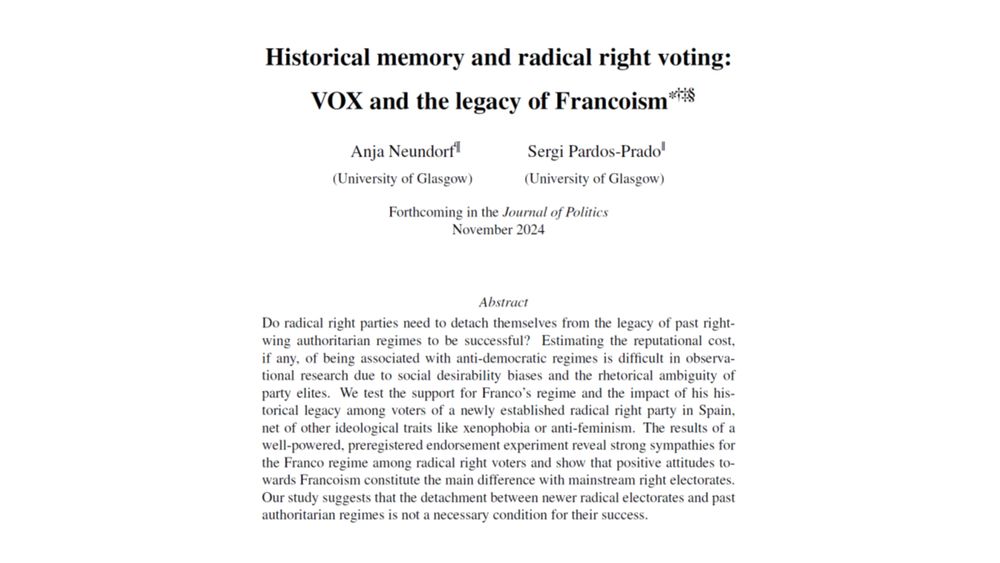
Do radical right parties need to detach themselves from the legacy of right-wing authoritarian regimes to be successful? It would appear not, or not anymore. New work with @anjaneundorf.bsky.social now forthcoming at @thejop.bsky.social. A couple of thoughts 👇
28.11.2024 12:17
👍 157
🔁 51
💬 6
📌 1

The Christian Democrats are currently favoured to become the strongest party in the next German parliament. The estimated policy position the CDU’s basic programme, which the party adopted in May 2024, indicates that the CDU moved to the right on economic and societal issues. 1/2
26.11.2024 14:05
👍 40
🔁 18
💬 2
📌 0
Spot on. Comprehensive pedestrianisation should be far higher up the agenda in our cities than it is. Nearly wherever cars go, cities get worse. Nearly wherever they’re removed, those urban spaces flourish.
26.11.2024 09:22
👍 1628
🔁 271
💬 70
📌 15
🗳️ Some thoughts on the 1st round of the 🇷🇴 #RomanianPresidentialElections as it now seems clear that the dark horse cand. Georgescu (no party, far-right) and Lasconi (USR, center-right, cult. progressive) will fight it out in the 2nd round (although PSD will prob appeal & there might be a recount) 🧵
25.11.2024 09:48
👍 58
🔁 30
💬 1
📌 4

Bringing War Back In
Cambridge Core - International Relations and International Organisations - Bringing War Back In
Timely joining bsky on the date "Bringing War Back In" was published worldwide with Cambridge UP. Check it out if you are interested in how war makes states also in its aftermath, and how the wars of a distant past explain the variation of state capacity within Latin America until today.
21.11.2024 10:49
👍 49
🔁 18
💬 0
📌 1
A lot of wealthy people in America are about to learn a bitter lesson in how autocracy operates
The winners circle in an illiberal regime is small & capricious and *you* are almost certainly not in it
21.11.2024 07:59
👍 159
🔁 27
💬 7
📌 5

A screenshot of the call for applications.
🚨 CfA: MZES-DVPW Conference "Methods of Political Science"
🗓️ Mannheim, Mar 27-28, 2025
⏰ Deadline: Dec 16, 2024
🔗Apply via sosci.sowi.uni-mannheim.de/mzes-dvpw-me...
@gessler.bsky.social, @aleininger.bsky.social, @hannahrajski.bsky.social, Oliver Rittmann & I look forward to your submissions!
20.11.2024 12:57
👍 46
🔁 37
💬 0
📌 5
Well, hello BlueSky! Looks like everyone is here now! Only downside: the decline of twitter was an effective tool in keeping my social media use in check 😅
20.11.2024 15:08
👍 0
🔁 0
💬 2
📌 0