A man significantly skinnier than me looking at a post with two retweets and three likes ans thinking "Oh man... this doin numbers"
You know those of us posting on the weekend are doing it purely for the love of the game
18.08.2025 00:43
👍 26
🔁 1
💬 1
📌 0

Public Science Engagement Using Social Media — Center for Wildlife Studies
Friends, it’s never been more important for scientists to break out of the ivory tower and engage with the public.
My course- which you can take for graduate school course credit, continuing professional education credit, or just to learn a new skill- can help.
Please share!
🧪🦑🌎🐠🦈 #SciComm
21.07.2025 18:57
👍 213
🔁 97
💬 1
📌 3

A screenshot shows the first page of a journal article titled "Don't Go," by Andrew V. Papachristos. A pair of images from the Folded Map Project contrasts the homes at Chicago's 6330 N. Paulina and 6329 South Paulina.

An undated historical photograph hows KaMar's Greek Diner in Chicago, IL. Its sign advertises: KaMara's Coffee Shop. Pancakes. Fountain. Bar-B-Que Restaurant.
"Cities might speak different dialects, but they share the same grammar of exclusion," writes sociologist @avpapachristos.bsky.social on the everyday practices of urban segregation. Read "Don't Go"--and our entire spring issue--free through 8/11 at journals.sagepub.com/doi/epdf/10....
#sociology
15.07.2025 12:30
👍 9
🔁 6
💬 0
📌 0
blue sky is supreme because every time you post you get 100 school principals in the replies asking to see you in their office
20.03.2025 08:03
👍 29253
🔁 3592
💬 260
📌 104

‘A war of the truth’: Europe’s heatwaves are failing to spur support for climate action
Voters may feel hotter summers are ‘too much’ but they appear to tolerate roll-back of policies to stop global heating
As climate shocks (like heatwaves and extreme/flash flooding) hit more frequently and with more severity, they should trigger more climate concern and action. There's a really important story to tell about why it isn't in some places/times! www.theguardian.com/environment/...
06.07.2025 11:40
👍 84
🔁 33
💬 4
📌 0
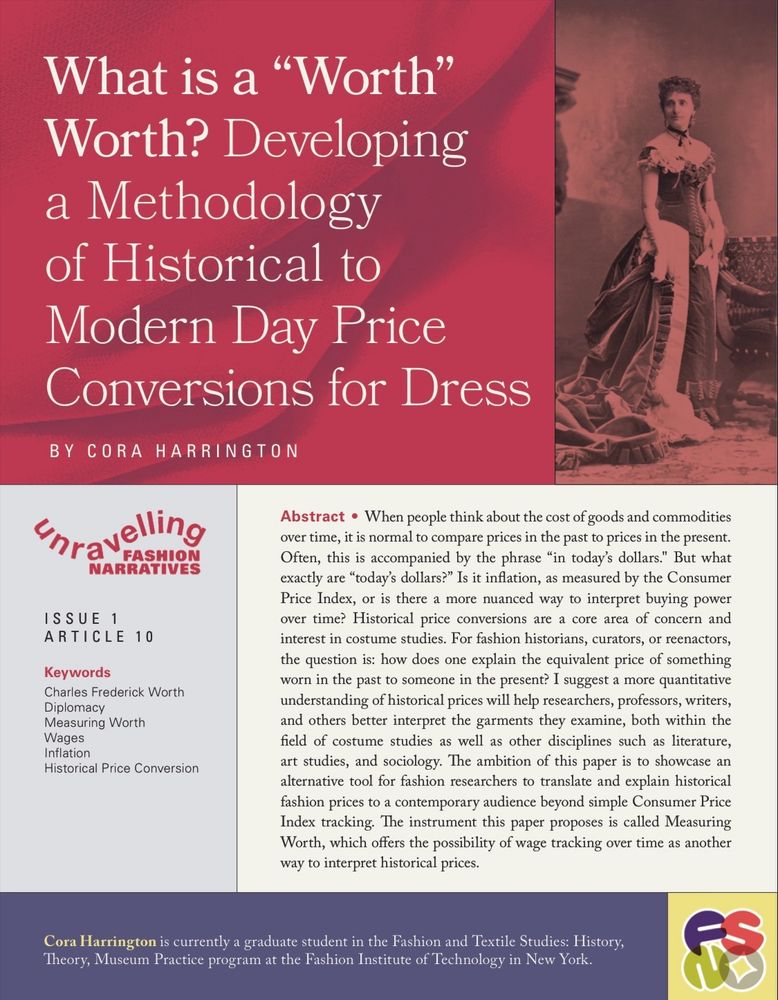
Historical price conversions are a core area of concern and interest in costume studies. For fashion historians, curators, or reenactors, the question is: how does one explain the equivalent price of something worn in the past to someone in the present? I suggest a more quantitative understanding of historical prices will help researchers, professors, writers, and others better interpret the garments they examine, both within the field of costume studies as well as other disciplines such as literature, art studies, and sociology. The ambition of this paper is to showcase an alternative tool for fashion researchers to translate and explain historical fashion prices to a contemporary audience beyond simple Consumer Price Index tracking. The instrument this paper proposes is called Measuring Worth, which offers the possibility of wage tracking over time as another way to interpret historical prices.
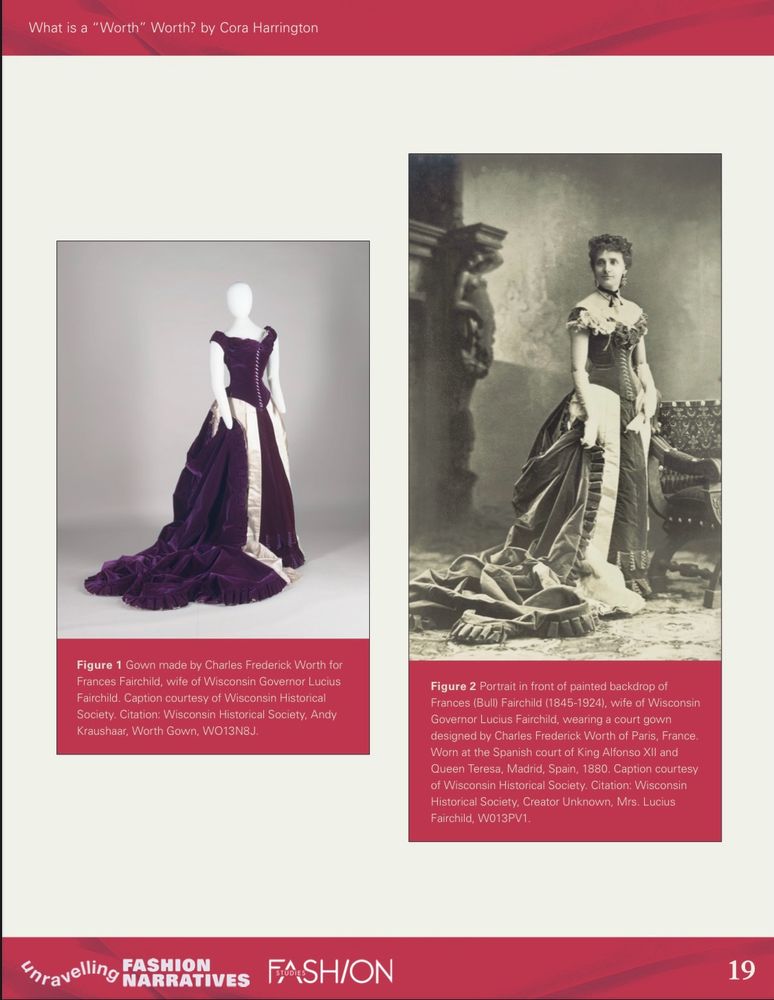
Image 1: Purple silk velvet and satin court gown made by Charles Frederick Worth for Frances Fairchild, wife of Wisconsin Governor Lucius Fairchild.
Image 2: Black and white photographic portrait in front of painted backdrop of Frances (Bull) Fairchild (1845-1924), wife of Wisconsin Governor Lucius Fairchild, wearing a court gown designed by Charles Frederick Worth of Paris, France. Worn at the Spanish court of King Alfonso XII and Queen Teresa, Madrid, Spain, 1880.
My first academic article is live!!
Published with Fashion Studies, “What is a ‘Worth’ Worth? Developing a Methodology of Historical to Modern Day Price Conversions for Dress” asks how we can better explain clothing prices in the past to people in the present. The approach explored is wage data.
25.06.2025 19:13
👍 457
🔁 97
💬 25
📌 8
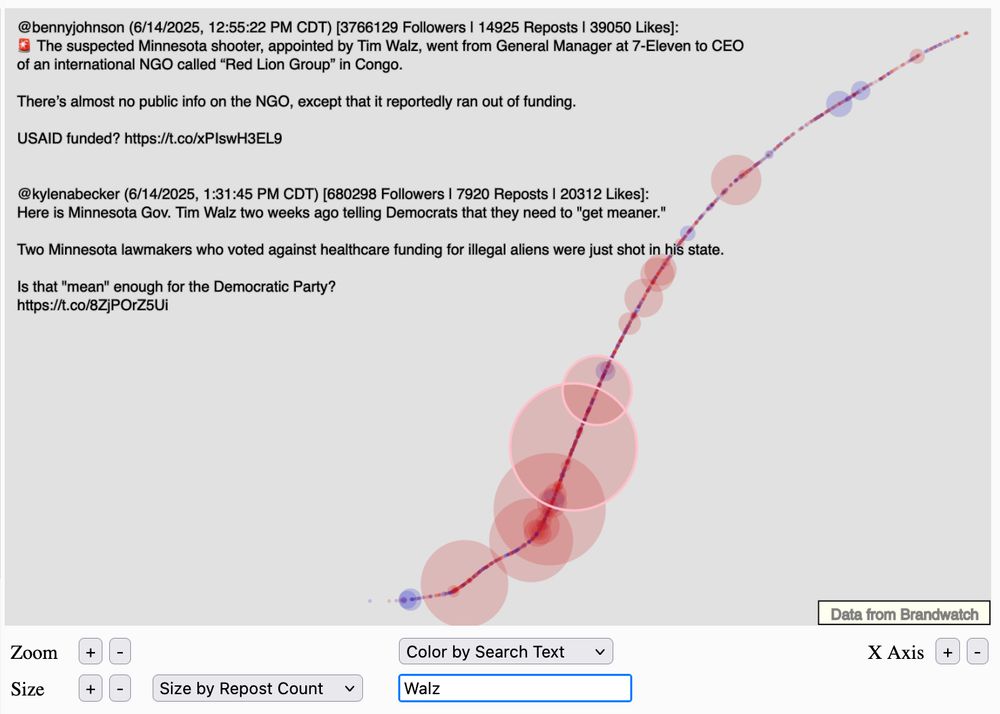
If you're interested in seeing what the conversation on X looked like on Saturday morning, as the information warriors there went to work framing the shootings of Democratic lawmakers for political gain, I made an interactive graph: faculty.washington.edu/kstarbi/Spot...
19.06.2025 21:51
👍 1907
🔁 502
💬 46
📌 43


Look what I found strolling around my yard! Hummingbird eggs are about the size of a jelly belly. Amazing treasure of the day!
18.06.2025 22:30
👍 1052
🔁 108
💬 45
📌 6
You might also want to check out some of the scholars who’ve been tracking these developments for a decade! @melhogan.bsky.social, @tamigraph.bsky.social, @zgtcooper.bsky.social, @lifewinning.com, Alix Johnson…
19.06.2025 19:50
👍 29
🔁 12
💬 0
📌 0
Ah the good old meme marinade
19.06.2025 22:45
👍 0
🔁 0
💬 0
📌 0
Everytime I see a screengrab of this old tweet of mine, it is more blurry than before
19.06.2025 22:01
👍 243
🔁 29
💬 13
📌 0

Old newspaper clipping:
"Americans Thick In The Head - Einstein Says We Are So Ignorant We Are Comic."
17.06.2025 10:03
👍 173
🔁 34
💬 2
📌 4

Part 2 of table. Source: Fine 1992, Manufacturing Tales: Sex and Money in Contemporary Legends.
19.06.2025 22:42
👍 0
🔁 0
💬 0
📌 0

A list of mercantile legends circulating in the 80s and their targets. Mercantile legends are urban legends that tie a corporation to some scary or harmful situation.
What do McDonald’s, P&G, and KISS have in common? They were part of an ‘80s urban legend about satanic cults
19.06.2025 22:39
👍 1
🔁 0
💬 1
📌 0
From Douglas et al 1980, “Introduction to the Sociologies of Everyday Life”
19.06.2025 22:24
👍 0
🔁 0
💬 0
📌 0

We love a good✨conceptual diagram✨😌
19.06.2025 22:09
👍 1
🔁 0
💬 1
📌 0
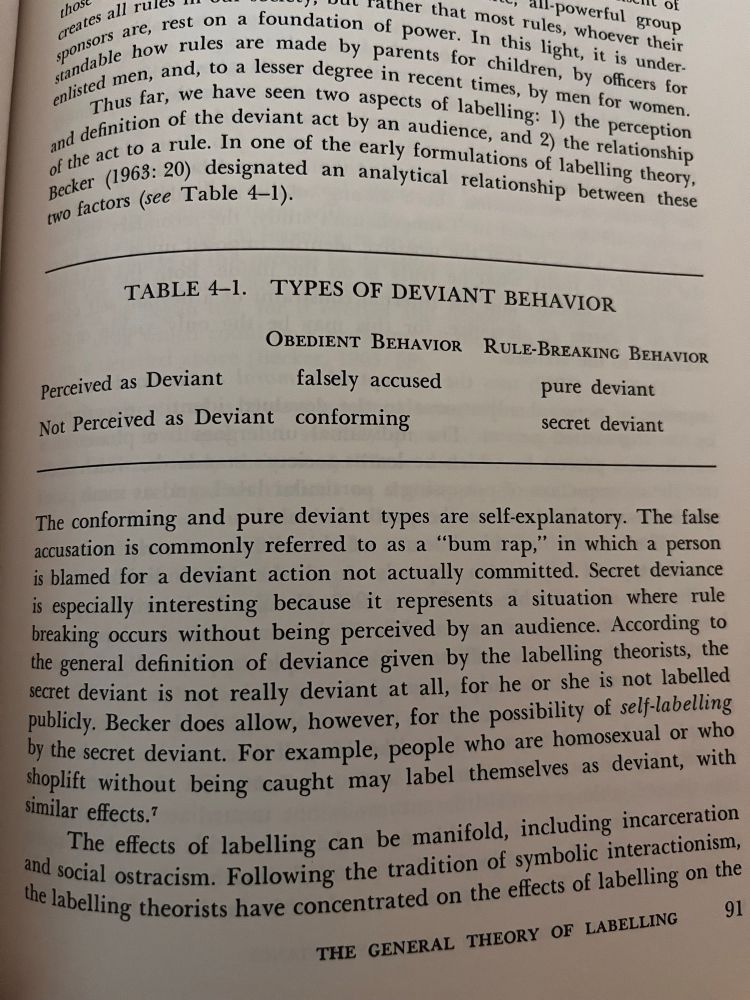
Types of deviant behavior: falsely accused (obedient but perceived as deviant), conforming (obedient behavior not perceived as deviant), pure deviant (rule breaking behavior perceived as deviant), secret deviant (rule breaking behavior not perceived as deviant)
Tag urself
I’m 20% “falsely accused”
19.06.2025 21:48
👍 2
🔁 0
💬 1
📌 0

go to grad school
11.06.2025 16:48
👍 208
🔁 17
💬 14
📌 1

okay now that's how you write a dang abstract and some keywords
11.06.2025 13:07
👍 35
🔁 6
💬 3
📌 0
Sociology is mostly about choosing whether something is “structured”, “contingent”, or “performed”
10.06.2025 13:10
👍 37
🔁 6
💬 7
📌 3

Despite low U.S. fertility rates since the Great Recession, two-child norms remain pervasive, suggesting individuals are unable to achieve their goals. To understand what may be driving the apparent mismatch between goals and behavior, we focus on pregnancy avoidance, as individuals may be deciding against births in the short term rather than deciding not to have any, or any more, children. Further, we incorporate subjective evaluations of the future related to economic and relational factors as well as objective socioeconomic indicators, drawing from the Narratives of the Future framework and Easterlin’s theory about expected standard of living. We use data from the 2018–2020 wave of the Toledo Adolescent Relationships Study (N = 880), a population-based dataset, to examine short-term pregnancy avoidance among adults aged 29–36. We find that higher levels of personal economic pessimism and concerns about having a good relationship in the future are associated with greater importance of avoiding a pregnancy in the short term, even when controlling for objective characteristics such as economic hardship, relationship status, and other sociodemographic covariates. The results highlight the need to incorporate both subjective and objective statuses in research on fertility decision-making, and the implications of these findings point to short-term pregnancy avoidance and fertility postponement as a potential mechanism underlying contemporary low birth rates in the U.S.
Declining birth rates are likely driven by "pregnancy avoidance" decisions - people repeatedly deciding that it's not a good time to get pregnant *right now* rather than deciding not to have any (more) children at all, as my colleagues and I show in a new paper. 1/ doi.org/10.1007/s111...
10.06.2025 15:37
👍 72
🔁 21
💬 2
📌 0
ChatGPT is down but The Museum of English Rural Life still stands, proving once again that Silicon Valley cannot compete with the history of rural England and its people.
10.06.2025 12:41
👍 13715
🔁 2358
💬 90
📌 75

The Illusion of Thinking:
Understanding the Strengths and Limitations of Reasoning Models
via the Lens of Problem Complexity
Parshin Shojaee∗† Iman Mirzadeh∗ Keivan Alizadeh
Maxwell Horton Samy Bengio Mehrdad Farajtabar
Apple
Abstract
Recent generations of frontier language models have introduced Large Reasoning Models
(LRMs) that generate detailed thinking processes before providing answers. While these models
demonstrate improved performance on reasoning benchmarks, their fundamental capabilities, scal-
ing properties, and limitations remain insufficiently understood. Current evaluations primarily fo-
cus on established mathematical and coding benchmarks, emphasizing final answer accuracy. How-
ever, this evaluation paradigm often suffers from data contamination and does not provide insights
into the reasoning traces’ structure and quality. In this work, we systematically investigate these
gaps with the help of controllable puzzle environments that allow precise manipulation of composi-
tional complexity while maintaining consistent logical structures. This setup enables the analysis
of not only final answers but also the internal reasoning traces, offering insights into how LRMs
“think”. Through extensive experimentation across diverse puzzles, we show that frontier LRMs
face a complete accuracy collapse beyond certain complexities. Moreover, they exhibit a counter-
intuitive scaling limit: their reasoning effort increases with problem complexity up to a point, then
declines despite having an adequate token budget. By comparing LRMs with their standard LLM
counterparts under equivalent inference compute, we identify three performance regimes: (1) low-
complexity tasks where standard models surprisingly outperform LRMs, (2) medium-complexity
tasks where additional thinking in LRMs demonstrates advantage, and (3) high-complexity tasks
where both models experience complete collapse. We found that LRMs have limitations in exact
computation: they fail to use explicit …
If I have time I'll put together a more detailed thread tomorrow, but for now, I think this new paper about limitations of Chain-of-Thought models could be quite important. Worth a look if you're interested in these sorts of things.
ml-site.cdn-apple.com/papers/the-i...
08.06.2025 06:35
👍 332
🔁 64
💬 15
📌 9
Word of wisdom from @peterhotezmdphd.bsky.social are applicable to U.S. scientists of all disciplines!
➡️ “Too often, young scientists focus only on their next step (or next NIH grant) and do not take a long view.”
✅ He advises: think long-term, be strategic & flexible
#PsychSciSky
#AcademicSky
08.06.2025 19:24
👍 32
🔁 11
💬 0
📌 0

“I Have Lost Everything”: The Toll of Cities’ Homeless Sweeps
Cities often take belongings — including important documents and irreplaceable mementos — when they conduct sweeps of homeless encampments. ProPublica gave notecards to people across the country so…
We asked people who lived in homeless encampments that were cleared out in city “sweeps” to write about what object was the hardest for them to lose.
“They took my baby pictures and my moms obituaries,” a 29-year-old in California wrote.
05.06.2025 01:00
👍 2806
🔁 1429
💬 77
📌 172