

‘Part of our biological toolkit’: newborn babies can anticipate rhythm in music, researchers find
05.02.2026 19:02
👍 86
🔁 20
💬 5
📌 3
‘Part of our biological toolkit’: newborn babies can anticipate rhythm in music, researchers find
Here is our latest work on newborns and music perception!
The MSCA funds two three-year PhD positions with research in collaboration with the ultra-high field Magnetic Resonance center Imago7 located in Pisa). Deadline: 27th of February 2026

The University of Pisa (PI Paola Binda) is recruiting two PhD candidates in the MSCA network indibrain.eu. Neuroscience students with an interest for the sensory brain are particularly encouraged to apply (webform: apply.workable.com/umcg1/j/5CA7...). .

macaques can synchronize to a subjective beat in real music and even spontaneously do so over alternative strategies.
Haven’t read the full article yet, but this is a big deal if true!
www.science.org/doi/10.1126/...
How does the brain track patterns 🎶 in a noisy world 🔊? How does it choose when to reset its memory and when to carry it forward?
We provide some answers in this new work by @kahomagami.bsky.social that I co-authored with @mariachait.bsky.social, Marcus Pearce and Edward Hall!
We are remarkably good at recognizing natural auditory “textures”, such as the soothing sound of a running brook or fire crackling in a chimney. But do you think you could remember the exact rain texture that opens “Riders on the Storm”?
#auditoryscience #musicscience #neuroscience
These complementary computational strategies highlight the flexibility of hearing in its most important task: using traces of the past to better deal with the present – even when the “past” is just a particular patch of rain at the start of a song.
Here, we suggest an additional trick your auditory system could use: randomly sampling a few auditory features in time, to create a compact but distinctive “fingerprint” for the memorised sound.
Storing all details of complex, stochastic sounds would be biologically unreasonable. Earlier work showed that “summary statistics” – long-term averages of sound features – are an efficient way to identify broad classes of natural textures.
This memory trace was highly specific to the repeated recording: it distinguished that particular texture from many other recordings coming from the same physical source (same type of fire, or water...).
This raises a deeper question: what kind of internal representation is being stored in memory?
The key is repetition. As with artificial sounds previously studied (like noise bursts and clicks), the re-occurrence of a natural texture was enough to create a memory trace.

Do you think you could remember the exact rain texture that opens “Riders on the Storm”?
We showed that the answer may be a surprising “yes” – at least in some circumstances.
Check our new work with @Bastug, @Rajendran, @Agus @Chait @Pressnitzer doi.org/10.1016/j.co...

What happens in the brain when we manipulate our thoughts?
We asked 30 epilepsy patients to mentally invert short melodies.
Intracerebral #iEEG recordings suggest brain synchrony and sensory inhibition are key for mental manipulation:
doi.org/10.1101/2025...
#neuroskyence #musicscience
Postdoc position on multi brain stimulation in Rome in an amazing lab!! Do apply!!!

Check out our new preprint on how infants respond to music over the first year of life! 👶🧠💃🎶
While neural responses are pretty much ready to go in the youngest, moving to music takes a bit longer, becoming more complex and potentially more dance-like by 12 months. www.biorxiv.org/content/10.1...
Our new MEG preprint on Building&Updating Predictive Models in auditory sequences 🧠🔊
✅ auditory-frontal areas & #hippocampus drive adaptive perception
with Maria Chait, M Pearce, K Magami @UCL
#Neuroscience #PredictiveProcessing #StatisticalLearning #BrainResearch #AuditoryPerception #musicscience
Flexible tapping synchronization in macaques: dynamic switching of timing strategies within rhythmic sequences https://www.biorxiv.org/content/10.1101/2025.03.27.645824v1

Here it is our new preprint on neural encoding of musical expectations in newborns!
in collaboration with B. Toth & I. Winkler's hungrain team and @giacomonovembre.bsky.social 's NPAlab
check it out 👇
www.biorxiv.org/content/10.1...
#musicscience #Neuroscience #MusicCognition #Neurodevelopment
Fantastic opportunity to work on music and the brain!
🚨 We’re hiring! 🚨
A postdoc position is available at my lab (npa.iit.it) in Rome! Join us to explore:
🎵 Neural bases of musicality (humans, infants, macaques)
💃🕺 Dance & joint music-making
🤝 Spontaneous social behavior
⬇️ Apply through the link below! ⬇️

How well can video-based methods estimate body kinematics? In my recent paper with @giacomonovembre.bsky.social, we show that accuracy of one such method (OpenPose) varied substantially across subjects & body parts. Interestingly, this accuracy strongly depended on the movement amplitude. t.ly/4Tlnc
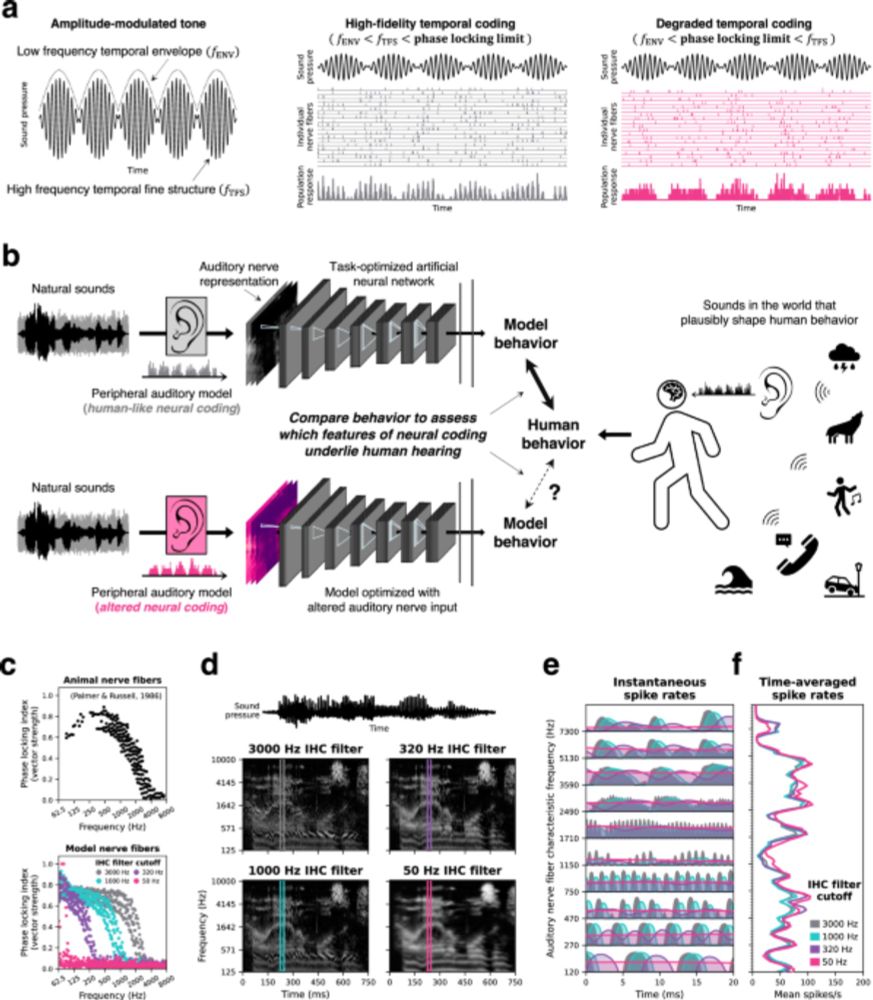
New paper from our lab, by Mark Saddler, using machine learning to test the role of temporal coding in hearing. Here is a quick summary. (1/n)
www.nature.com/articles/s41...

Open-source software allows the calibration of eye trackers for subjects who can't follow instructions (infants, primates). Extension to Titta toolbox uses attention-grabbing videos for calibration, tested successfully with chimps, baboons & macaques
link.springer.com/article/10.3...

Neuroscience & Biobehavioral Reviews
Emotions in multi-brain dynamics: A promising research frontier
www.sciencedirect.com/science/arti...

Fascinating work from Andrea Migliano’s group, out in Science, on cultural evolution, showing how population connectivity shapes the distribution and complexity of chimpanzee cumulative culture
(Congrats @ceciliapad.bsky.social & colleagues not yet on this platform)
www.science.org/doi/10.1126/...

We are recruiting postdocs! Want to grow your own social networks to study creativity, cultural evolution & decision-making? We are hiring an NSF-funded postdoc at Cornell in collaboration with UC Davis, CUNY, & Princeton. Apply here : academicjobsonline.org/ajo/jobs/28959
Hi all! Can I be added please?

Image prompt: jazz pianist rhythm - ensemble synchronization - complexity; Bill Evans; Bud Powell; Kenny Barron; Oscar Peterson
Great musicians have a unique style and, with training, humans can learn to distinguish between these styles. What is this based on? royalsocietypublishing.org/doi/10.1098/... Also see huwcheston.github.io/Jazz-Trio-Da...