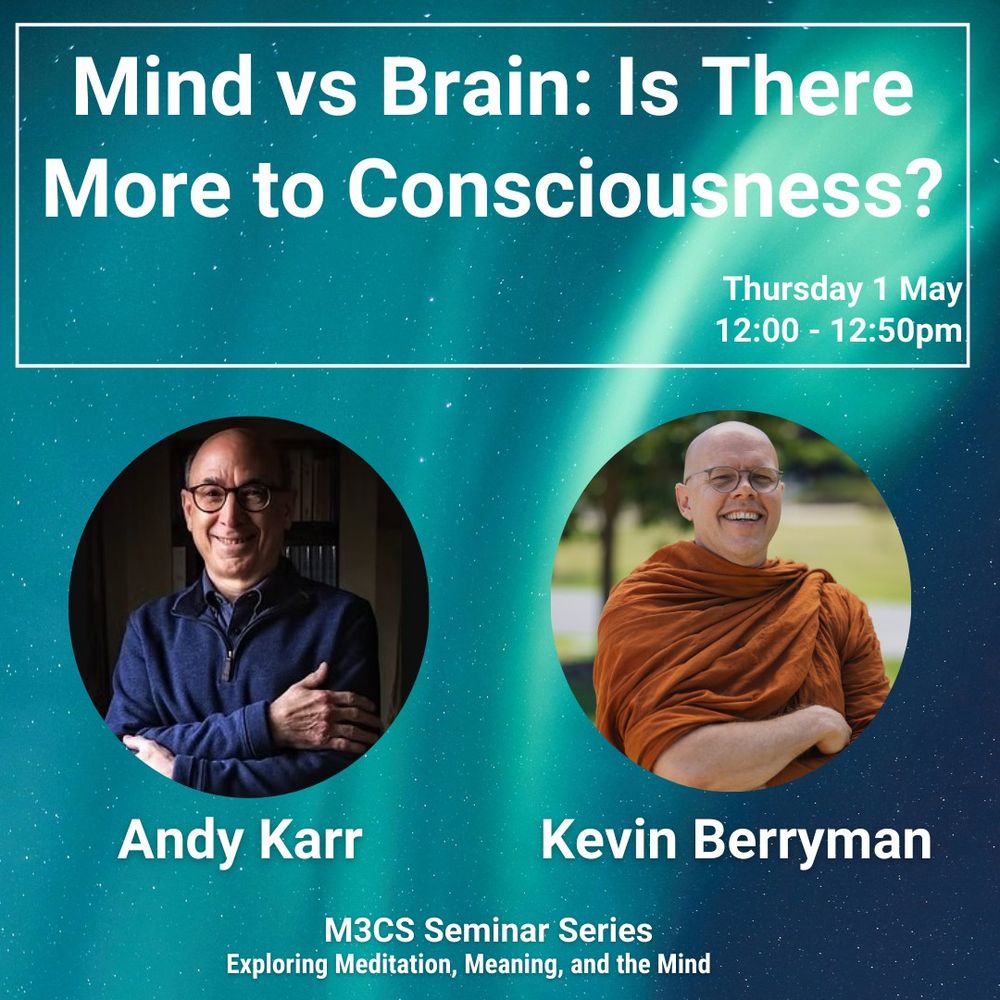
Join us for our May Seminar!
We’re excited to welcome Buddhist teacher & author Andy Karr in conversation with @kevinberryman.bsky.social for a thought-provoking discussion: Mind vs Brain – Is There More to Consciousness?
📅 Thursday 1 May 2025
⏰ 12:00 – 12:50 PM AEST
💻 Online & free - register below
17.04.2025 03:30
👍 3
🔁 1
💬 1
📌 0
Some of our vendors are cancelling production of new products, delaying manufacturing of existing lines, shutting down shipping while tariff turmoil plays out. So, what does a small business like mine do? We're called the "backbone of the American economy." Well, Trump is breaking that backbone.
15.04.2025 22:15
👍 6
🔁 2
💬 0
📌 0
Ok so yeah, this has quickly become the #1 misunderstanding about the canceled grants
the grants are not “subsidies” or “entitlements” to Harvard or Princeton or whatever
they aren’t going into universities’ endowments
they are competitive contracts won by these universities to do research
18.04.2025 11:55
👍 7419
🔁 2487
💬 123
📌 100
JD Vance owns AcreTrader, an app that lets wealthy—often foreign—investors buy up U.S. farmland.
Guess who’s deliberately tanking farm economies so JD and his billionaire tech buddies can scoop it up for pennies.
civileats.com/2024/09/18/j...
18.02.2025 20:51
👍 8977
🔁 5457
💬 534
📌 462
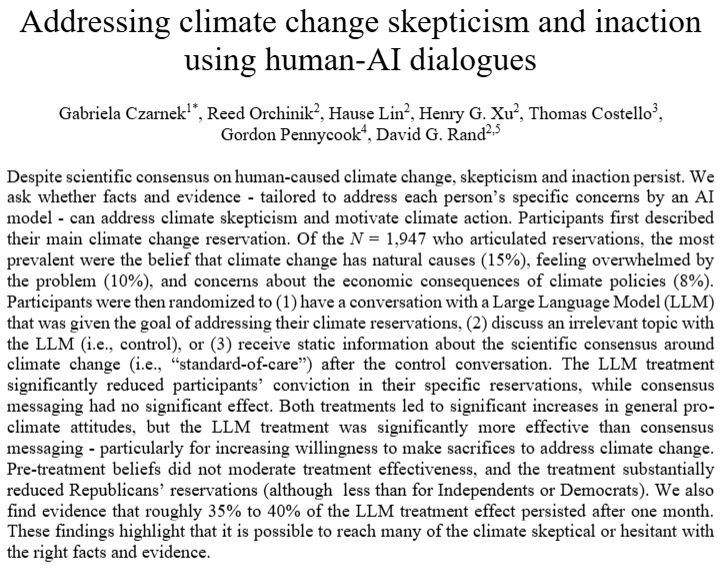
🚨New WP🚨
Using GPT4 to persuade participants significantly reduces climate skepticism and inaction
-Sig more effective than consensus messaging
-Works for Republicans
-Evidence of persistence @ 1mo
-Scalable!
PDF: osf.io/preprints/ps...
Try the bot: www.debunkbot.com/climate-change
Here’s how 👇
18.04.2025 13:02
👍 125
🔁 43
💬 8
📌 10
I got an email yesterday afternoon that my NSF SPRF Postdoctoral Fellowship was terminated. My grant focused on testing interventions to address online misinformation and I was 8 months into a two year appointment.
19.04.2025 16:43
👍 1044
🔁 463
💬 70
📌 24
#academicsky
20.04.2025 21:13
👍 18
🔁 8
💬 0
📌 0

11.04.2025 16:53
👍 0
🔁 0
💬 0
📌 0
Current Issue Table of Contents: Biological Psychiatry: Cognitive Neuroscience and Neuroimaging
Very happy to report that the Special Issue of Biological Psychiatry:Cognitive Neuroscience & Neuroimaging dedicated to mindfulness is now published!
www.biologicalpsychiatrycnni.org/issue/S2451-...
08.04.2025 22:01
👍 2
🔁 0
💬 1
📌 0
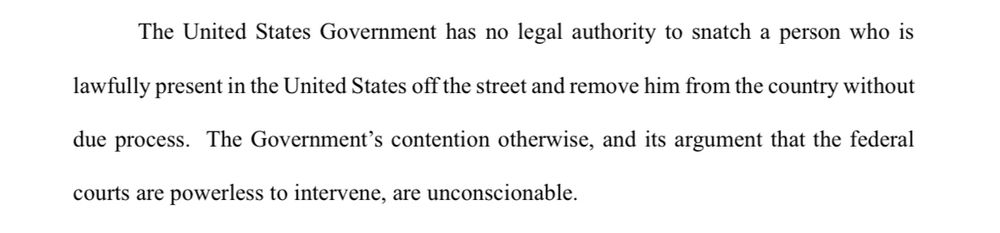
The United States Government has no legal authority to snatch a person who is lawfully present in the United States off the street and remove him from the country without due process. The Government's contention otherwise, and its argument that the federal courts are powerless to intervene, are unconscionable.
The Fourth Circuit is famously succinct. storage.courtlistener.com/recap/gov.us...
07.04.2025 16:00
👍 21705
🔁 5862
💬 302
📌 283
Congrats Vaibhav!!
10.03.2025 21:00
👍 1
🔁 0
💬 1
📌 0
Did you know we could end not just hunger but all poverty in America if we just collected taxes on billionaires?
Not taxed them more, not changed the laws, if we just *collected* what they are supposed to pay, there would be no more poverty.
Instead, the richest man on earth is stealing from you.
08.03.2025 10:57
👍 310
🔁 102
💬 10
📌 2

Screenshot of the title, author list, and abstract of a publisher paper. Auto-text:
Behaviour Research and Therapy 187 (2025) 104717
Contents lists available at ScienceDirect
Behaviour Research and Therapy
BEHAVIOUR
RESEARCH AND
ELSEVIER
journal homepage: www.elsevier.com/locate/brat
Direct mapping of intervention to thought features: A Bayesian
proof-of-concept study
Nur Hani Zainal a
", Christian A. Webb b
, Lauren S. Hallion C;
* Department of Psychology, National University of Singapore, Singapore
" Department of Psychiatry, Harvard Medical School and McLean Hospital, USA
* Department of Psychology, University of Pittsburgh, USA
ABSTRACT
Although uncontrollability is the core feature of perseverative thought that best accounts for its relationship to psychopathology, other features - for example,
valence and content - have also been identified as potentially clinically relevant in their own right. We describe results from a proof-of-concept study that examined
the extent to which major underlying features of worry could be used to predict which of three common cognitive regulatory strategies (mindful acceptance; focused
attention meditation; and thought suppression) would help regulate that worry. N = 40 adults selected for high trait worry (80% also met criteria for one or more
DSM-5 anxiety-related diagnoses) generated and provided feature ratings for three idiographic thought topics. Participants then attempted to control each worry
using each of the three strategies during functional magnetic resonance imaging (fMRI) in a within-subjects design with a total of 468 observations. We used Bayesian
multilevel modeling to test preregistered hypotheses regarding the extent to which each of five empirically-derived underlying dimensions of a worry (uncontrol-
lability; negative valence; self-focus; apprehension; and social-memory content) could be used to predict which strategy would be most efficacious for regulating that
worry. We did not find support for our preregistered hypotheses; however, in exploratory analyses, we found that mindfulness-based strategies were particularly
effective compared to thought suppression for thoughts rated as higher (versus lower) in uncontrollability. Future research should test these principles in larger
samples, using more diverse expressions of perseverative thought.
Can we skip classifying thoughts into “types”? What if we match on dimensions instead?
Hani Zainal, Christian Webb, and I investigate at Behaviour Research and Therapy:
Direct Mapping of Intervention to Thought Features: A Bayesian Proof-of-Concept Study
https://doi.org/10.1016/j.brat.2025.104717
09.03.2025 15:51
👍 18
🔁 3
💬 1
📌 1

MRI scanner speaking into a microphone.
We're thrilled to announce the BlueSky debut of the MGH Martinos Center for Biomedical Imaging!
Follow us for research updates, collaborations, and insights into the world of imaging. Or just say hello. We always love hearing from you.
#Science #BiomedicalImaging #SuperAwesomeResearchers&Staff
10.03.2025 19:34
👍 28
🔁 7
💬 0
📌 1
Redirecting
Happy to share a new article about changes in rsFC related to decrease self-judgement following self-compassion practice. In short, decreased PCC-amygdala connectivity and increased connectivity of PCC with dlPFC, dmPFC and IFG. With Diane Joss, Liz Hoge, Mike Datko et al
doi.org/10.1016/j.xj...
20.12.2024 15:38
👍 1
🔁 0
💬 1
📌 0
Just joined BlueSky. Happy to see a Contemplative Science group has already formed
@contemplativeneuro.bsky.social
Thanks Dave for starting this!
09.12.2024 18:12
👍 5
🔁 0
💬 1
📌 0
Hello Roshi! Nice to see familiar faces here. I just joined today....
09.12.2024 17:49
👍 1
🔁 0
💬 0
📌 0
Here is a good beginning to a Contemplative Research Starter Pack. Suggestions welcome. I'll try to keep it updated as more people migrate over to the blue sky 🙏 #contemplativeresearch #contemplativescience #mindfulness #meditation #yoga #breathwork #psychedelics go.bsky.app/StDaiA6
09.12.2024 05:25
👍 35
🔁 13
💬 7
📌 1