Proposed model for FASCIATED EAR 3 BARELY ANY MERISTEM 1D receptor signaling complex in Zea mays meristems.
Antagonistic interactions between CLAVATA receptors shape maize ear development
📖 nph.onlinelibrary.wiley.com/doi/10.1111/...
by Lindsay et al.
@penlindsay @WIleyPlantSci #PlantScience
27.01.2026 18:09
👍 7
🔁 5
💬 0
📌 0
1/ ✨ New preprint alert ✨
It is my pleasure to share:
"Stepwise evolution of the developmental and symbiotic functions of DELLA in land plants"
Here we investigated the role of the single GRAS transcription factor DELLA in #MyMarchantia
doi.org/10.64898/202...
#PlantScience
A thread...
04.03.2026 05:20
👍 48
🔁 36
💬 5
📌 2

Delighted to share our new preprint: "Evolution of moss leaf-like organs through variations in deeply conserved developmental principles."
Led by Ph.D. student Wenye Lin from my lab @irbv.bsky.social ,
in collab. with Yoan Coudert (ENS Lyon) and Richard Smith (JIC).
www.biorxiv.org/content/10.6...
20.02.2026 12:40
👍 66
🔁 35
💬 3
📌 3

Big news from our lab: we can now stably edit the genome of a parasitic plant! Transgene-free, genome-edited P. japonicum in one generation! This will transform how we study #parasiticplants and other hard-to-transform plants.
www.biorxiv.org/content/10.6...
12.02.2026 09:24
👍 55
🔁 21
💬 3
📌 1

Did you ever wonder how a dividing cambium cell looks like and what determines its striking regular division? Xiomin Liu, PhD student in the lab, found out in a heroic histological approach. Fruitful collaboration with the group of Sabine Müller (@phragmoplast.bsky.social) doi.org/10.64898/202...
21.12.2025 10:28
👍 31
🔁 12
💬 3
📌 1

Fig. 1.Auxin, cytokinin, and gibberellin as a hormonal triad controlling inducible plantlet formation on the leaf margins of K. pinnata. During early leaf development, auxin (AUX) and cytokinin (CK) drive the formation of crenulations. Crenulations are required for the subsequent development of epiphyllous buds (EBs). In attached mature leaves, the EBs are kept dormant by gibberellic acid (GA3). Once the leaf is detached, GA3 depletion and accumulation of AUX and CK in the EBs induce plantlet initiation. The interactive feedback network between the hormones regulates further plantlet development.
🌿 INSIGHT 🌿
"Leaf as nursery: insights on hormonal control of asexual reproduction from Kalanchoë pinnata".
Joanna Kacprzyk comments on research recently published in JXB by Jácome-Blásquez et al.
Insight 🔗 doi.org/10.1093/jxb/...
Research 🔗 doi.org/10.1093/jxb/...
#PlantScience 🧪
12.12.2025 14:50
👍 10
🔁 5
💬 1
📌 1

Cycad plants use thermogenesis to warm their reproductive cones. A beetle dusted with pollen and fluorescent dyes lands on the warm cone of a cycad. High concentrations of dye have been deposited on the cone’s hottest regions during previous visits by other labeled beetles. Beetle pollinators use these thermal infrared patterns as a guide to locate host pollen and ovulate cones.
Long before flowers dazzled pollinators with brilliant colors and sweet scents, ancient plants used another feature to signal insects: heat. The findings in Science offer insights into what shaped the earliest eras of plant-animal coevolution.
Read more in this week's issue: https://scim.ag/4rVtArQ
11.12.2025 19:05
👍 53
🔁 25
💬 1
📌 2

Our editors write:
- Organ patterning: Phyllotaxis by emerging apical vasculature rdcu.be/eR3Hm
A highlight of this paper in @cp-devcell.bsky.social : "Self-organization of vascular strands drives their patterning in the Arabidopsis shoot apex"
www.sciencedirect.com/science/arti...
27.11.2025 11:51
👍 8
🔁 2
💬 0
📌 0

How do Xylem-Pole-Pericycle cells decide between forming a new Lateral Root or contributing to cambium formation & secondary growth?
Cytokinins facilitate cambium development & reduce LR potency, shaping the entire root architecture!
@apmahonen.bsky.social
doi.org/10.1016/j.mo...
#PlantScience
25.11.2025 14:29
👍 18
🔁 6
💬 1
📌 0

“The ZAT14 family promotes cell death and regulates expansins to affect xylem formation and salt tolerance in Arabidopsis”. Now out in @theplantcell.bsky.social led by Ming Feng and colleagues. A 🌱 thread 👇 1/x
academic.oup.com/plcell/advan...
23.11.2025 21:13
👍 39
🔁 18
💬 1
📌 0
Very happy to share that this paper is now online on @currentbiology.bsky.social !! 🥳🧪 Check out the final published verion here: www.cell.com/current-biol...
#mimuluspropaganda
24.11.2025 16:25
👍 113
🔁 34
💬 6
📌 1
![Fig. 2.Localization of RS2Z proteins in all vegetative and reproductive organs. Translational fusions are expressed in seed coat (A/a), embryo (B/b), hypocotyl (C/c), and cotyledons (D/d), 2-week-old root epidermis (E/e) including root hairs (F/f), leaf epidermis (G/g–I/i) including trichomes (G/g and H/h) and stomata (I/i), immature floral bud (including sepals, petals, stamens, and pistil) (J/j), mature gynoecium (valves, stigma, and style) (K/k), mature androecium (anther and filament) (L/l), pollen grains [(M/m and N/n), arrow], ovules (O/o), and funiculi [(O/o), arrow], petals (including veins) (P/p) and sepals (including veins) (Q/q). Red signals represent chlorophyll autofluorescence. At least three independent T3 homozygous lines were generated and analyzed, revealing similar fluorescence profiles.](https://cdn.bsky.app/img/feed_thumbnail/plain/did:plc:ggz22gcwkakll7efac23g33s/bafkreibhelpcpqlrctcub7vqjtoble6zkgrop2wiu4mekifnsqhay4pwoq)
Fig. 2.Localization of RS2Z proteins in all vegetative and reproductive organs. Translational fusions are expressed in seed coat (A/a), embryo (B/b), hypocotyl (C/c), and cotyledons (D/d), 2-week-old root epidermis (E/e) including root hairs (F/f), leaf epidermis (G/g–I/i) including trichomes (G/g and H/h) and stomata (I/i), immature floral bud (including sepals, petals, stamens, and pistil) (J/j), mature gynoecium (valves, stigma, and style) (K/k), mature androecium (anther and filament) (L/l), pollen grains [(M/m and N/n), arrow], ovules (O/o), and funiculi [(O/o), arrow], petals (including veins) (P/p) and sepals (including veins) (Q/q). Red signals represent chlorophyll autofluorescence. At least three independent T3 homozygous lines were generated and analyzed, revealing similar fluorescence profiles.
🧬 RESEARCH 🧬
Specific domains of the Arabidopsis RS2Z splicing factors contribute to their nuclear localization, nucleocytoplasmic dynamics, and ability to contact protein partners and specific pyrimidine-rich RNA motifs - Fanara et al.
🔗 doi.org/10.1093/jxb/...
#PlantScience 🧪
24.11.2025 13:50
👍 14
🔁 5
💬 1
📌 0
Parabéns @renatacferrari.bsky.social !!
13.11.2025 01:44
👍 3
🔁 0
💬 0
📌 0

Image shows two elongated cells with rounded tips. The cell periphery and internal structures are visible in different shades of orange. Some internal structures are very small, while others are very big and occupy a large part of the cell. Small cyan-colored ovoid chloroplasts are dotted around within the cells.
During my postdoc, I looked at hundreds of images like this 🤩
These are two apical caulonemal cells from moss Physcomitrium patens stained with MDY64 (shown in shades of orange). The natural autofluorescence of chlorophyll is in cyan.
#microscopymonday #moss #plantcells #plantmicroscopy
10.11.2025 15:33
👍 40
🔁 7
💬 3
📌 0

Hydathodes at the forefront of plant immunity against vascular pathogens
Hydathodes are tiny plant organs that form an interface between the leaf surface and xylem vasculature. They facilitate excretion of xylem fluid under…
We wrote a review 📖 on hydathode immunity! Learn how bacteria exploit hydathodes to access the vasculature and open questions for future research.
📣 If you are curious about this topic, please consider applying for two open positions in my lab (until Nov23)! www.sciencedirect.com/science/arti...
04.11.2025 10:43
👍 20
🔁 13
💬 0
📌 0
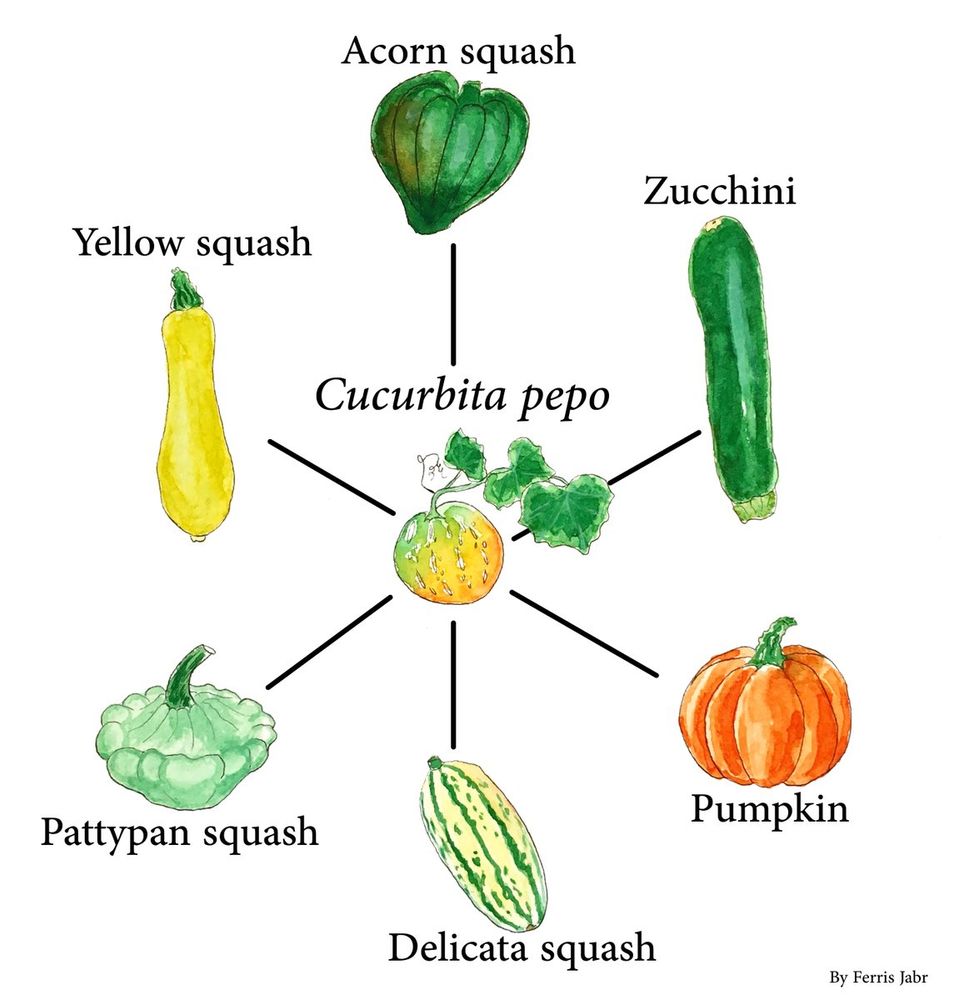
A watercolor illustration showing the modern cultivars of squash descended from the ancestral Cucurbita pepo. C. pepo is in the middle, depicted as a round-ish speckled squash ripening from green to yellow-orange. Acorn squash, zucchini, pumpkin, delicata, pattypan, and yellow squash surround it in a circle, each connected to C. pepo by a line, like spokes in a wheel. Illustration by Ferris Jabr.
Cucurbita pepo is one of the oldest domesticated species. Over millennia, it has proved astoundingly versatile.
Just as Brassica oleracea gave us broccoli, kale, cabbage, Brussels sprouts etc, C. pepo morphed into the pumpkin, zucchini, delicata, pattypan, acorn, yellow squash and more!
18.11.2024 18:32
👍 540
🔁 138
💬 11
📌 24

Coming this week! @minyaaa.bsky.social @roederlab.bsky.social @naascarabidopsis.bsky.social 🌱 Join us for our upcoming workshop Quantifying Plant Morphogenesis: 4D Insights with MorphoGraphX!
Learn how to quantitatively analyze plant confocal imaging data using MorphoGraphX.
20.10.2025 18:07
👍 10
🔁 3
💬 0
📌 1

Leaf development engineering challenges and opportunities.
#TansleyReview: Unlocking #grass leaf development: foundations for tunable #cereal design
Trisha McAllister, Hilde Nelissen, Josh Strable and Annis Richardson 👇
📖 nph.onlinelibrary.wiley.com/doi/10.1111/...
#LatestIssue #PlantScience
19.10.2025 14:03
👍 16
🔁 8
💬 0
📌 0
Congratulations, Penelope!!!
You deserve all the recognition for your beautiful work 👏🏽👏🏽👏🏽
20.10.2025 06:44
👍 2
🔁 0
💬 1
📌 0

Photo of a cluster of black palm fruits (drupes) hanging on red, dangling stalks.

A close-up photo of a bug climbing on a plant shoot. The bug is all black with red spots.
It blows my mind that red-&-black fruits and seeds are attractive, but red-&-black insects are repellent (aposematic). In dispersal, as in life, context is everything! 📷1: Ripe fruits of Pinanga malaiana (#Arecaceae). 📷2: red-spotted stink bug, Jose Amorin CCBYNCSA2. #dispersal #Botany 🌾🧪🌱
11.10.2025 11:57
👍 87
🔁 15
💬 6
📌 0

New preprint! 🐛 Root-knot nematodes hijack root cells, turning them into feeding sites and making plants very sick. Using a cross-species scRNA-seq approach we mapped this process and show how this knowledge can be used to engineer resistant crops.🌱 A summary🧵 :
www.biorxiv.org/content/10.1...
10.09.2025 14:30
👍 60
🔁 24
💬 7
📌 2

Watercolor painting with blue and red blobby shapes
Painted some xylem for a thing. Pretty pleased. #sciart
12.10.2025 01:20
👍 203
🔁 32
💬 3
📌 1

AnatomyArray: a high-throughput platform for anatomical phenotyping in plants (Yikeng Cheng, Jiawei Shi, Zhanghan Pang, Nuo Xu, et al) doi.org/10.1093/plce... #PlantScience
03.10.2025 21:38
👍 14
🔁 5
💬 0
📌 1

Simplified regulatory models and predicted origins of gene families.
#Leaf #evolution: integrating #phylogenetics, developmental dynamics, and genetic insights across #land #plants
📖 buff.ly/rhBlpc6
#TansleyReview by Hokuto Nakayaman and Neelima R. Sinha
@WileyPlantSci #PlantScience
04.10.2025 14:38
👍 20
🔁 8
💬 0
📌 0