

The making of this week's #TidyTuesday chart recorded with {camcorder} in #RStats 📹
23.10.2025 15:04
👍 78
🔁 9
💬 3
📌 1
The making of this week's #TidyTuesday chart recorded with {camcorder} in #RStats 📹

An international team of researchers has proposed an overall definition of questionable research practices (QRPs) and published a comprehensive list of them—as well as ways to detect and prevent them. @nagyt.bsky.social @amathia-deluxe.bsky.social #Psychology

The structure of a good software test - the latest in my Better Code, Better Science series. russpoldrack.substack.com/p/the-struct...
🚨New paper out in AMPPS! proud to be part of this one, another solid product of @improvingpsych.org✨
We mapped the grey zones of psychology’s research culture through a consensus process. Ever wondered, “Wait... is this a questionable practice?” You’re not alone: doi.org/10.1177/2515... #OpenScience
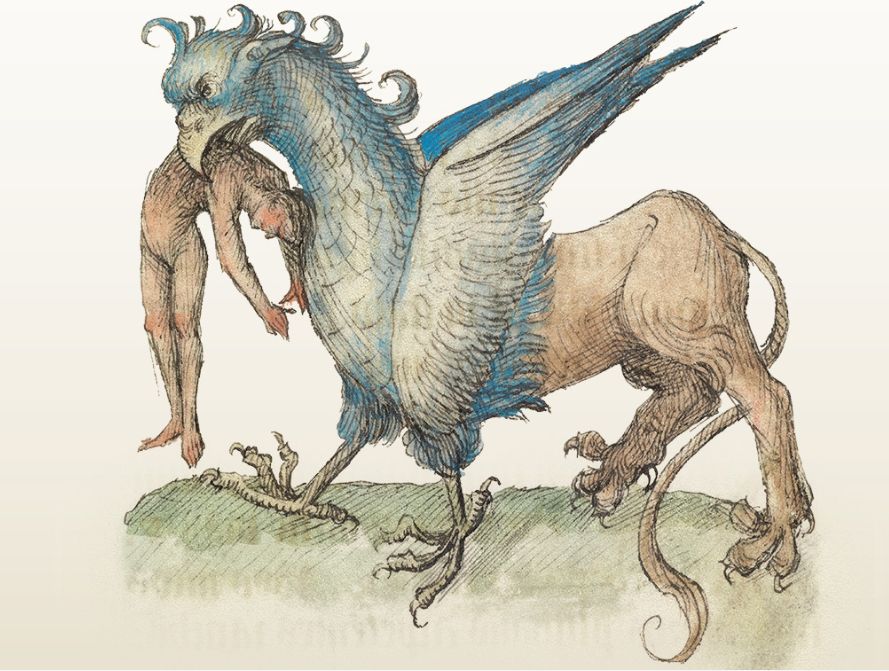
🚨 New study alert! We're excited to share our "Bestiary of Questionable Research Practices in Psychology" in #AMPPS. We tackle the credibility crisis in research by defining, collecting, and categorizing QRPs using a community consensus method. 🧵#OpenScience #QRPs @psychscience.bsky.social

🧌This "bestiary" can be a vital resource for researchers, educators, and reviewers to recognize, understand, and mitigate QRPs, ultimately raising the standard of psychological research. Read the full article here: journals.sagepub.com/doi/10.1177/...
Aleksandrina Skvortsova, Samuel Alarie, Katherine Graves, Lukas K. Sotola, @davidmoreau.bsky.social , @evarubinova.bsky.social
🙏Huge thanks to all co‐authors: @amathia-deluxe.bsky.social , @mamsmandrill.bsky.social, @lukaswallrich.bsky.social, Kathleen Schmidt, Tal Waltzer, Jason W. Payne, Biljana Gjoneska, @yashvin.bsky.social, @andrewang.bsky.social, Daniel Scharfenberg, Gabriella Tyson, @ufangyang.bsky.social, ...
😮💨But there's hope! Our study highlights key preventive measures to avoid QRPs: transparent reporting, preregistration, blind data analysis, following best practices, and performing robustness checks. These foster research integrity!
⚡Why should we care? QRPs pose a substantial threat to scientific conduct and quality. They can lead to biased statistical error rates, reduced replicability & reproducibility, biased effect size estimates, and inflated credibility, undermining research trustworthiness.

🕵️How detectable are QRPs? Our study identified 18 QRPs detectable directly from a publication📰, while 19 more need supplementary info like preregistration or open data. We found 97 unique clues🔍! This info can serve as a checklist for human reviewers & prompts for AI risk assessment.
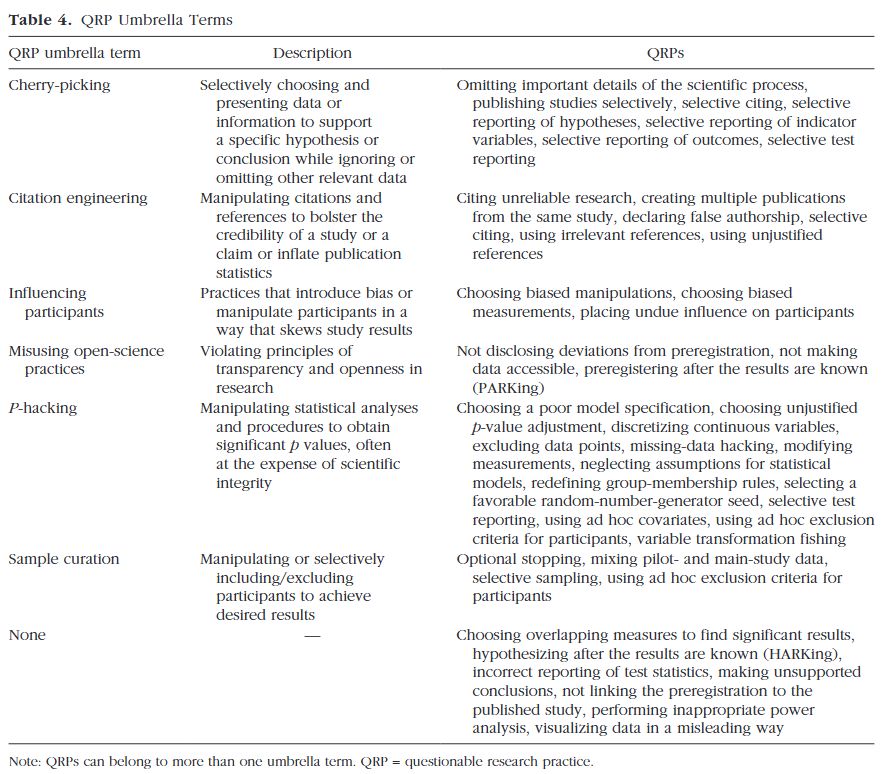
☂️To bring clarity, we introduced "QRP umbrella terms" that group conceptually related QRPs. For example, #Phacking 🪓consists of 13 specific QRPs, and #CherryPicking 🍒covers 7. This disaggregation helps pinpoint specific behaviors.

🧑🔬We collected and categorized 40 distinct QRPs for quantitative research in psychology, spanning all stages of the scientific enterprise from planning to publication. Many of these QRPs were previously unlisted, despite being recognized (e.g., visualizing data in a misleading way 📊).
❓So, what are QRPs? Our community consensus study agreed on this definition: "Ways of producing, maintaining, sharing, analyzing, or interpreting data that are likely to produce misleading conclusions, typically in the interest of the researcher". Crucially, they don't include fraud or random error.
🚨 New study alert! We're excited to share our "Bestiary of Questionable Research Practices in Psychology" in #AMPPS. We tackle the credibility crisis in research by defining, collecting, and categorizing QRPs using a community consensus method. 🧵#OpenScience #QRPs @psychscience.bsky.social
Very excited to publicly share news about a new tool, Papercheck, that @debruine.bsky.social and me started to develop more than a year ago! In an introductory blog post, we explain our philosophy to automatically check scientific papers for best practices. daniellakens.blogspot.com/2025/06/intr...
Join us for the exciting hackathons during #SIPS2025 in Budapest on June 25-27!
Hackatron participants will work on projects related to diversity and inequity in academia, career guides for psychology, secondary data analysis, the quality of psychological tests, new publishing initiatives, & more!

📣 Big news: Lifecycle Journal is now open for submissions! 📣
Lifecycle Journal is a new, innovative, community-driven approach to scholarly publishing, initiated by COS.
Learn more and submit: lifecyclejournal.org/

a valuble checklist for cross-cultural studies: “The Test Adaptation Reporting Standards (TARES): reporting test adaptations”
www.tandfonline.com/doi/full/10....
People are often surprised to learn they can design a study where you look at the data twice (a sequential design) at no cost (because the alpha correction is so small, there is no increase in the sample size). To learn how, see lakens.github.io/statistical_...
DATA COLLECTED BY STUDENTS: Do you use it for your own research? Concerned about its quality? 🤔
Our new paper explores questionable practices and research misconduct (QRP/M) during data collection in student projects: spb.psychopen.eu/index.php/sp...
🧵1/6