Out now in Translational Psychiatry! www.nature.com/articles/s41...
28.11.2025 14:53
👍 42
🔁 20
💬 0
📌 1
Out now in Translational Psychiatry! www.nature.com/articles/s41...

Day 1 ✅ #ACNS2025

Only two weeks in and Melbourne already feels like home. Loving what the city has to offer on both the research front and beyond! Oh, and my walk to the office isn’t half bad either 🌿☀️
Fantastic news, congrats Claire 🍾 Lucky UCD!
Academics are under unrelenting pressure to accept the narrative of the inevitability of #generativeAI & to embrace it in teaching & learning. We resist - because it is ecologically destructive, ethically corrupt, & because it undermines the thinking abilities that make us both human & intelligent.

Trinity College unveils 'gamechanger' brain scanner. Watch the full interview with Professor Redmond O'Connell with RTE here:
www.rte.ie/news/ireland...
@redmondoconnell.bsky.social
Exciting news! 🎉 In 3 weeks I’m moving to Melbourne 🇦🇺 to finish my PhD remotely 🎓. While still a TCD student, I’ll be kindly hosted by the Bellgrove Lab at Monash University and getting involved in some applied research 🧠
Decision neuroscience folks—keen for a coffee? ☕🤓
Hi Charlotte, very excited for you as you embark on this next chapter—wishing you all the best!🌟
Was there a prize for best fan?
New research study from my music and health psychology lab -
Masters student Erin Smith is looking for adults to answer her 15 minute survey about musicality and neurodivergent traits.
#music #autism #adhd #skills
eu.surveymonkey.com/r/XL38HFY
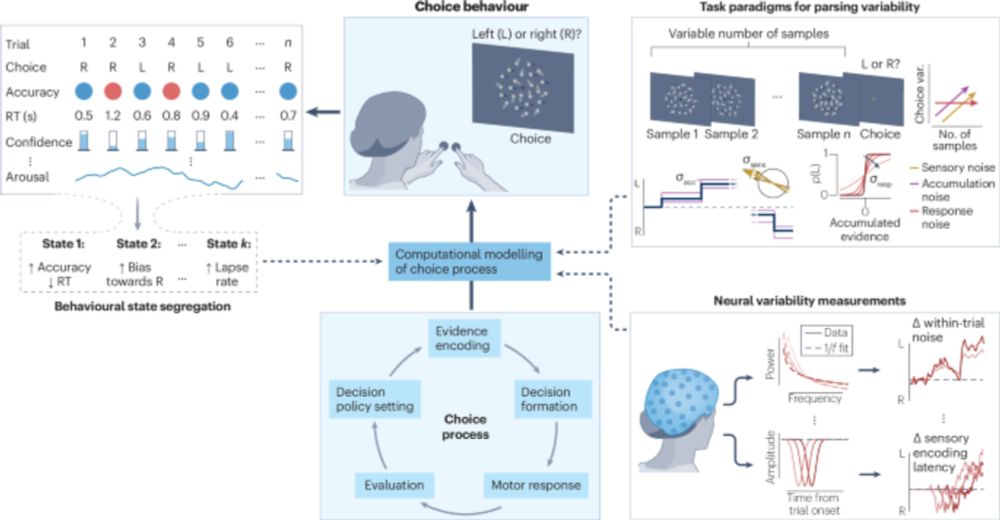
Disentangling sources of variability in decision-making — a Review by Jade S. Duffy, Mark A. Bellgrove, Peter R. Murphy & Redmond G. O’Connell
www.nature.com/articles/s41...
@jduffy9.bsky.social @neuromurphy.bsky.social @redmondoconnell.bsky.social
#neuroscience
I'm looking for a public dataset of young+older people doing a simple perceptual decision-making task, with sufficient trial + subject numbers. Ideally, multiple stimulus difficulty levels but no manipulations (conditions, task switching etc).
This must exist - tips for where to look? 🧒👨🦳🧠
These approaches will enable SSMs to handle greater complexity without adding free parameters 🔧. By combining them, we open exciting avenues to deepen our understanding of choice variability in both health and disease 🧠💡.
The final stream leverages electrophysiology ⚡ to identify neural variability 🧠 and integrate it into models 📊. Measuring neural signals 🧬 helps constrain variability parameters 🔧, bridging abstraction levels and deepening our understanding of variability 🔄.
Another promising avenue is developing advanced task paradigms 🎮 that carefully manipulate stimuli and timings 🎯, enabling estimation of parameters 🔍 often challenging to identify in conventional models 📊. This approach uncovers deeper insights into decision-making variability 🧠.
Recent advances bring us closer to models capturing distinct variability sources 🔄. A key area is how behavioral 👆 and neural 🧠 states evolve during a task ⏳. Accounting for these changes may improve parameter estimates 📊 and clarify variability 🔄.
Identifying the psychological 🧠 and neurobiological 🧬 causes of variability is a key goal of computational research 💻. Sequential sampling models (SSMs) capture variability 🔄, accuracy ✅, and RT ⏱️ across tasks 🎯, but limitations 🔧 prevent them from capturing all variability sources🔄 and timescales⏳.
Variability, in itself, is a stable, reliable trait—increased across many brain disorders 🧠⚠️—and can explain more variance ⚖️ than even the most robust experimental manipulations 🔬. Disentangling its many sources operating across distinct timescales ⏳⏰is no easy feat 🧩.
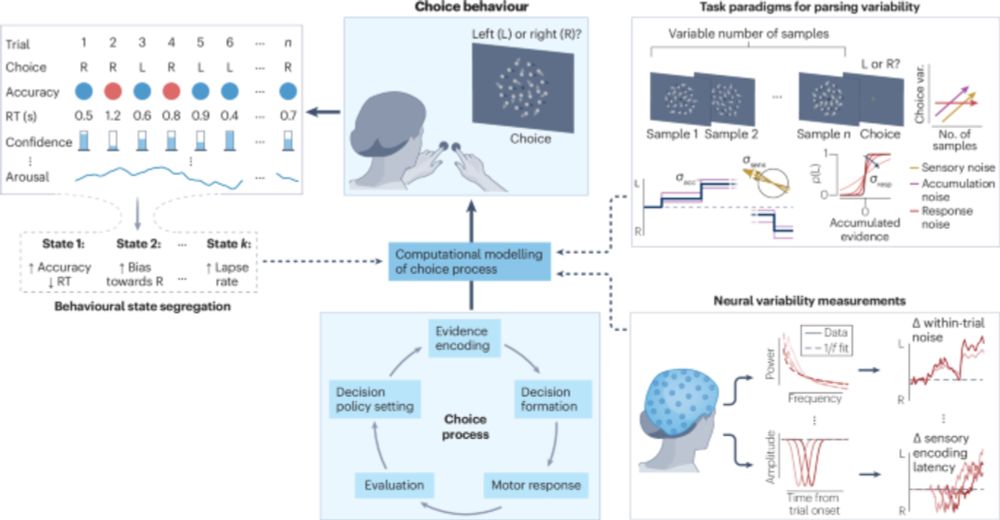
In life, 3 things are certain: death, taxes, and decision-making variability🧠. Our review tinyurl.com/4dcwafc4 explores how computational models 💻 explain variability, their limits, and recent advances. A thread🧵👇
@redmondoconnell.bsky.social @neuromurphy.bsky.social Mark Bellgrove (not on Bluesky)