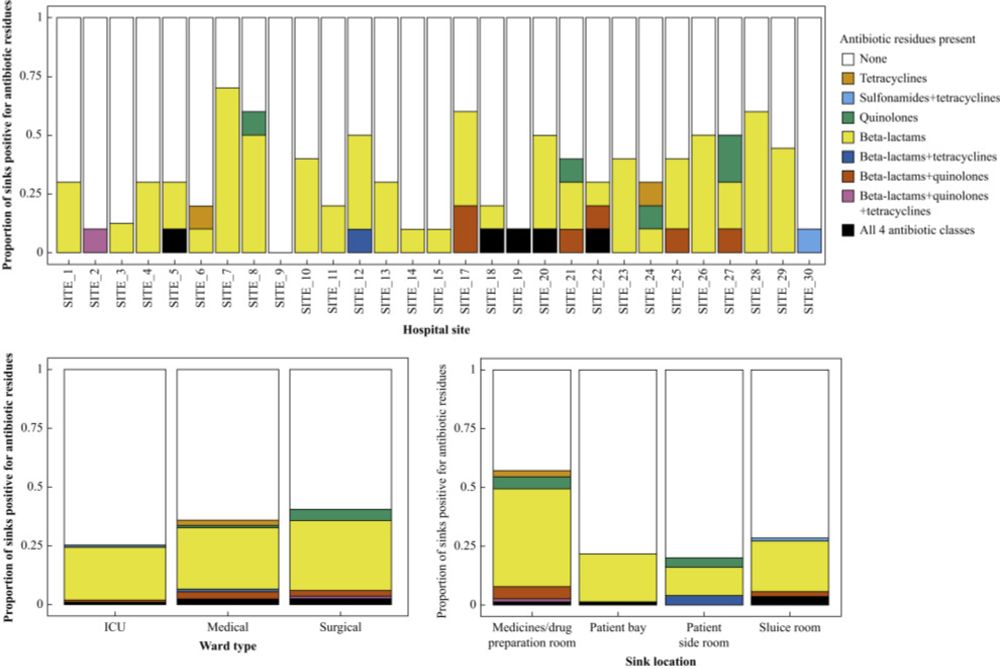
Previous work led by Olga Tosas Auguet suggests yes: doi.org/10.1016/j.ec....
25.02.2026 08:20
👍 0
🔁 0
💬 1
📌 0
Job Details
Are you a post-doctoral microbiologist interested in characterising bacterial resistance evolution and want to apply your knowledge and expertise to developing new therapeutics for Klebsiella (and other Enterobacterales) infections? Then we need you! Apply now bit.ly/3MX39Ce close date March 13th 👀
24.02.2026 14:59
👍 6
🔁 13
💬 0
📌 2
Optimising the use of alternative therapies for the treatment of urinary infections - The University of Nottingham
🚨 Fully‑funded PhD for Home Students🚨
We'll explore non-antibiotic alternatives in relatistic environments, uncovering how they work, if they affect antibiotic activity and whether they influcence AMR acquistion. Come join a wonderful supervisory team!
#MicroSky #UTISky #AMar
tinyurl.com/38u552bu
21.01.2026 21:12
👍 5
🔁 10
💬 1
📌 3
🚨 New pre-print! 🚨 In the largest study of its kind to-date, we investigate the ecological and evolutionary mechanisms driving within-patient evolution of antimicrobial resistance (AMR). Read here:
www.biorxiv.org/content/10.6... , and follow along with this thread, discussing our findings (1/21)
20.02.2026 15:57
👍 64
🔁 32
💬 2
📌 3
If you're interested, click on www.ox.ac.uk/admissions/g... - Life and Medical Sciences, Clinical Medicine 04!
09.02.2026 17:29
👍 2
🔁 2
💬 0
📌 0

Biofilm removal in hospital sink drains drives unintended surges in antibiotic resistance
npj Antimicrobials and Resistance - Biofilm removal in hospital sink drains drives unintended surges in antibiotic resistance
By Shireen Kotay/Amy Mathers - Biofilm removal in hospital sink drains drives unintended surges in antibiotic resistance rdcu.be/e1uTu. Effects akin to gut microbiome dysbiosis/loss of colonisation resistance. To mitigate these reservoirs we need better evidence to understand what works best where.
30.01.2026 13:38
👍 17
🔁 10
💬 1
📌 3


Our project "Sardinia’s Invisible Marine Microbiome" is one of six 2026 #PartArt4OW participatory art initiatives! Excited to do this with the brilliant @annadumitriu.bsky.social (image credit), Sardinian scientists, citizens of Alghero, and colleagues in @modmedmicro.bsky.social @bashthebug.net
30.01.2026 12:50
👍 3
🔁 3
💬 0
📌 0


New out by @dotnagy.bsky.social & colleagues synthesising published epidemiological/microbiological/genomic data on 'big 5' CPE hospital outbreaks: www.medrxiv.org/content/10.6...
Lots of them, but sampling and reporting heterogeneity makes it hard to nail risk factors for dissemination.
06.01.2026 13:37
👍 2
🔁 1
💬 0
📌 0

Our team wore blue for World Antimicrobial Awareness Week 2025💙
Research into how resistance emerges, spreads and can be prevented is vital. Our group works to understand these processes and develop better tools to detect, monitor and combat antimicrobial resistance.
#WAAW @oxfordbrc.bsky.social
20.11.2025 15:14
👍 10
🔁 8
💬 0
📌 0
Congrats Viki!
13.10.2025 20:20
👍 2
🔁 0
💬 1
📌 0
Now published in @natcomms.nature.com 🎉
www.nature.com/articles/s41...
With Gillian Rodger, @nstoesser.bsky.social, @samlipworth.bsky.social, @stat-sarah.bsky.social, and many others!
30.09.2025 16:21
👍 21
🔁 14
💬 0
📌 0
Pleased to see this pre-printed, highlighting the completeness/accuracy of @nanoporetech.com long-read genome assembly for clinical Enterobacterales: www.biorxiv.org/content/10.1...
Thanks to colleagues @modmedmicro.bsky.social, @ukhsa.bsky.social, @genewiz.bsky.social and @oxfordbrc.bsky.social!
25.09.2025 08:48
👍 10
🔁 12
💬 1
📌 1
Job opportunity for microbial genomicists interested in E. coli and Klebsiella infections and AMR 👀⬇️ - do get in touch if you might be interested! Closing date 7th Oct.
24.09.2025 20:27
👍 4
🔁 8
💬 0
📌 1
@modmedmicro.bsky.social
01.09.2025 19:25
👍 0
🔁 0
💬 0
📌 0
Details | Working at Bristol | University of Bristol
Great new opportunity to work with #Liamshaw and @mutantbug.bsky.social as part of our HPRU collaboration (www.expmedndm.ox.ac.uk/research/hpr...) - sinks, phages, wastewater genomes, novel threat detection bit.ly/45Wcv6I - deadline 14th Sept 👀
01.09.2025 19:23
👍 1
🔁 1
💬 1
📌 0
Wastewater and AMR Special Interest Collaborative (SPARC)
More evidence to support best practice "water-safe" care in healthcare facilities is urgently needed. If you're interested please tap into the @hisinfection.bsky.social Wastewater and AMR Special Interest Collaborative (SPARC) - see you there!
26.07.2025 09:47
👍 2
🔁 1
💬 0
📌 0
New analysis from Kevin Chau @modmedmicro.bsky.social for the SinkBug Consortium (a collaboration with teams across 29 UK hospitals, NITCAR, UKHSA): Pathogen and AMR gene burden in 287 hospital sink-trap metagenomes and factors associated with high burdens.
26.07.2025 09:47
👍 2
🔁 3
💬 1
📌 0