

TL;DR
Middle management is hard. Caring is required, but the kind of care you provide matters.
02.12.2025 22:00
👍 89
🔁 26
💬 8
📌 10
TL;DR
Middle management is hard. Caring is required, but the kind of care you provide matters.
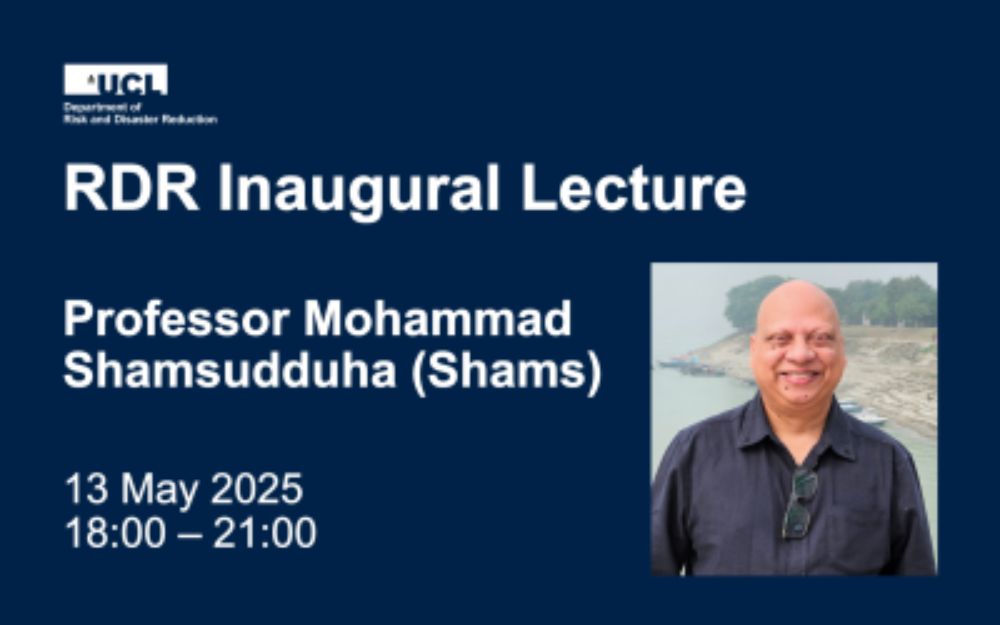
How Data-Driven Science Transforms Lives: Spotlight on Water Security
13 May 6–8:30 pm, UCL
Join @uclrdr.bsky.social for an inspiring talk on how Prof Shams’ research evolved, focusing on his data-driven research in groundwater science, particularly in Bangladesh.
www.ucl.ac.uk/risk-disaste...
In the UK, many big datasets employ people to 'do research in their data'. And encourage people to 'think of ways to use our data'.
I don't think this is how we should do science.
I think we always start with formulating a research question, & then identify the best data to answer that question.

"Empirical studies on peer review bias are primarily conducted by people from privileged groups & with affiliations to journals studied. Data access is a major barrier to conducting peer review research. We propose pathways to broaden access to peer review data to people from diverse backgrounds"

A blue slide with the text Open Science in Qualitative Research. Speakers: Professor Rebecca Campbell, Michigan State University. Dr Sharon Cox (University College London), Dr Sebastian Karcher (Syracuse University) and Professor Alex Stevens (University of Sheffield). And the BR-UK logo.
Join our next webinar to learn how address the ethical & practical challenges related to open science & sharing of qualitative data. We'll discuss real-world dilemmas, new frameworks & methodological approaches to handling sensitive data.
Register at: us02web.zoom.us/webinar/regi...

‘There is a worldwide shortage of scientists and because it’s a worldwide shortage, there’s worldwide competition,' says our Foreign Secretary Professor Alison Noble, as she warns that the UK's visa process and costs could put off scientists from moving to the UK: www.dailymail.co.uk/news/article...
And he's launching it on our turf too

Call for Proposals: Metascience 2025
Be part of the biggest Metascience meeting yet! We're inviting proposals for:
✅ Virtual symposia
✅ In-person panels
✅ Talks & posters
⏰ Submit by 7 Feb 2025
🔗 Full details: metascience.info/call-for-pro...
"When those who hold the most power over the AI ecosystem give up on the net-zero challenge, what can be done and by whom?" New blog from BRAID partner ALI is interesting read, and the authors include BRAID Fellow @fedelucivero.bsky.social Good show! #AIgovernance #Sustainability #ClimateChange

We work in socio-technical systems. Very often our improvement efforts over-focus on the technical (strategies, priorities, processes, methods, metrics) & under-focus on the socio (collaboration, agency, relationships, culture). See nateschloesser.medium.com/people-over-.... By Nate Schloesser.
"Open science advocates should broaden their recommendations to include qualitative researchers and accommodate the paradigmatic differences among post-positivist and interpretivist social science, for example, by incentivizing a broader range of open science practices."
#MetaSci #Methodology

Infographic showing 8 ways to speed up knowledge mobilisation
Coproduction is increasingly becoming part of the research process.
As part of our @nihr.bsky.social Knowledge for Public Health work, Liz Such and @joelangley.bsky.social compiled 8 tips to speed up that process and I turned it into a infographic.
Find out more at know-ph.ac.uk

I've been working with Goran Henriks to identify enabling factors for systemic, profound change (at a deeper level than incremental improvement). One of our themes is "leading people through transitions in situations of uncertainty". Great to see this focus in a new article in HBR: lnkd.in/eX2piq3g.
Measuring the soft underbelly of science - @jasonwilliamsny.bsky.social ponders how we could use existing tech infrastructure such as ORCID to start to track the impact of the trainings individuals participate in lifescitrainers.org/2024/02/14/m...

Interesting insights of how different actors can be "stewards of trust" & contribute to an ecosystem of trust in science.
link.springer.com/article/10.1...

Important commentary on computational analysis in bioimaging
Highlights how biology is now a data science (omics, imaging, structure, epidemiology, clinical...)
This has major implications for education, training, research culture & infrastructure
journals.biologists.com/jcs/article/...