In this event, I will present a roadmap of the human rights politics of Iran that has gotten us to where we are today.
Talk description and registration for joining online in comment.
03.03.2026 14:43
👍 3
🔁 2
💬 0
📌 0

think it’s essential to build global alliances that better integrate Chinese perspectives. The starting point would be listening to and building alliances with grassroots organisations from within China and in the diaspora. As I have said, there are many creative forms of resistance to authoritarian and conservative nationalism within China and among the diaspora. The Western left space is not particularly used to hearing voices that are critical of both Western imperialism and non-Western authoritarianism, as well as drawing linkages between them. Sometimes, the concern about racism and not wanting to encourage imperialist foreign policies leads to an unwillingness to engage with criticisms of the Chinese state, including those from Chinese nationals and from minoritised groups in China.
Yao Lin conceptualises this as what he calls ‘interregimatic missolidarisation’. By this he means an ostensibly supportive relationship that does not really correspond to struggles against injustice or oppression within a different regime. This is not only due to cultural or linguistic distance, but also because of the ways in which different structures give rise to different forms of injustice, creating both experiential and discursive barriers to transnational solidarity.38 Our conversations with diaspora Chinese organisers engaged in anti-racist, queer, feminist, and decolonial work reflect this. Their lived experiences are often exoticised or dismissed by ‘mainstream’ civil society, and they find it easier to connect with or be understood by other immigrant groups.
This also brings to mind Shadi Mokhatari’s critique of the ‘uncritical anti-imperialist solidarities’ and the victimhood politics of the ‘anti-imperialist-branding states’. Here again, allegedly anti-imperialist actors mis-solidarise with the oppressor, conflate the state with citizens at large, as well as essentialist notions of culture, and disregard the agency of the oppressed.39

This vision of the so-called ‘multipolar civilizational order’ bears a disturbing resemblance to that of the European far right, where racial-civilisational categories are defined in terms of ontological and epistemological difference and ‘indigenous’ civilisational identity is placed in opposition to the ‘globalist’ order.41
For me, then, solidarity requires calling out this misplaced equation of geopolitical opposition with decolonisation or emancipation. It requires listening to and understanding the lived experiences of activists from across the Global South who are organising against authoritarianism and imperialism. Historically speaking, and in the aftermath of 1989, overseas Chinese pro-democracy politics tended to be aligned with the right in Europe and the US. But this is changing. Younger diaspora groups are now looking for new languages and imaginaries, creating decentralised spaces of resistance and solidarity. They are already building transnational alliances against the far right in many ways. What remains is for established left-wing movements to recognise, engage with, and support these emergent transnational practices.
solidarity means not mistaking geopolitical opposition for decolonization
inspired by the works of @linsantu.bsky.social @shadimokhtari.bsky.social and others
read the full interview here on China and the global politics of the far right www.tni.org/en/article/m...
05.02.2026 10:34
👍 50
🔁 23
💬 2
📌 3
very excited to be hosting this talk!
@shadimokhtari.bsky.social
04.02.2026 12:33
👍 3
🔁 1
💬 0
📌 0
incisive piece on the victimhood politics of "anti-imperialist-branding states"
05.10.2025 16:11
👍 6
🔁 5
💬 0
📌 0

The Reverse Savages, Victims, Saviours metaphor of human rights | Review of International Studies | Cambridge Core
The Reverse Savages, Victims, Saviours metaphor of human rights
Fascinating new @shadimokhtari.bsky.social article in @risjnl.bsky.social exploring:
'The Reverse Savages, Victims, Saviours metaphor of human rights' 🎉
@cambup-polsci.cambridge.org 📚
Read here now 👉
27.08.2025 08:00
👍 3
🔁 3
💬 0
📌 0

🚨New First View Article🚨
"The Reverse Savages, Victims, Saviours metaphor of human rights " by Shadi Mokhtari is now available to read. And it's #OpenAccess!
Check it out here 📄 ➡️ buff.ly/m1pTqjo
13.08.2025 13:41
👍 1
🔁 1
💬 0
📌 0

A long, long journey article published today- had been thinking about it for years & finally compelled to write it after the Woman, Life, Freedom protests in Iran. Now turning it into a book project, which expands on the WLF section at the end. www.cambridge.org/core/journal...
13.08.2025 14:40
👍 10
🔁 3
💬 1
📌 1
A long, long journey article published today- had been thinking about it for years & finally compelled to write it after the Woman, Life, Freedom protests in Iran. Now turning it into a book project, which expands on the WLF section at the end. www.cambridge.org/core/journal...
13.08.2025 14:40
👍 10
🔁 3
💬 1
📌 1
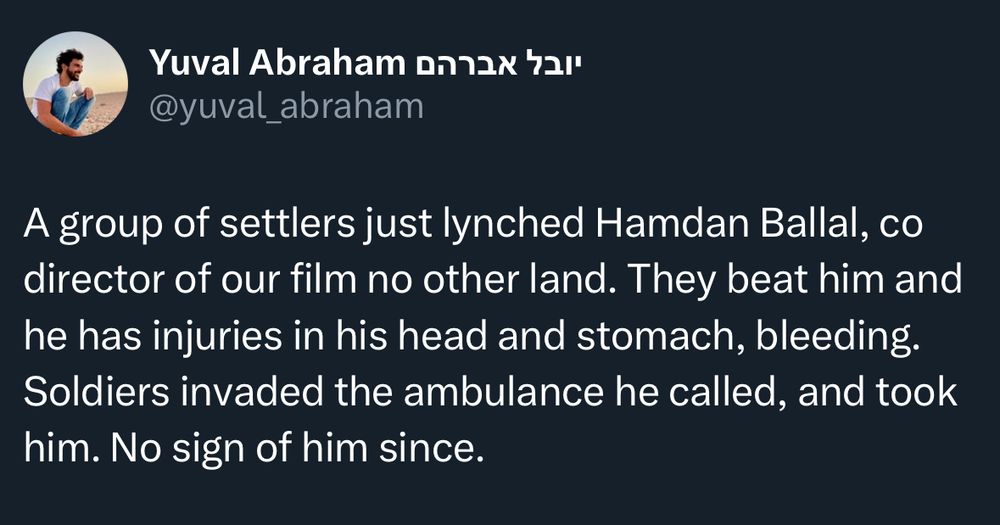
Tweet from Yuval Abraham:
"A group of settlers just lynched Hamdan Ballal, co director of our film no other land. They beat him and he has injuries in his head and stomach, bleeding. Soldiers invaded the ambulance he called, and took him. No sign of him since."
BREAKING: Yuval Abraham, co-director of Oscar-winning documentary "No Other Land," says Israeli settlers beat his co-director Hamdan Ballal, injuring his head and stomach — and then Israeli soldiers invaded the ambulance he was in and seized him.
Ballal's whereabouts are now unknown.
24.03.2025 18:30
👍 9452
🔁 6600
💬 136
📌 510
