
A group of people looking very exhausted in front of their laptops
DocuCharm is almost done and we are a bit tired. Much was done, still have a long to-do list
06.03.2026 19:38
👍 5
🔁 0
💬 0
📌 0
A group of people looking very exhausted in front of their laptops
DocuCharm is almost done and we are a bit tired. Much was done, still have a long to-do list
Overheard as we document our Data Release 20 at DocuCharm :
"I was trying to be artistic"
Upping our game from yesterday

A group of smiling people in front of a paddle boat with a large, green-lit mouth, and googly eyes.
And of course, had to go say hi to Mr. Trash Wheel before heading out for a seafood dinner and home

A group of smiling people in front of a harbor. There are some paddle boats in the shape of cute dragons behind them.
then we walked around the Inner Harbor, stopping to admire the dragon paddleboats...

A group of smiling people standing outside of a museum. There is a whirligig structure in the background.
And then we explored Charm City, aka Baltimore! We started at the American Visionary Art Museum

A complicated flowchart on a whiteboard
Yesterday, we thought deeply at DocuCharm

A roomful of people working, including people on a Zoom meeting in big screens
Back at it for DocuCharm

A selfie around a bar table with beer
DocuCharm is going well. We are documenting the local brews

At our Documentation workshop (DocuCharm) in Baltimore. The power going into typing away at webpages, wikis, GitHub, etc could power a small city
Can you email helpdesk@sdss.org with specifics?

We have 470 webpages to update for Data Release 20. Which is in July.

Sad news today about the passing of Don York, an absolutely vital part of SDSS:
news.uchicago.edu/story/donald...
We are devastated to learn that Patrick Gaulme ((@patrickgaulme.bsky.social) has passed away. He had an illustrious career in planetary and red giant seismology and was an Astronomer for SDSS-IV. He was awarded Architect status in SDSS-IV for all of his work on observations.
Thank you!
With the release of DR19 of @sdssurveys.bsky.social we published a suite of tutorials to help astronomers use the data. I’d like to highlight two tutorials that are a little different and are targeted at introductory astronomy undergrad classes. 1/4
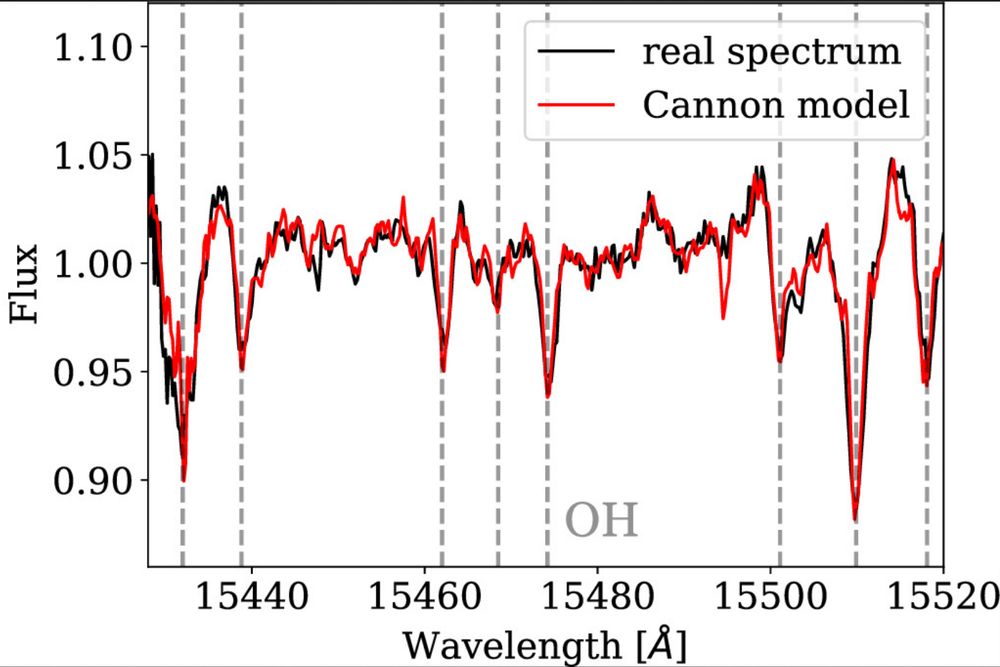
M-dwarf infrared spectrum in black, and model fit in red, showing good agreement. This figure is taken from Behmard et al. 2025, and their M-Dwarf VAC is available in DR19 from https://www.sdss.org/dr19/data_access/value-added-catalogs/, together with 8 other DR19 brand-new value added catalogs.
DR19 also includes nine brand-new Value Added Catalogs (VACs). These catalogs are based on SDSS-V spectra and data products, and produced by SDSS-V collaboration members. Find these 9, and the 67 VACs from earlier data releases all here: www.sdss.org/dr19/data_ac... #DR19
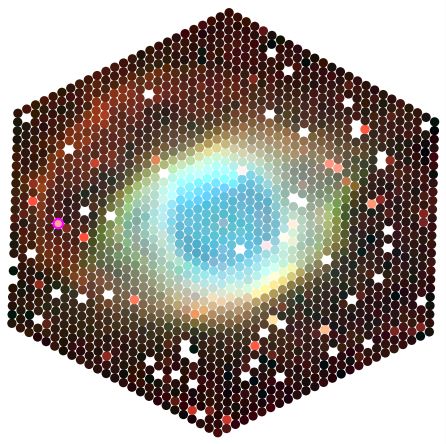
This image shows the Local Volume Mapper data of the Helix Nebula. The round fibers are arranged into a hexagon, and are coloured by combining emission lines of sulphur (red), hydrogen (green) and oxygen (blue). Image credit: Aida Wofford, and you can find this image and others on the SDSS-V image gallery: https://www.sdss.org/science/image-gallery/. Make a version of this image yourself with the tutorial on https://www.sdss.org/dr19/lvm/tutorials/
In DR19, Local Volume Mapper are releasing a tile of the Helix Nebula as a preview into future data releases. They also have a tutorial to guide you through using the data: www.sdss.org/dr19/lvm/tut... #DR19
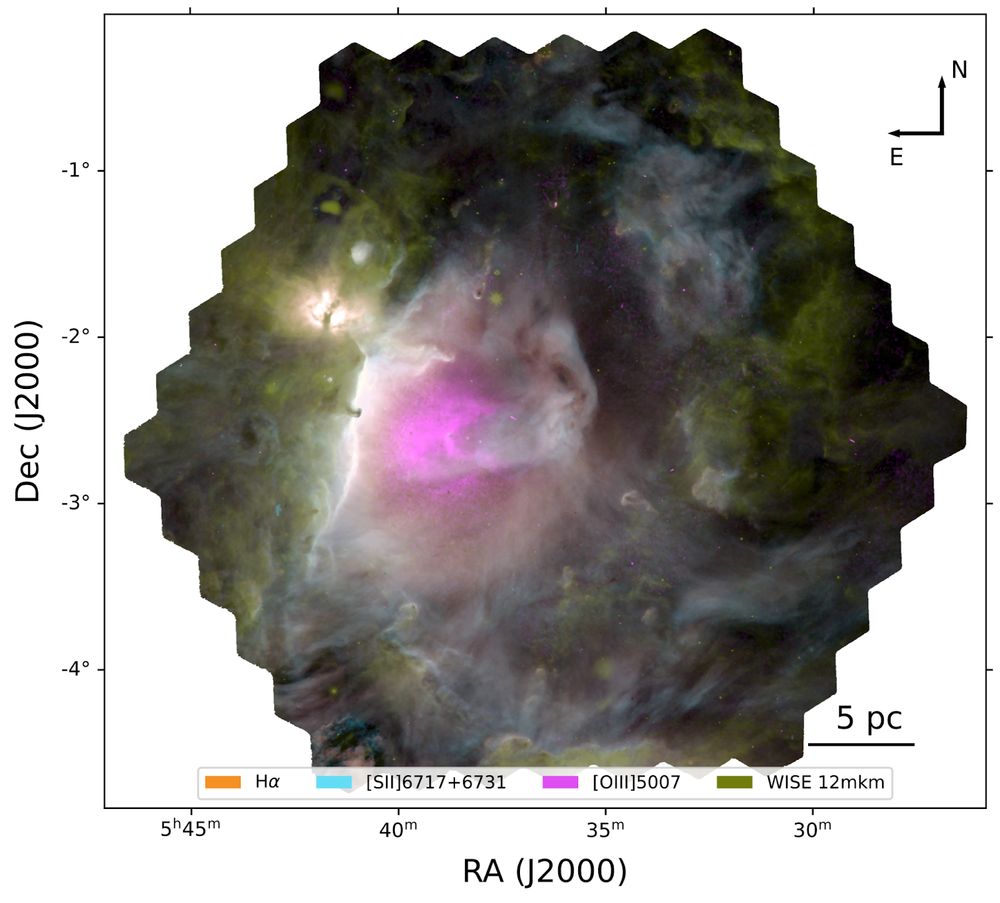
This image shows the Orion Nebula as observed by Local Volume Mapper, and published in Kreckel et al. 2024 (https://ui.adsabs.harvard.edu/abs/2024A%26A...689A.352K/abstract). Different emission lines (hydrogen, silicon and oxygen) are represented with different colour, tracing the ionisation structure of the nebula, carving a bubble in the surrounding dense gas shown by WISE 12micrometer imaging. The ionized gas emission traces wispy, filamentary structures and dusty eroding clouds and clumps. Figure taken from https://www.sdss.org/dr19/lvm/about/.
@localvolumemapper.bsky.social is an integral-field spectroscopic survey of the Milky Way, the Magellanic Clouds, and other Local Volume Galaxies. Read more about what they are doing here: www.sdss.org/dr19/lvm/abo... #DR19

Black Hole Mapper also has a range of tutorials available to get you started working on the data: www.sdss.org/dr19/tutoria... #DR19
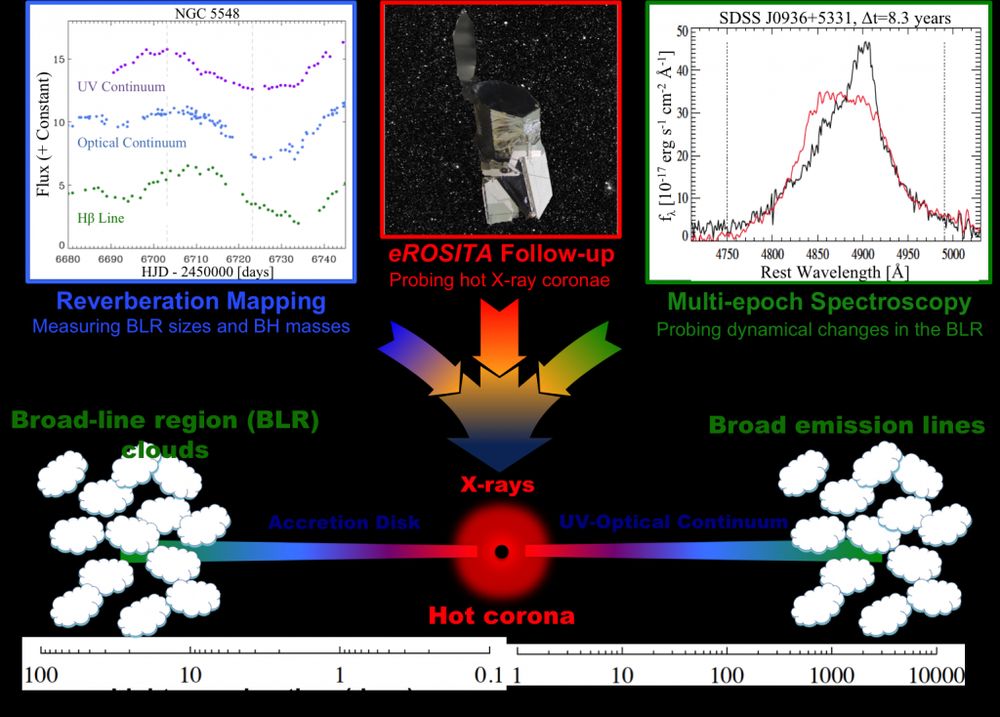
This image shows at the bottom a cartoon of an Active Galactic Nucleus, with X-rays produced by the central hot corona, and then the accretion disc and broad line region clouds further out. The top shows three images highlighting the science that Black Hole Mapper is focusing on, with X-ray follow-up in the centre, and reverberation mapping and multi-epoch spectroscopy located above the broad line regions on either side. Figure taken from https://www.sdss.org/dr19/bhm/about/
All @blackholemapper.bsky.social science programs are available here, www.sdss.org/dr19/bhm/pro..., and they include time domain programs such AQMES (All-Quasar Multi-Epoch Spectroscopy and reverberation mapping, X-ray follow-up programs.
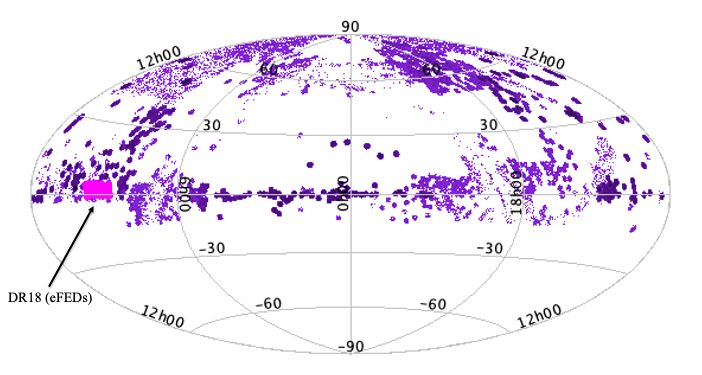
This image shows the location of Black Hole Mapper targets on the sky, with each purple point depicting an object. All fields are in the North taken with the Sloan Telescope at Apache Point Observatory in New Mexico, US. Fields in the South by the du Pont Telescope at Las Campanas Observatory will be part of the next data release, DR20. There is a pink blob around right ascension = 9 hours, which are the eFEDS fields (eROSITA Full Equatorial Depth Survey) released in DR18. Figure taken from https://www.sdss.org/dr19/bhm/
@blackholemapper.bsky.social had already released a few spectra in DR18, but they are going all out for DR19, with lots of galaxy and quasar spectra #DR19
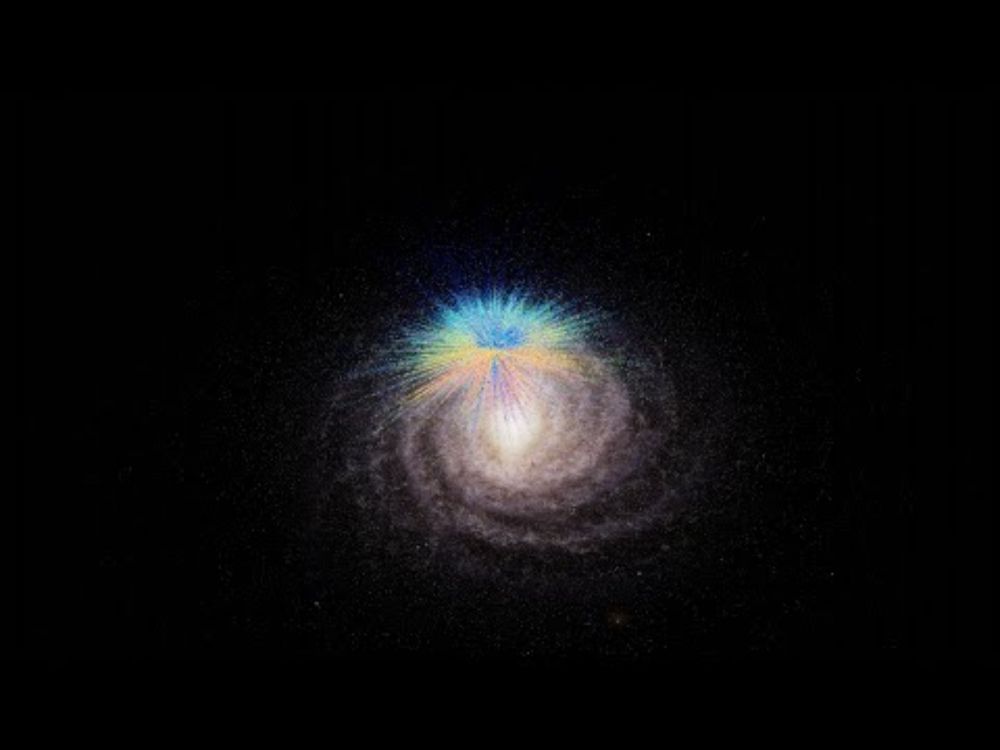
Also, check out his amazing video visualising the @milkywaymapper.bsky.social survey on our YouTube Channel, by Szabolcs Mészáros of the MWM Survey Calibration working group: www.youtube.com/watch?v=H5w2...
See www.sdss.org/dr19/mwm/pro... for all the science that Milky Way Mapper is doing, and see www.sdss.org/dr19/tutoria... for a set of tutorials to get started working with our data #DR19
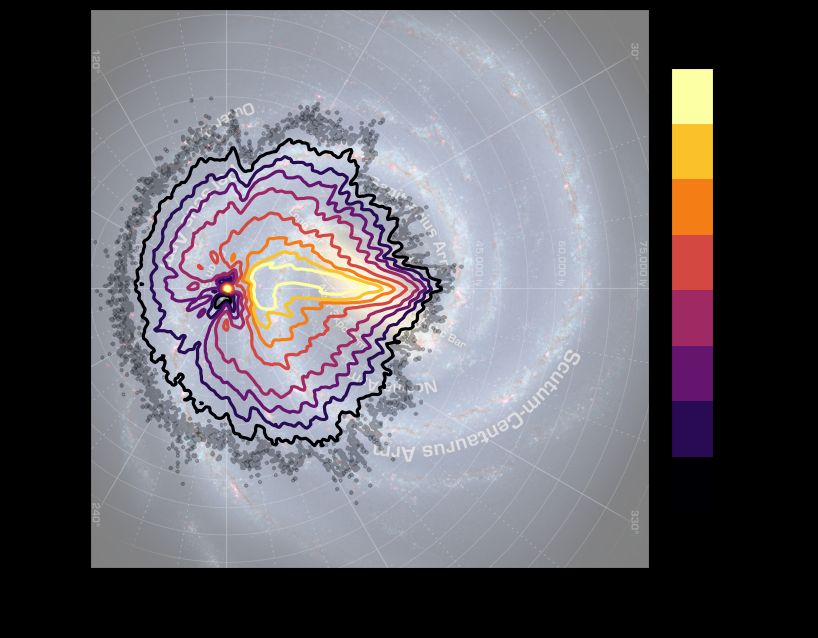
This image has in the background an artist impression of the Milky Way, face on, featuring its spiral arms. On top with contours we have the number density of target stars for Milky Way Mapper's Galactic Genesis program. The target density is higher closer to the Sun's location, and towards the Galactic Bulge. Image taken from https://www.sdss.org/dr19/mwm/programs/gg/, with image credit to Jon Bird for the target density contours, and Robert Hurt/NASA for the Milky Way image.
DR19 is the first big data release for SDSS-V, and the first time @milkywaymapper.bsky.social is featured: this mapper loves stars because stars are cool (or hot), but also because they can tell us how the Milky Way formed www.sdss.org/dr19/mwm/abo... #DR19
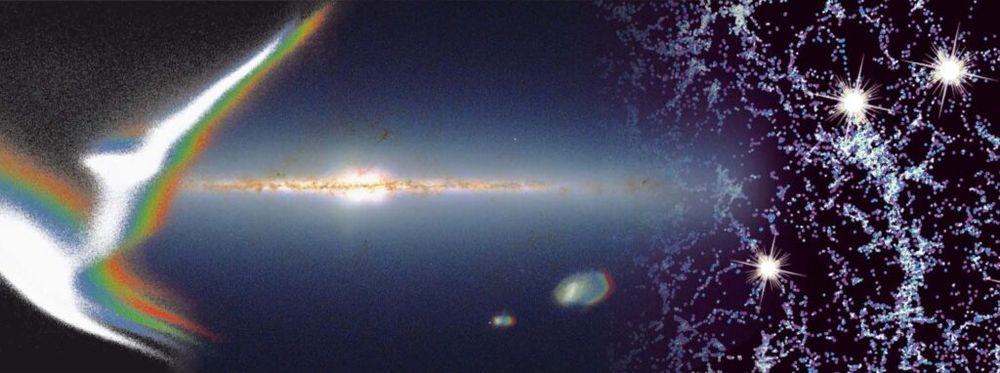
The figure is the banner from the SDSS website www.sdss.org. In the middle it has an image of the Milky Way, showing the bulge, disc and dust lanes. On the left we see an stylised version of the Hertzsprung Russel diagram, while on the right the image transforms into the cosmic web. This image showcases the range of science covered by the three mapper programs in SDSS-V.
Yesterday we released our nineteenth data release into the wild: www.sdss.org/dr19, let’s now take a closer look on what is in this data release. #DR19

🔭LVM is a robotic SDSS facility at Las Campanas Observatory in Chile’s Atacama Desert mapping the interstellar medium of the Milky Way and nearby galaxies✨
Get an eye on LVM with our image gallery: www.sdss.org/science/imag...

The SDSS-V DR19 is now online at www.sdss.org 🎉
For the first time, LVM data is released.
Get a sneak peak into LVM data and download our amazing LVM tile of the Helix Nebula!✨
A tutorial showing how to access, read in, and work with the data is available here: www.sdss.org/dr19/lvm/tut... 💻

We have a data release! Check out sdss.org/dr19 for all the data that just became publicly available with our 19th data release #DR19