Excited to head to Oxford for this on Friday! 🐦
24.02.2026 09:09
👍 17
🔁 3
💬 0
📌 0
Puffins and Shags seem to have been hit hardest by recent storms, with many reports of birds washed ashore. This includes one Isle of May Puffin that was ringed as an adult in 1995, making it at least 34 years old!
#stormChandra #seabirds #winterstorms
www.bbc.co.uk/news/article...
18.02.2026 17:04
👍 36
🔁 25
💬 2
📌 0
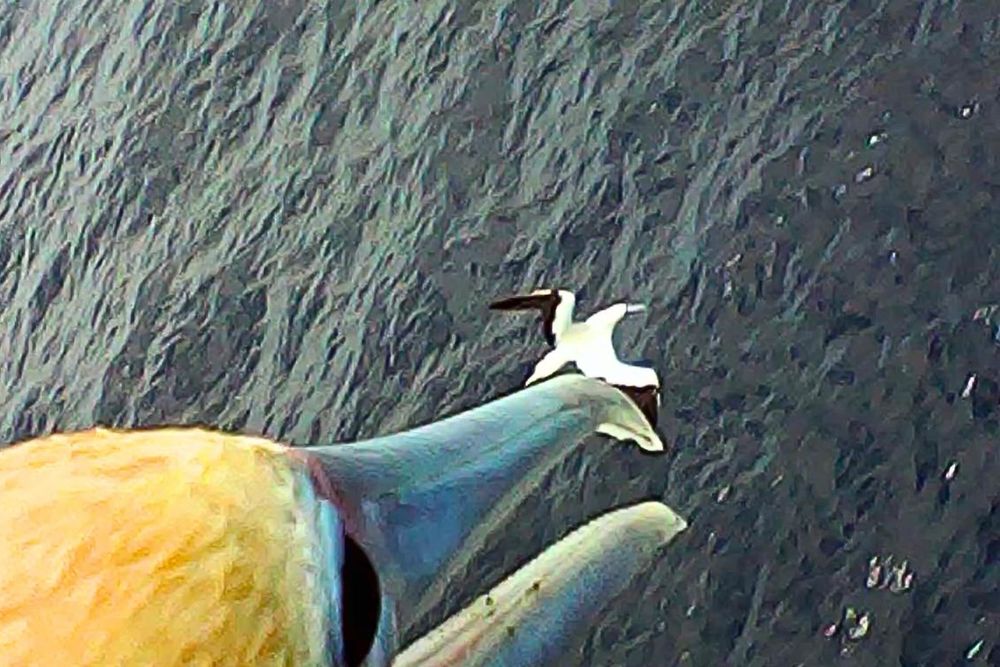
Thrilled to share my first PhD publication - gannets put more effort into diving when they are in groups 🐟🐟🐟
Out now in @meps-ir.bsky.social www.int-res.com/abstracts/me...
+Thanks to my coauthors who put a lot of effort into collecting the videos!
#seabirds #ornithology #animalbehaviour
06.02.2026 16:54
👍 61
🔁 24
💬 2
📌 0
Go Lila! 🎉
21.01.2026 16:47
👍 2
🔁 0
💬 0
📌 0

🚨 PhD offer (please share)
Fascinated by bird migration and movement ecology? 🦜🌍 Join us at @vogelwarte.bsky.social to study annual cycle energetics with multi-sensor loggers in multiple species
Deadline: 20 Feb 2026
Starting: June 2026
Supervision: Martins Briedis & me
Info: tinyurl.com/2dbv9nzh
15.01.2026 13:30
👍 74
🔁 96
💬 1
📌 2
Three weeks left to apply for our two PhD positions - come and join @lec-reefs.bsky.social to deliver applied research in restoration ecology and corporate sustainability! 🪸🐟🌳📊
Please do share amongst your networks, and I'm happy to meet with potential candidates to discuss the position further 👍
12.01.2026 09:19
👍 5
🔁 7
💬 0
📌 0
Join us! A great opportunity to join the @ukcehseabirds.bsky.social team working on the Isle of May. Great team, great place, great birds... what more could you want?!
#seabird #fieldwork #job #ornithology #superseabirdsunday
04.01.2026 13:34
👍 13
🔁 16
💬 0
📌 0

ShoalBase | Join, Explore, Contribute Now
ShoalBase offers a global database on fish social behaviour, supporting research, conservation, and ecology through community contributions and visual data mapping.
🧵1/9 There are 35,000+ fish species, but we have formal social-behaviour classifications for a tiny fraction. Most knowledge lives in the experience of researchers, fishers, divers, aquarists, naturalists, and Indigenous communities, but almost none of it is centralised. So we built ShoalBase.org.
25.11.2025 13:10
👍 50
🔁 34
💬 4
📌 4

Nominations for #WSC4 Keynote Speakers are open! ✨🌊
Early-career voices encouraged!
📍WSC4 In-person & Hybrid: 7–11 Sept 2026, Hobart, Tasmania
🔗 bit.ly/3Jv71c9
#seabirds #ornithology
17.11.2025 16:32
👍 9
🔁 5
💬 0
📌 0

✈️ WSC4 Travel Awards are here!
Supporting students, early-career researchers & conservation practitioners to attend the 4th World Seabird Conference.
📅 Apply 1 Oct 2025 – 15 Jan 2026
More info on the Registration page.
🔗https://bit.ly/4nAYG4j
#WSC4 #Seabirds #Research
06.11.2025 16:24
👍 8
🔁 7
💬 0
📌 1
NEW PAPER in #ornithology summarizes why #seabirds are so important to the ecosystem of #islands and what knowledge gaps remain: buff.ly/rHuNnOr
06.11.2025 07:23
👍 21
🔁 8
💬 0
📌 0

©️Photo by Quentin d’Orchymont
New paper by @entropie-marinelab.bsky.social and @iomarinescience.bsky.social is out! 🐦🌊
#Genomics uncovers striking genetic #differentiation and taxonomic uncertainties in a tropical #seabird across the Western Indian Ocean. 🧬
Learn more 👉 doi.org/10.1111/ddi....
01.11.2025 11:27
👍 6
🔁 4
💬 0
📌 0

Schematic diagram of the influence of seabirds on temperate and tropical near-shore marine systems.
Temperatre systems:
- Nutrient enrichment and predation on herbivorous invertebrates can lead to increased algal production
- Phytoplankton communities change, featuring more large-celled species
- Intertidal organisms incorporate seabird-enriched material by grazing on detritus and biofilm in tidepools
- Macroalgae biodiversity and primary production are boosted
Tropical systems:
- Mangrove leaf nutritional quality increases
- Corals recover faster after bleaching events
- Fish biomass increases across different trophic groups
- Pelagic and benthic consumers' foraging behaviour shifts
- Parrotfish grazing and bioerosion rates increase
- Fish grow larger
New in @natrevbiodiv.nature.com: our review of the influence of #seabirds, via their nutrient transfer, on islands & adjacent marine ecosystems 🐦🏝️🪸
We highlight knowledge gaps & future directions ✨
"The circular seabird economy is critical for oceans, islands and people": doi.org/10.1038/s443...
27.10.2025 07:49
👍 69
🔁 37
💬 3
📌 0

Temporal Variation in Early-Life Conditions Impacts on Later-Life Levels of Infection in Sex Specific Ways | doi.org/10.1002/ece3... | Ecology and Evolution | #ornithology 🪶
03.10.2025 09:30
👍 24
🔁 9
💬 0
📌 2

Title and author list for the synthesis paper titled "Understanding and Predicting Population Response to Anthropogenic Disturbance: Current Approaches and Novel Opportunities" published in Ecology Letters.
The latest paper from the DISCAR synthesis group is out at Ecology Letters! We discuss the key approaches to predicting human impacts on wildlife populations, highlighting avenues for incorporating indirect effects, such as energetic modelling. doi.org/10.1111/ele....
23.08.2025 10:40
👍 52
🔁 26
💬 2
📌 2

A simple landscape illustration with a grey-green ocean, a dark grey rocky islet partly covered by orange lichen and a light grey overcast sky. On and around the islet are seabirds of several species, most pictured realistically in colour. The largest bird is a now-extinct great auk, depicted as a semi-translucent white ghost figure.
#SciArtSeptember 1: Islet
Somewhere in the waves of Barents Sea, a rocky islet acts as a perch for seabirds. Puffins, guillemots, razorbills and skuas are still here, though threatened by heating oceans and spreading disease. With them sits a lonely ghost of a great auk that once roamed these seas.
01.09.2025 11:18
👍 833
🔁 268
💬 11
📌 7

These Majestic Seabirds Never Stop Pooping
You know this story is going to be a good time because my editor told me the first draft had too many instances of the word "poop" www.nytimes.com/2025/08/18/s... 🧪 (featuring Leo Uesaka, @ruthedunn.bsky.social and @movementecology.bsky.social)
18.08.2025 17:16
👍 25
🔁 3
💬 1
📌 1

Homing navigation is optimized to diurnal constraints in a tropical seabird, the red-footed booby | doi.org/10.1016/j.an... | Animal Behaviour | #ornithology 🪶
11.08.2025 11:01
👍 13
🔁 7
💬 0
📌 0

A graphical abstract depicting the paper title, author list, and brief description of the paper. One images displays an adult common gullemot with one logger on each leg, next to a chick. The second image displays a close-up of a common guillemot's legs with both loggers shown. The text reads:
An improved method to derive behavioural budgets and energetics from geolocator data in Common Guillemots Uria aalge
Lila Buckingham, Maria Bogdanova, Francis Daunt, Robert Furness, Sophie Bennett, Ruth Dunn, David Jardine, Mark Newell, Ewan Weston & Jonathan Green
We deployed two devices (time-depth recorder & geolocator) on 39 Common Guillemots for one non-breeding season.
We allocated time to behaviours using 1) both devices (see Buckingham et al. 2023) and 2) only geolocators, following previous methods.
We compared the behavioural budgets. We could not extract foraging behaviour (diving) when only using geolocator data.
We devised an improved method for estimating behaviours and energetics in Common Guillemots using geolocator data. We also provide guidance for studies of other diving seabirds that rest at sea.
Photos by Andrew Carter
Seabird 37 (2025) Early Release
Do you use geolocators to estimate foraging time, behaviour, or energetics in diving seabirds? See our new paper for insights from a study of Common Guillemots.
doi.org/10.61350/sbj...
@theseabirdgroup.bsky.social
11.08.2025 11:02
👍 36
🔁 19
💬 0
📌 0
Thank you, Sal! 🤩
08.08.2025 14:08
👍 1
🔁 0
💬 0
📌 0