
5/5 📌 Global Reach
Testing 22 non-OECD countries confirmed that while context varies, heavy usage among girls is consistently associated with lower well-being.
17.02.2026 08:50
👍 0
🔁 0
💬 0
📌 0
5/5 📌 Global Reach
Testing 22 non-OECD countries confirmed that while context varies, heavy usage among girls is consistently associated with lower well-being.
4/5 📌 Gender & Confounders
The link is far more robust for girls. After controlling for SES and bullying, the association for boys disappears in most countries. For girls, high usage (>5h) remains significantly related to lower satisfaction.
3/5 📌 The Goldilocks Pattern
Pooled data shows an inverted J-shaped association. Moderate users (1–3h) report the highest life satisfaction. Both non-use and excessive use (>5h) are linked to lower satisfaction levels.
2/5 We analyzed data from 159,185 15-year-olds across 24 OECD countries. We examined how daily social media usage (from 0 to 5+ hours) is related to life satisfaction measured on a 0–10 scale.


1/5 📱 Gendered Associations Between Social Media Usage & Adolescent Life Satisfaction
Our new study (w/ Ricarda Ullrich) finds no one-size-fits-all "social media effect". The link is deeply gendered and context-dependent.
🔗 Read here: doi.org/10.1186/s405...
Based on over 82k respondents (born 1995–2009) from:
📊 #Eurobarometer & #CARE surveys @gesis-dataservices.bsky.social
📊 @ess-survey.bsky.social
📊 @isspsurvey.bsky.social
📊 European Quality of Government Index
🧩 Does living in a more gender-equal country close the attitude gap between young men and women? Our new data says: Not necessarily.
📌 We find that gender gaps in attitudes are often larger in countries with higher gender equality scores. This aligns with the "Gender Equality Paradox".
📌 However, gaps vary by domain! Differences are smaller regarding private norms (e.g., shared parenting) where consensus is emerging. They are much larger regarding public issues (e.g., fairness & discrimination).
📌 We find widespread gaps: Young women are consistently more egalitarian. Young men are significantly more likely to perceive gender equality as a "zero-sum game" or believe discrimination is already resolved.

🚨 Are Gen Z gender gaps in gender equality attitudes really as pronounced as perceived?
In a new preprint w/ @stinasiegert.bsky.social , we analyzed 82k+ young adults across 24 European countries.
👉 Read here: osf.io/6h9gd_v1

Sprechblase vor grünen und blauen Punkten. Darunter in schwarz der Schriftzug EQUAL-NET.
Welche Rolle wird KI in der Schule spielen?
Welche Chancen und Herausforderungen bringt sie mit sich? Bitte nehmt an unserer Befragung teil und unterstützt unser Projekt in Kooperation mit der @dkjs.de: www.soscisurvey.de/EQUAL-NET/?q...
Join my team in beautiful Berne! ☀️🏔️

📠 New paper out!
It explores how gendered career patterns among couples around first birth intersect with changes in individual poverty risk, i.e. under the assumption of no income pooling.
Read it OA here: doi.org/10.1016/j.al...

Despite popular perception, there is no clear evidence of a broad rightward shift among young men.
New study by @nennstielr.bsky.social & @hudde.bsky.social explores political divides btw young men and women - looking back as far as 1990 and using data from 32 EU countries.
tinyurl.com/389b8mmx
❌ “No” still isn’t heard equally.
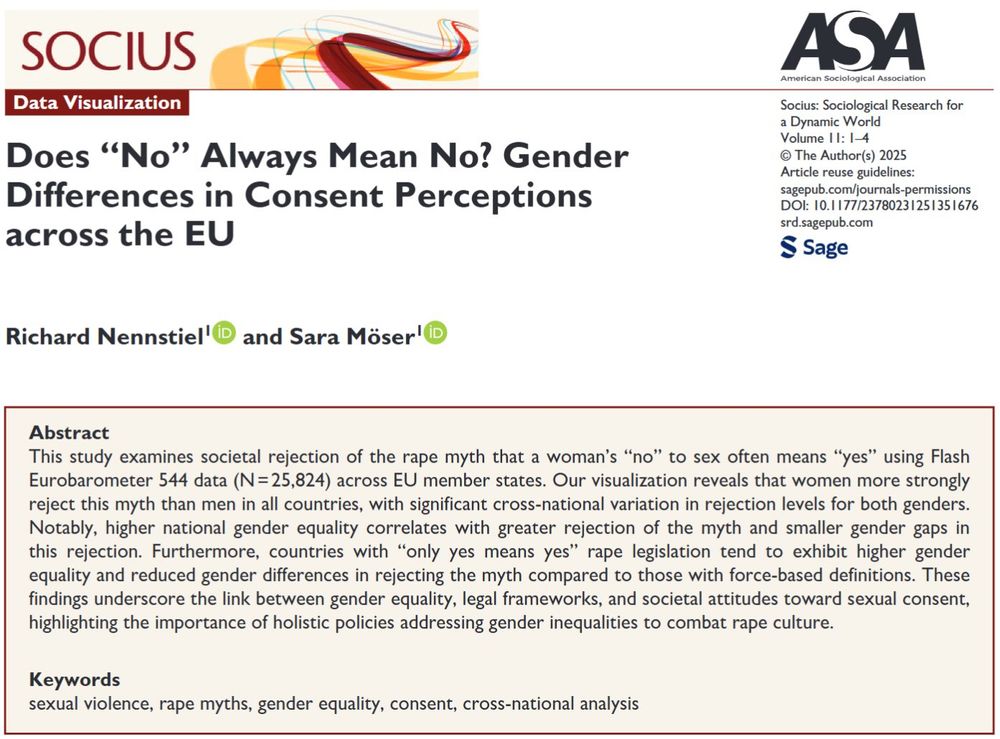
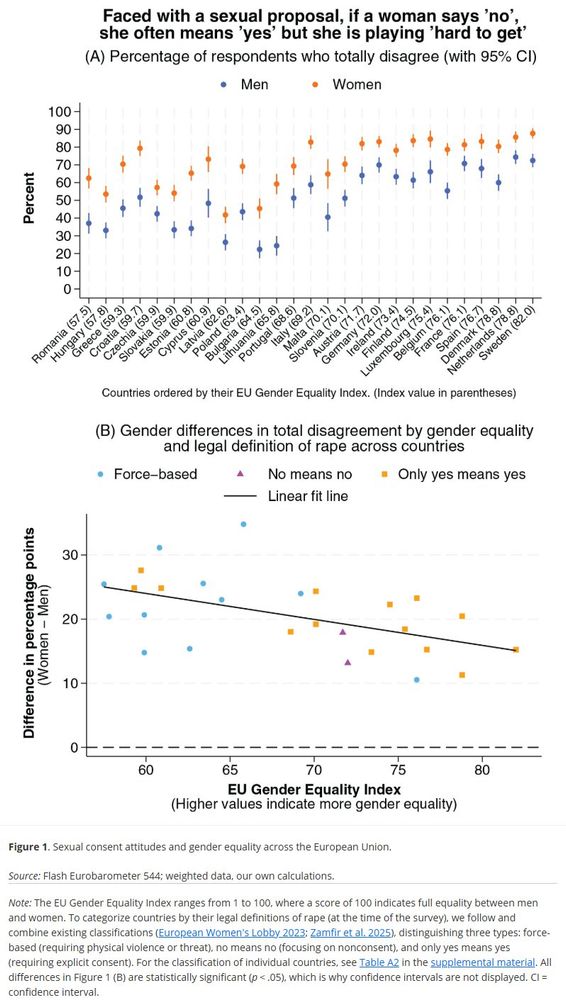
Drs. @nennstielr.bsky.social and @saraalice.bsky.social’s #Socius study using #Eurobarometer shows men across the EU are less likely to reject “no means yes.” Rejection rises with #GenderEquality and stronger #ConsentLaws.
Read: doi.org/10.1177/2378...
📊 We use Eurobarometer 544 data from @gesis.org and the EU Gender Equality Index data from @eurights.bsky.social / EIGE to dig into consent perceptions across 25,824 respondents in the EU 🇪🇺.
👉 doi.org/10.1177/23780231251351676

Women consistently reject this myth more than men — but in countries with higher gender equality and “only yes means yes” consent laws, these gender gaps are smaller.
Published in @sociusjournal.bsky.social @asanews.bsky.social
👉 doi.org/10.1177/23780231251351676

🚨 New paper out! 🚨
We use Eurobarometer data to explore how strongly people across the EU reject the “no means yes” rape myth.
Gender gaps persist, but shrink with higher gender equality and “only yes means yes” laws.
w/ @saraalice.bsky.social l (@unibe.ch)
👉 doi.org/10.1177/23780231251351676

📊 Using ÜGK data from Switzerland
📄Published in ERVET (@springernature.com @sbfi.admin.ch )
w/ @tamaragutfleisch.bsky.social (@mzesunimannheim.bsky.social)
👉 doi.org/10.1186/s40461-025-00187-3
Women are less likely to pursue STEM in VET than men — with a gender gap of 48 percentage points (!) among those choosing VET occupations.
Existing explanations (achievement, values, self-concept) help explain gender gaps better for academic routes than for VET.
👉 doi.org/10.1186/s40461-025-00187-3
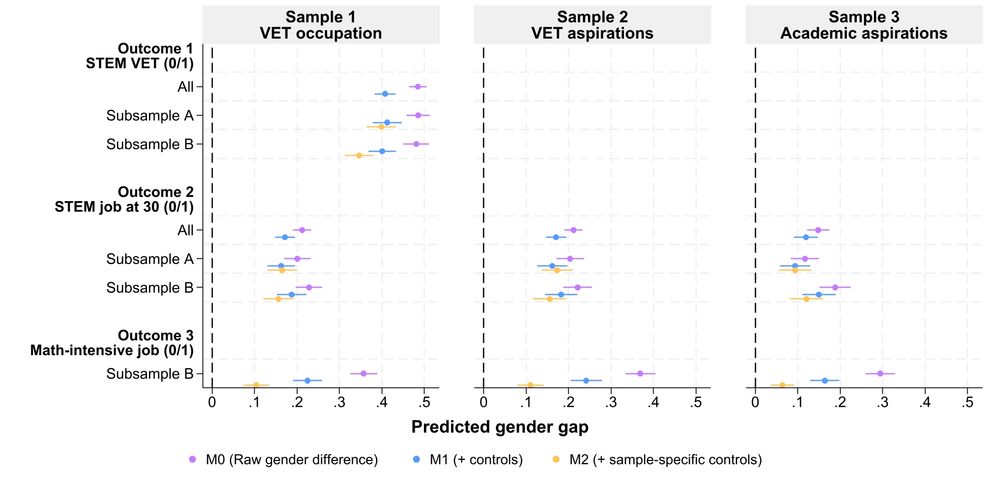

🚨 We analyze gender gaps in STEM aspirations across educational pathways in Switzerland.
Gender gaps are larger in vocational (VET) routes than in academic pathways — and existing theories explain less of these gaps among students aspiring VET.
👉 doi.org/10.1186/s40461-025-00187-3
Published in Research in Social Stratification and Mobility (RSSM), Special Issue “The Growing Gender Divide in Educational Credentials: Trends, Causes and Consequences” edited by Claudia Buchmann.
Findings highlight persistent gendered penalties despite educational gains.
👉 doi.org/10.1016/j.rs...
We use Swiss census data (1970–2000) and structural surveys (2011–2020) from @statdatach.bsky.social to study how equal educational credentials translate into unequal labor market outcomes for women and men. 🇨🇭
👉 doi.org/10.1016/j.rs...


🚨 New paper published in RSSM @isa-rc28.bsky.social🚨
We explore how gender differences in occupational status have evolved in Switzerland across five decades, as women have attained increasingly higher educational qualifications.
w/ Rolf Becker (@unibe.ch)
👉 doi.org/10.1016/j.rs...
🧠🚀 What happens when early-career social scientists use ChatGPT for academic writing? Clearer and more coherent text - but no boost to depth, originality, rigour, or literature use, according to our field experiment.
📄👇
HOW IMPORTANT IS SOCIAL BACKGROUND FOR SES? A major issue in social stratification/class mobility research is the effect of one's social origins (or class background) on socioeconomic outcomes. Our new paper tackles this question using two research designs. Preview: It's not that important.
[1/9]
Thank you! It is political ideology (measured by left-right self-placement)
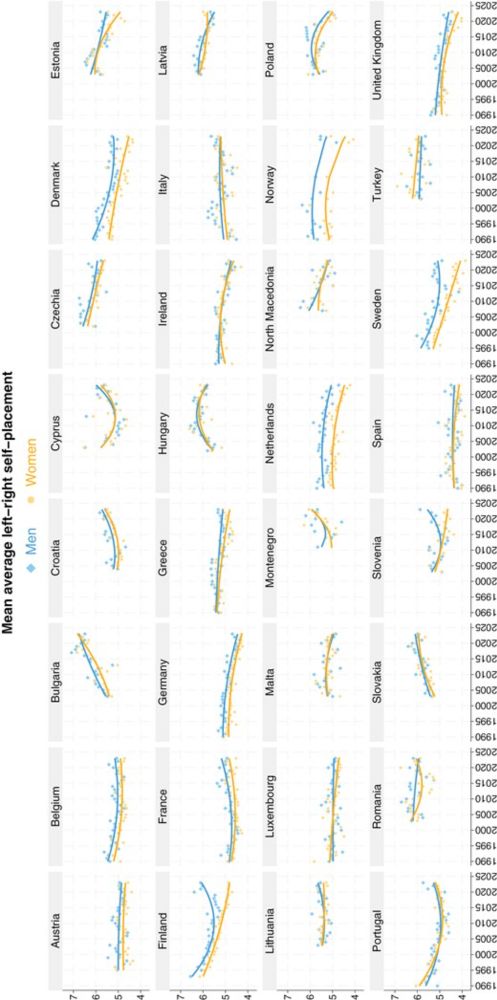
Paper on the ideology gender gap with Eurobarometer data from @gesis.org by @nennstielr.bsky.social and
@hudde.bsky.social . Most interesting finding: while young women are becoming more left-wing in 11 countries, in 5 of them young men are also becoming more right-wing (DK, FI, SE, FR and LT)
Another great reason to submit manuscripts to @europeansocreview.bsky.social 🙃
Based on over 466k respondents aged 20–29 from:
📊 #Eurobarometer surveys
📊 @ess-survey.bsky.social (European Social Survey)
We used APC models + trend graphs to unpack youth gender gaps in political ideology across Europe.
More details here 👉 doi.org/10.1093/esr/...
@europeansocreview.bsky.social