A Transport Theoretic Perspective for Nonlinear Control, Karthik Elamvazhuthi
YouTube video by GERAD Recherche
Link to my zoom talk at the GERAD Research Center, "A Transport Theoretic Perspective for Nonlinear Control":
www.youtube.com/watch?v=cXy1...
Thanks to the organizers, Aditya Mahajan, Peter Caines, and Shuang Gao for the wonderful opportunity to present and great interactions.
14.02.2026 15:30
👍 1
🔁 0
💬 0
📌 0
The generative modeling for control lectures are proceeding in nonlinear order. Here is one on a control generalization of gradient descent that I refer to as nonholonomic gradient descent. I explain why it's doomed to fail due to Brockett, and how noise might save us.
hackmd.io/pTtk6ohHSBSf...
09.02.2026 03:20
👍 0
🔁 0
💬 0
📌 0
Encoding geometry in neural network architectures has wide applications, from robots' configuration spaces to safety. We present natural ways to enforce constraints by design.
Link to preprint: www.researchgate.net/publication/...
#geometricdeeplearning
03.02.2026 02:43
👍 1
🔁 0
💬 0
📌 0
Designing the optimal slide for a lion, of course.
Also curious if you are going to be rightfully referring to the maximum principle as the Pontryagin–Boltyanskii–Gamkrelidze–Mishchenko Maximum Principle it time you mention it. 😆
29.01.2026 17:19
👍 1
🔁 0
💬 1
📌 0
What is a good source for this? And is there a non-finance analogue of arbitrage opportunities that motivates this?
24.01.2026 14:58
👍 0
🔁 0
💬 1
📌 0
All hail the Lie bracket 🙌
08.01.2026 03:47
👍 1
🔁 0
💬 0
📌 0
I’m writing notes on how generative modeling connects with control theory.
Starting with intuition: simulations, nonlinear control, and how stochastic dynamics can shape long-term behavior.
LN1 (Fokker–Planck): hackmd.io/@clopenloop/...
LN2 (Nonholonomic Fokker-Planck): hackmd.io/@clopenloop/...
24.11.2025 04:24
👍 4
🔁 0
💬 0
📌 0


The road to the maximum principle turns out to be more non-smooth than one might expect.
Boltyanski, Martini & Soltan’s book ( Geometric Methods and Optimization Problems) has far more drama than you’d guess from the Sussmann–Willems survey.
31.10.2025 17:24
👍 2
🔁 0
💬 0
📌 0


Job season in academia can take a toll on confidence, identity, and energy. You’re not alone.
Sometimes it helps to zoom out.
Hunter Wapman’s thesis highlights some interesting hiring patterns:
www.hne.golf/static/pdfs/...
Non-US trends may differ, perhaps shaping distinct knowledge bubbles.
24.10.2025 16:53
👍 4
🔁 1
💬 0
📌 0
I suspect a case of chaos or non-uniqueness. 🧐
20.10.2025 22:37
👍 1
🔁 0
💬 0
📌 0
Multi-agent control often feels like control theorists doing dynamical systems instead of control theory. What if we posed it like classic control problems.
Collective decision-making as feedback stabilizability. Turns out, it leads to a strange kind of control problem.
hackmd.io/@clopenloop/...
16.10.2025 23:10
👍 2
🔁 0
💬 0
📌 0
It’s hard enough following Stroock when he’s explaining his own perspective.😵💫
10.10.2025 05:05
👍 0
🔁 0
💬 1
📌 0

A basin of attraction
08.10.2025 16:33
👍 0
🔁 0
💬 0
📌 0
An interesting result on how LQ problems in optimal control can fail to have minimizers: arxiv.org/pdf/1311.200... (in an almost merciless way).
24.09.2025 16:15
👍 1
🔁 0
💬 0
📌 0
Naive random sampling of initial conditions and control.
21.09.2025 17:10
👍 1
🔁 0
💬 0
📌 0
Optimal Transport (OT) is emerging as a versatile tool for control questions. We show an OT-based way to sample from the reachable set (RS), especially useful when systems have strong attractors.
www.researchgate.net/publication/...
RS of Van der Pol vs. naive random sampling (below).
21.09.2025 17:09
👍 1
🔁 0
💬 1
📌 0
ACE AI and Data Talk Series-Dr. Karthik Elamvazhuthi
YouTube video by Automatic Control Engineering Network (ACE)
Finally, my YouTube debut! A recording of my talk at the AI and data seminar series organized by the Automatic Control Engineering Network.
m.youtube.com/watch?v=o-4B...
Here I pontificate on using time reversals of diffusions for stabilization and planning problems.
19.07.2025 02:22
👍 3
🔁 1
💬 0
📌 0
I am starting to compile some notes on Generative Modeling for Control Theory. The goal is to include topics such as degenerate Fokker-Planck equations (FPEs) and Optimal transport theory. Here is a first post on the classical (nicer) FPE and its long-term behavior.
hackmd.io/@clopenloop/...
30.06.2025 00:33
👍 1
🔁 0
💬 0
📌 0
That’s an amazing stat 😵
10.06.2025 12:42
👍 1
🔁 0
💬 0
📌 0
Fun tangential fact: The idea of velocity-averaging in the flow matching can be found in Lacker's notes on mean-field control. He refers to it as "mimicking".
05.06.2025 03:45
👍 1
🔁 0
💬 0
📌 0

Probably a good chapter if it starts with Nietzsche.
- Tanja Eisner, Bálint Farkas, Markus Haase and
Rainer Nagel (Operator Theoretic Aspects
of Ergodic Theory)
05.06.2025 00:28
👍 0
🔁 0
💬 0
📌 0
I like how some inequalities were derived for fun. 😄
03.06.2025 13:56
👍 1
🔁 0
💬 0
📌 0

Universal Approximation of Mean-Field Models via Transformers
This paper investigates the use of transformers to approximate the mean-field dynamics of interacting particle systems exhibiting collective behavior. Such systems are fundamental in modeling phenomen...
Permutation equivariance is a common property of multi-agent systems. In a new paper with Shiba Biswal and
@rishisonthalia.bsky.social
, accepted to ICML, we leverage this property shared by transformers, for mean field models of collective behavior.
#machinelearning
arxiv.org/abs/2410.16295
30.05.2025 03:50
👍 3
🔁 1
💬 0
📌 0

Analysis of Heat Equations on Domains. (LMS-31)
A reference for Markov semigroups that I have found extremely useful.
press.princeton.edu/books/hardco...
24.05.2025 15:28
👍 2
🔁 0
💬 0
📌 0
People are talking about controls in Bluesky?! Where?
23.05.2025 17:44
👍 0
🔁 0
💬 0
📌 0
Nice timeline! Adjoint equations arose in optimal control of finite dimensional ODE systems initially due to Pontryagin and coworkers extending methods of calculus of variations. Lions popularized them for infinite dimensional systems like PDEs.
21.05.2025 14:24
👍 1
🔁 0
💬 0
📌 0
A linear test for global nonlinear controllability
It’s known that the Laplacian operator, describing how heat flows through a domain, carries rich information about the domain’s underlying geometry. Similarly, one can understand the geometry of a control system using its sub-Laplacian.
See
comptes-rendus.academie-sciences.fr/mathematique...
20.05.2025 23:39
👍 0
🔁 0
💬 0
📌 0
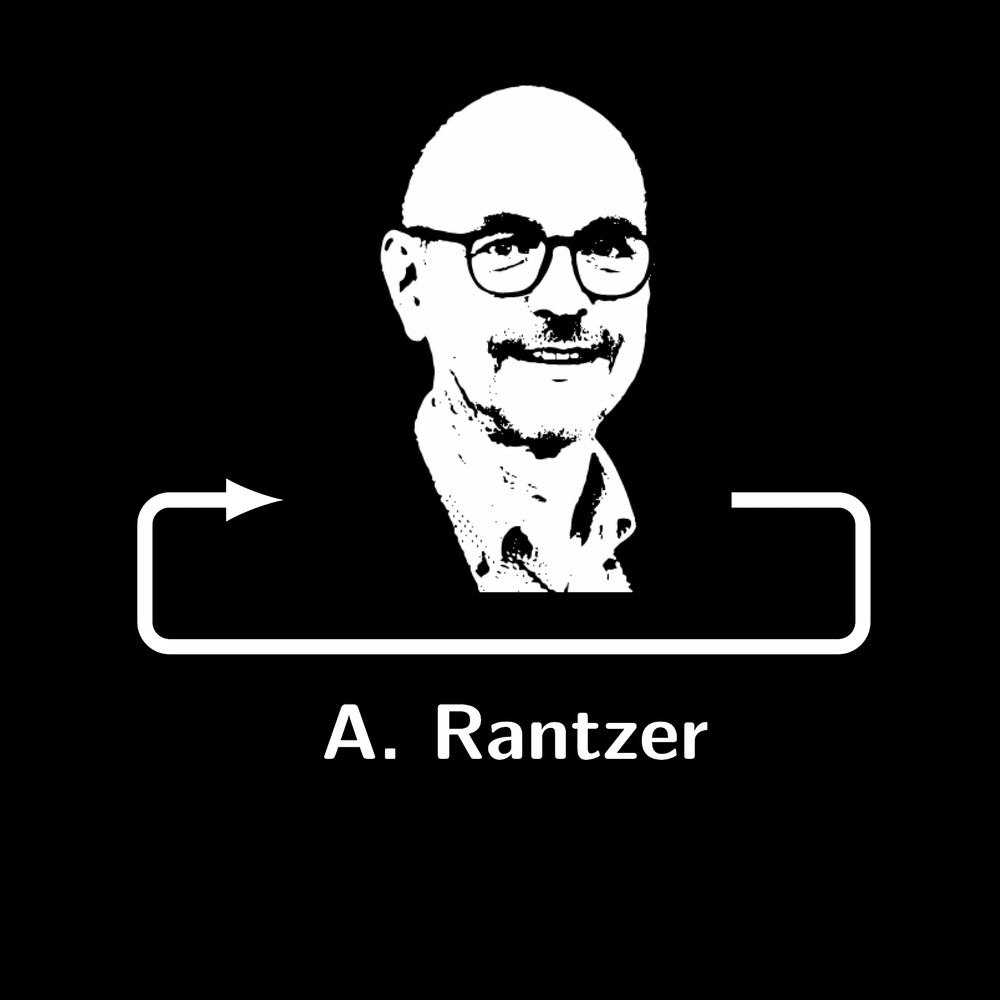
🎙️ New episode! Anders Rantzer (@lunduniversity) walks us through robust control, IQCs, the KYP lemma, nonlinear and hybrid systems, scalability and positivity, and dual (adaptive) control. A journey shaped by the dialogue between Western and Russian control traditions — don’t miss it! 🧠🚀
16.05.2025 17:01
👍 3
🔁 1
💬 0
📌 1


