
📢 Counting on Citizens: Unveiling Butterfly Diversity Through 30-Minute Counts biss.pensoft.net/articles.php... #LivingData2025
19.01.2026 22:06
👍 0
🔁 0
💬 0
📌 0
📢 Counting on Citizens: Unveiling Butterfly Diversity Through 30-Minute Counts biss.pensoft.net/articles.php... #LivingData2025
CSUN Researchers Call for Public’s Help in Documenting Joshua Trees’ Surprise Out-of-Season Bloom 🌿
newsroom.csun.edu/2025/12/16/c...

Graphic with black background featuring green silhouettes of diverse organisms including a crane, dragonfly, bear, spider, snake, jellyfish, starfish, lizard, mushrooms, butterfly, scorpion, snail, coral, cattails, and insects. White text reads "HELP US IDENTIFY" at top and "UNKNOWNS" at bottom.

Slide with black background and white text explaining that anyone can help with identifications on iNaturalist by sorting unknown observations — defined as observations uploaded with no identification at all. Below shows a screenshot of the iNaturalist Identify interface displaying a grid of thumbnail photos all labeled "Unknown."

Slide titled "WHAT YOU CAN DO" with three tips: add broad IDs like "Plants," "Insects," "Birds," or "Fungi"; start with what you recognize (example: ID a dragonfly as "Dragonflies"); and skip anything you're unsure about. Below shows an iNaturalist screenshot of a dragonfly observation being identified at the suborder level, with the Identify menu option circled in the navigation bar.

Slide stating "You can contribute identifications from any computer, anywhere in the world" with a call-to-action link tr.ee/identifyweek1. Below shows the iNaturalist Identify filters panel with the "Unknown" category icon and "Filters" button circled in green, highlighting how to find unidentified observations.
All you need to help make identifications on iNaturalist is a computer! Join our first-ever ID-a-thon and build your nature-identification skills — this week, we'd love your help sorting Unknown observations into broad categories. Learn more: tr.ee/identifyweek1


📢 45 extended #conference #abstracts already made publicly & permanently available in the #LivingData2025 conference collection in our #journal!
💡Browse them by session to revisit the 2025 joint event by @tdwg.org, @gbif.org, @obis.org & @geobon.org!
biss.pensoft.net/collection/5... 🔓

A beautiful taxidermy leopard lays comfortably on a branch in a diorama display in the "Fierce! The Story of Cats" exhibition on view at the Natural History Museum of Los Angeles County.
From Fierce felines to Dueling Dinos and some of the most spectacular minerals ever Unearthed, there’s so much to see this season!
🐾 Spend your 𝙥𝙖𝙬lidays with us! Plan your visit today: NHM.org

This is unusual, but it's not unheard of! There was a late-season bloom in and around Joshua Tree National Park in 2018/2019. A study by a team including @vijaybarve.bsky.social analyzed iNaturalist records and concluded it was cued by an unusually cool, wet fall doi.org/10.1038/s415...

India is one of the most biodiverse & unique countries on Earth, with high levels of endemism & evolutionary distinctiveness, yet its biodiversity is still poorly understood. It is important to make biodiversity research available to all, starting with collections 👇 🌍

Photograph of Panshak Solomon in the field
PhD student Kumdet Panshak Solomon of #Nigeria has been named as a 2025 GBIF Graduate Researchers Award winner! 🥳
🐦 Panshak’s research advances biodiversity informatics in West Africa by leveraging GBIF-mediated data collected through BirdPlus 📲
🔗: gbif.link/GRA_panshak

Photograph of Esteban in the field
Master's student Esteban Marentes of #Colombia has been named as a GBIF Graduate Researcher's Award winner! ⭐
🪲Esteban’s research focuses on using machine learning models to predict beetle species diversity across Colombia’s Antioquia province. 🌎
🔗: gbif.link/GRA_esteban

Group shot of people at the GBIF global nodes event

Branching out, one buddy group at a time 🌱💡
At the Global Nodes Training, collaboration grows when knowledge takes root 🌳
Featuring 📷 group highlights from the past days
#Bogotá #Colombia #SiBColombia

signatories to the joint strategy

group shot of GBIF and OBIS communities at Living Data 2025
🌊 Seas the day!
Today at #LivingData2025 GBIF and @obis.org renewed their Joint Strategy for Marine Biodiversity Data which enhances collaboration between OBIS and GBIF nodes and facilitates opportunities for training and aligned documentation.

A collage of images from the GBIF global nodes training
💪Train today, mobilize data tomorrow ⚡
Delegates from around the world at the Global Nodes Training are participating in modules organized by the GBIF Community and Capacity team and led by subject-matter expert trainers.
#Bogotá #Colombia
We are thrilled to announce that the data gathered during the Bisle Frog Watch from 2012 till 2025 has been published on @gbif.org The Global Biodiversity Information Facility! Thanks to @vijaybarve.bsky.social for making this happen & Bharata for organising it all. See
www.gbif.org/dataset/db53...

New paper alert! Worked with an incredible group of scientists across fields on this vision for much needed investment in Indian natural history collections:
Linking eras and data: natural history collections as the foundation of India’s biodiversity science url: academic.oup.com/biolinnean/a...


Northern Cardinals in #Gainesville, #Florida today.
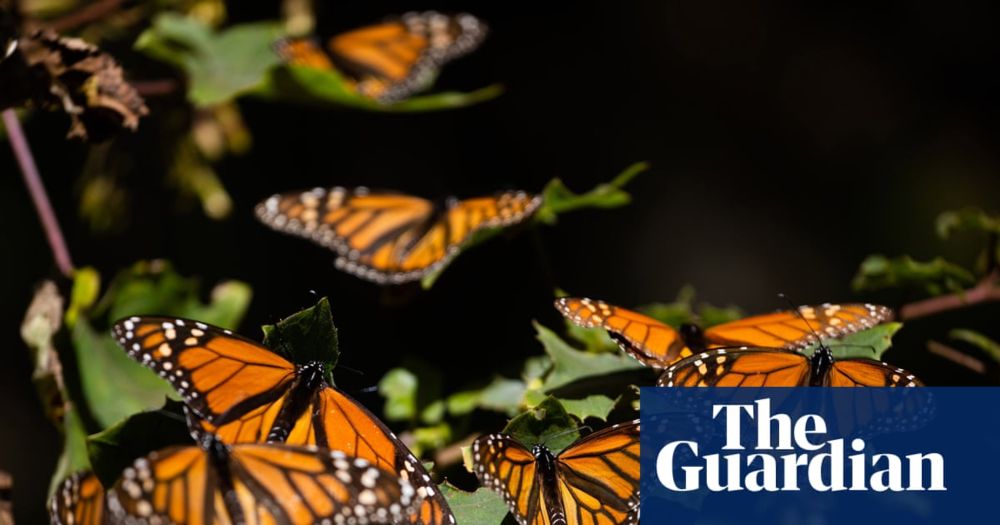
Pesticide residues found in butterflies during the 2024 western Monarch population crash.

The Carolina Wren (Thryothorus ludovicianus) is a common resident throughout the Eastern United States and one of the most frequent encounters here in #Gainesville, #Florida. myencounterswithnature.blogspot.com/2025/07/caro...

Banana slugs are also romantics at heart. Slugs are hermaphrodites, and they reproduce by exchanging sperm with their mate, but banana slugs sometimes spend hours in foreplay before doing the deed. Sometimes, their penises get caught, and they have to use their radula to chew themselves out of the embrace. By Andy Goryachev/Wikipedia.
🍌 These slugs are a pretty big deal (literally and figuratively)! Just in time for Snail Search 2025, California finally has a state slug: 𝘼𝙧𝙞𝙤𝙡𝙞𝙢𝙖𝙭, a.k.a. the banana slug. bit.ly/CAStateSlug

Please share. We are #hiring #PhD students to work on #citizen #science, #insect #migration, or #insect #conservation. If interested, please email me. You can find more about our research interests and contact information here. shawanchowdhury.com.

drawing of a stingray with the text data use club overlaid
⏰ There's still time to register for our upcoming #DataUseClub practical session - Data standards & processing!
📍 Wed 12 Feb 2025 15:00-16:30 CET (this event will be recorded).
🔗 gbif.link/datauseclu...
#Biodiversity #Data #FreeEvent

Do you think butterflies are beautiful? You can help researchers at the University of Florence understand why by taking this online quiz. It only takes a few minutes. Thanks in advance www.unveiling.eu/en_US/

I think this is the first ever iNaturalist based bioblitz to be held in Sri Lanka. Diyasaru Park is on the east side of Diyawanna Lake. As a child I knew the area on the opposite side that was converted into the Beddagana Wetland Park.
www.inaturalist.org/projects/cit...
cream coloured graphic with a drawing of a stingray
Registrations are open for our next Data Use Club practical session - Data standards & processing!
📍 Wed 12 Feb 2025 15:00-16:30 CET. This event will be recorded.
🔗 gbif.link/datauseclu...
#DataUseClub #GBIF #Biodiversity #Data #FreeEvent

Hearing from @er1ngrady.bsky.social, science grad student as part of @inaturalist.bsky.social event today.
We will hear from @vijaybarve.bsky.social + Jeremy Yoder. (archive will be on youtube here )
Phenology is the timing of #seasonal changes in plants and animals
www.youtube.com/watch?v=CZGp...

Register for this @inaturalist.bsky.social webinar next Wednesday to learn about annotating phenophase— buds, flowers, or fruits on a plant you're observing with the app— and how researchers use that data, with examples from @vijaybarve.bsky.social and me!
us06web.zoom.us/webinar/regi...

Publication!🚨@zookeys.pensoft.net published an 167-page guide to marine isopods in the Southern CA Bight. This paper covers 190 species of isopods & is an organized biodiversity resource that will allow for scientists to better monitor the SCB. @nhmla.bsky.social zookeys.pensoft.net/article/1003...


Sea stars are excellent at regenerating. Most can grow back a lost arm, & some species can grow an entire body back from a severed arm! ⭐️ But even these stars of regrowth make mistakes. Regeneration errors cause some individuals to have 1 too many or 1 too few arms.
@myfwc.bsky.social
That is a beautiful collection. 😍
To avoid males as much as possible, female Rocky Mountain Parnassians don’t fly much. Instead, they spend most of their time running around on the ground!
Douglas County, Colorado, USA
cream coloured graphic with a drawing of a stingray. text overlaid reads data standards and processing
Going to other clubs: 😵😒🍹
Going to GBIF clubs: 😎💚🧬#DataUseClub
Registrations are open for our next Data Use Club practical session - Data standards & processing!
📍 Wed 12 Feb 2025 15:00-16:30 CET. This event will be recorded.
🔗 gbif.link/datauseclu...
#FreeEvent #Webinar #Biodiversity
