
About 25 little orange and brown bugs on a red and green Eucalypt leaf. Each nymph has made its own white fan or shell shaped shelters. They suck nutrients under the leaf. The birds love to eat the lerps and the bugs underneath and you can hear quite a satisfying crack sound as they forage.
Psyllids are quite underrated #insects. They are tiny leaf dwellers and some make elaborate sugary shelters (lerps). These are Cardiaspina sp. nymphs with their intricate fan-shaped covers. #Tasmania
01.03.2026 21:23
👍 24
🔁 8
💬 0
📌 0

A cute mainly black bee with yellow blobs on its face legs and back. It has a lot of long white hairs. It is resting on a green leaf. Side view.

A cute mainly black bee with yellow blobs on its face legs and back. It has a lot of long white hairs. It is resting on a green leaf. Face view.
The European wool carder #bee has been extending its range this summer. Its Australian (Victorian) arrival was written up in 2020. There have been a number of sightings around Launceston and tonight they appeared in our Hobart garden. They love the Lambs Ear plant. #Tasmania #feral
06.01.2026 10:38
👍 6
🔁 2
💬 0
📌 0

A shiny metallic green jewel beetle, on a face on but angled photo. The eyes are black and the wings are covered with orange waves. A bit like an upside down ? followed by a ˜on each elytra. The beetle is on white Ozothamnus flowers.
The slightly pensive look of Castiarina flavopicta, a Tasmanian Jewel Beetle. #invertefest
25.12.2025 07:17
👍 76
🔁 16
💬 0
📌 1

A black male flower wasp watching me from a curved eucalypt leaf. The leaf is well chewed and the veins and leaf margins are pink. The flower wasp is fringed with golden hairs and has quite long antennae. He was probably waiting for a wingless female to crawl out of her burrow and start calling to him with pheromones. He then picks her up to mate on the wing.

Close up of the head and thorax of the wasp. The eyes are overall dark grey but made up of black and lighter grey checkerboard patterns.
Some of the male flower wasps have mesmerising checkered eyes. #thynnidae #insect
22.12.2025 04:45
👍 2
🔁 1
💬 0
📌 0

True Bugs by Colour
True bugs (Hemiptera) come in a huge diversity of body forms; from flat looking blobs to metallic beetle like insects. They all have sucking mouthparts. Click on the colours that are closest to the ...
"True Bugs by Colour" is now up and running after a year of preparation. We have around 250 named species of Hemiptera and they are now sorted into a rainbow of shades. We hope it helps you track down the name of one of your locals!
tasmanianinsectfieldguide.com/hexapoda/ins...
13.08.2025 02:46
👍 11
🔁 5
💬 0
📌 2
Thank you! I hope it's useful.
08.07.2025 05:13
👍 1
🔁 0
💬 0
📌 0

Side view of a thin and hunched leafhopper, about 6-7mm long. The rudimentary wings are beige but the rest is dark brown with pale hairs all over. The visible eye is very large and almost has a "brain fold" pattern of dark brown over green/cream. This was on the rim of a sample jar.

Top view of the hunched leafhoppe. It's about 6-7mm long. The rudimentary wings are beige but the rest is blotchy dark brown with pale hairs all over. The eyes are very large and almost have a "brain fold" pattern of dark brown over green/cream.
Taslopa montana is a fairly ungainly looking leafhopper. Adults can either have wings, or not, so I'm not sure how to decide when a nymph has reached the adult form.. #Tasmania #Hemiptera #InverteFest
27.04.2025 01:32
👍 8
🔁 0
💬 0
📌 0
Wow! Thanks so much!
26.04.2025 02:03
👍 1
🔁 0
💬 0
📌 0

A macro of a full body view of a beige maggot. It is very small, slim lined with a slightly hardened head bearing orange jaws. The tail end is more interesting with 4 feathery prongs. You can see a few internal organs on the last half of the body.

Detail of 3 of the four hairy prongs at the end of the body.
A little more unusual for us is a freshwater fly larva (maggot). Found in a creek at Montrose #Tasmania. Hopefully someonewill recognise where it belongs in #Diptera #InverteFest
25.04.2025 10:39
👍 25
🔁 2
💬 1
📌 0

Face on view. The fly has large brown eyes but most of the rest is orange, including the legs. The mouthparts are a heavy triangle shape.

Side on view of the fly. It has colourless wings, folded down the body, its back and legs are bright orange, apart from a patch of black on its back and large dark eyes. The legs are very bright orange. The main body has white hairs on the underside but the legs have orange hairs.
Another amazing Tasmanian fly, Deineches nudiventris. This is a hoverfly that seems to be a bit prone to getting trapped indoors in early March. It's about 2cm long. #Diptera #Tasmania
12.04.2025 03:25
👍 8
🔁 2
💬 0
📌 0

Side view of a small honey brown coloured beetle on a reddish leaf blade.

Top view of the honey-brown, oval beetle pointing down the image. The pronotum (thorax) is purely honey brown. The elytra (wing covers) have a base colour of honey brown but a three lines of black and two cream in the top half, two upside down Vs of balck in the middle, and a band of cream at the wing tip. It is on a browning leaf (I think it was Pandani).
It's so exciting to add our own images of the endemic #Tasmanian leaf #beetle Ewanius nothofagi to our website. It's the only leaf beetle in Tasmania that feeds on Myrtle. Identification thanks to Martin Lagerway. Mount Field National Park, January.
10.03.2025 22:56
👍 4
🔁 1
💬 0
📌 0

A side view of a small beige and black striped fly sitting on a deep green leaf. It has very pointed antennae and lots of hairs covering the body. The hairs come from very neat little puncture marks across the body. The eyes take up most of its head. Frankly, I think the neat little punctures are a highlight. There are more leaves in the background.
A snipe #fly Atherimorpha sp. on the Lake Dobson Circuit in mid-January. #Tasmania
09.03.2025 03:39
👍 11
🔁 2
💬 0
📌 0

A brown, bullet shaped Ptinid beetle with one orange mite on its head and 4 on the one of the outer wings. The mites are very large for the size of the beetle, probably 1/8 the length. The beetle was attracted to light on a window at night, so the background is black from the flash photo.
Beetles are strong fliers. Mites, however can only crawl. So that mites can travel further afield, they often hitchhike on beetles (phoresy). When the beetle lands somewhere favourable, the mites crawl off. These are sejine mites on a Ptinid beetle. January, Bruny Island #Tasmania
08.03.2025 21:38
👍 6
🔁 0
💬 0
📌 0
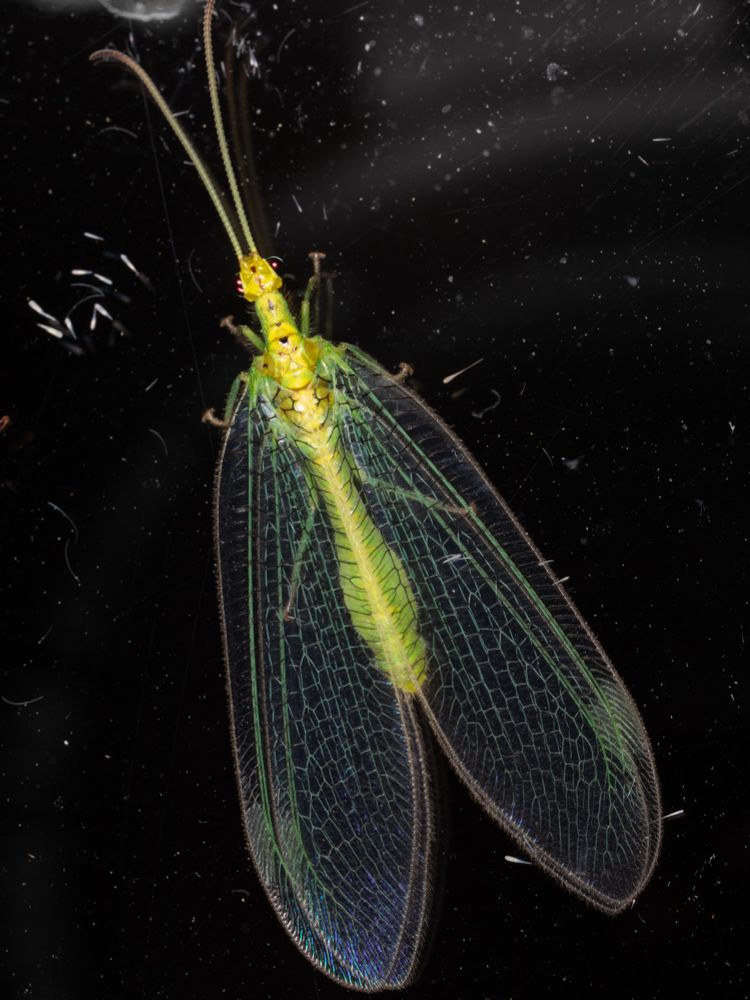
A green lacewing taking up the whole image. It was attracted to window light so the background is all black. The lacewing's body is mainly yellow and lime green. The wing nets are green and wing margins are black. The reflective eyes appear maroon. There are light black markings on the centre of the head and thorax.
The #lacewings are the sign of summer. This is not-your-usual green lacewing (Family Chrysopidae), it is one of the split-footed lacewings (Family Nymphidae). These catch me out every time! Osmylops sejunctus.
07.03.2025 05:39
👍 3
🔁 1
💬 0
📌 0

A beetle on a branch. The beetle is central to the photo and is facing right. the Head portions are black with golden hairs and the elytra (wing covers are a dark brown, fringed black and covered in lines of golden hairs. Tasmania does brown and hairy very well ;-)
Not so pretty is one of our #Tasmanian endemic scarab #beetles. Phyllochlaenia villosus
05.03.2025 23:54
👍 5
🔁 1
💬 0
📌 0

Side view of the front half of a metallic green damselfly. Between the segments there are orange lines. The eyes are brown. It is resting on a thistle, shown the right of the photo.

Overhead (dorsal) view of the front half of a metallic green damselfly. Between the segments there are orange lines. The eyes are brown. It is resting on a thistle, shown the top of the photo.
We don't often add fresh images of Odonatans. Our lenses need to be too close to the insects, and the fast fliers don't tolerate us. This #damselfly was chilled in the early morning air and was happy to pose for a few different angles. A female Metallic Ringtail (Austrolestes cingulatus). #Tasmania
05.03.2025 23:45
👍 8
🔁 2
💬 0
📌 0

A small black wasp foraging on a fallen, hole riddled gum tree trunk. This photo is selected to show some of their habitat.

Detail of the small black wasp. Its antennae are attached low on the head. Its black eyes have notches on the inside, which helps to narrow down that this wasp belongs in Pison. The timber it is on is dry and rust coloured on the rotted inside, silver on the outside.
Pison sp. These are not the most glamorous of #wasps but they work through crevices and holes and collect up live spiders to use as food for their own larvae. Fascinating lives and really important bio-control agents. Lucky people may find similar species building mud nests on brick walls.
28.02.2025 02:07
👍 5
🔁 0
💬 0
📌 0

A fly with long orange and black legs. The head and thorax are also black. In this photo you are looking just slightly on an angle to overhead. The wings are orange at the top, then barred black with 3 broad clear windows. it is on a leaf and its feet are just looped over the leaf margins.
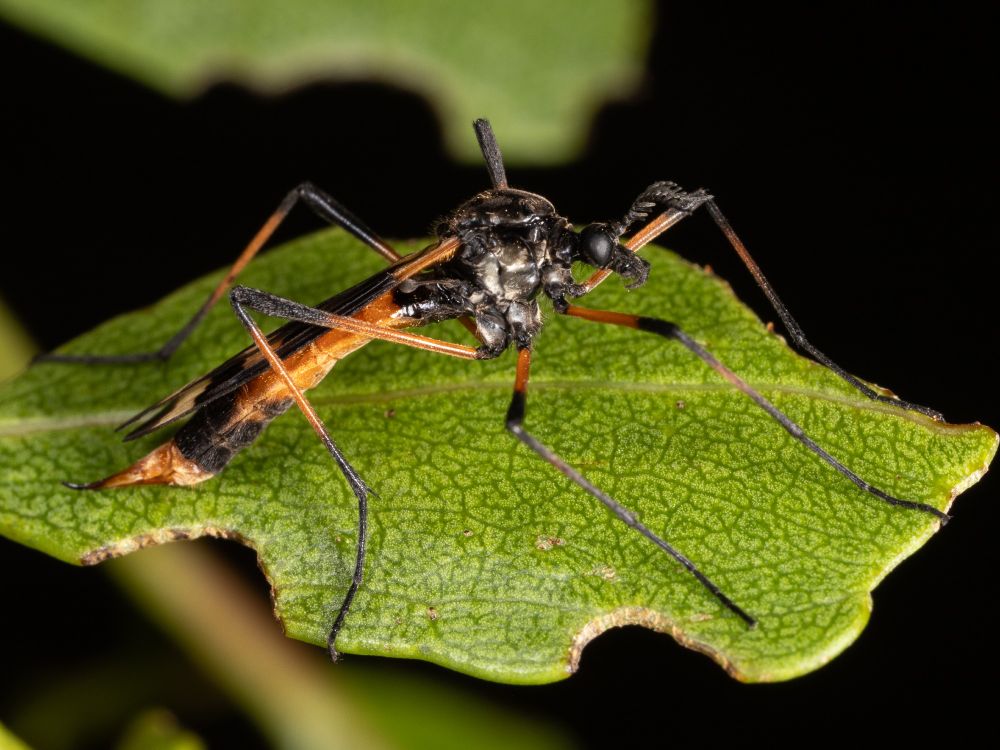
A fly with long orange and black legs, photo taken on the side. the head and thorax are mainly black. The thorax has some silvering at the sides. The antennae are quite feathery. The abdomen is long and mainly orange with a black join the the thorax and a couple of black segments close to the tip. There is an orange and black ovipositor.
Gynoplistia cf. bella. A very pretty short-palped crane #fly. You can see this is a female as she has a long ovipositor to lay eggs. She also has quite subdued antennae when compared to a male which has longer "reindeer-like" flanges. You find these near damp places. This was at Penstock Lagoon.
15.02.2025 04:23
👍 2
🔁 0
💬 0
📌 0
(Note that it is possibly a similar species from that genus which isn't endemic!)
23.01.2025 06:21
👍 1
🔁 0
💬 0
📌 0

Side view of a bright yellow glossy wasp with lots of caramel stripes down its segments. It is standing on a brown leaf.

Face on view of the yellow wasp. Its a skinny native, not bulky like the European wasps. The large eyes are a caramel brown, and a largely bright yellow head. The long antennae are black and the forelegs are bright yellow.
How can anyone dislike a native wasp? This Ichneumon #wasp (Theronia steindachneri) parasitises other invertebrates - a natural biocontrol agent. Buckland, Tasmania.
23.01.2025 06:16
👍 12
🔁 5
💬 0
📌 0

A mating pair of orange/brown craneflies. The photo angle is lateral and the male is pointing up, the female pointing down, with only their genitals touching (I couldn't think of a better way to phrase this, sorry). The male has a more consistent orange/brown body very long antennae. The female is bulkier in general but with more black along her body. Both have very long legs that don't fit into the frame of the photo.

A mating pair of orange/brown craneflies. The photo angle is from the top and the male is pointing to the left, the female pointing to the right, with only their genitals touching (I couldn't think of a better way to phrase this, sorry). The male has a more consistent orange/brown body very long antennae. The female is bulkier in general but with more black along her body. Both have very long legs that don't fit into the frame of the photo, and the long wings that are held perpendicular to the body is also cut off in the photo frame.
These #Tipulidae craneflies must surely be some of the longest of our #Tasmanian endemic #fly species. The legs were way too long to fit into the frame.
13.01.2025 21:39
👍 7
🔁 4
💬 2
📌 0

The male with its huge purple and green-yellow striped eyes that are so close together that they join at the top. This photo is face on so that you can compare the male and female eyes.
And I realised that I hadn't actually posted a face-on angle of the male for comparison!
13.01.2025 21:30
👍 5
🔁 1
💬 0
📌 0

The face of a female of the same species. The eyes are more finely striped purple and yellow-green than the male. They also have a big "Forehead" separating the eyes. The male eyes are so close together that they touch at the top. The gap between the eyes is beige/white with black dots all over them.
The female. Unfortunately it wasn't noticed at the time and only this photo was taken. Fortunately it showed the face full on and you can see how much more widely spaced the eyes are.
13.01.2025 06:39
👍 4
🔁 0
💬 0
📌 0

A side view of a fly, slightly smaller than your usual blowfly on a fluffy cottony flower bud. The eyes are large and striped purple and yellow-green. The thorax is fine rippled stripes of black and beige on the back, and the "tummy" is fluffy straw yellow. The thorax is black, orange and hairy.

A almost undrside view of a different male fly. It's lightly smaller than your usual blowfly on a white flower. The eye is just in view and is large and striped purple and yellow-green. The mouthpart is really thick and long. The thorax is fine rippled stripes of black and beige on the back, and the "tummy" is fluffy straw yellow. The thorax is dotted black on orange and beige.
These Stomorhina sp. #flies are unusual finds in #Tasmania. The Tasmanian Bushland garden at Buckland had plenty just after Christmas. These are two different males. Females have their crazy eyes slightly wider apart. #Diptera
13.01.2025 06:34
👍 12
🔁 2
💬 2
📌 0

A small butterfly with black and white striped antennae. The wings have broad brown borders and orange triangles inside. There is a coating of green tinged metallic scales across the thorax and upper wings. Buckland, Tasmania.
The Bright Copper is a bit too big for the lens, but worth noting here because we rarely photograph butterflies. The lenses we tend to use need to be very close to the subject and butterflies don't tolerate invasion of their personal space. They have to be unusually placid for us to have any luck!
12.01.2025 23:45
👍 11
🔁 2
💬 0
📌 0

A coppery brown beetle with a fairly black head and legs. It was on small white florets with brown looking stamen.
The honey brown beetle (Ecnolagria rufescens) is usually a fairly easy summer find around the state. It's also distributed from South Australia, right around the coast of the eastern states up to northern Queensland.
11.01.2025 06:50
👍 3
🔁 0
💬 0
📌 0

A pair of stocky brown weevils about to mate. They are red-brown all over and have large, dark brown eyes. They are on tough, well chewed Eucalypt leaves.
The adults. These would be one of the most easily spotted Tasmanian weevil species.
02.01.2025 22:45
👍 5
🔁 0
💬 0
📌 0

An early stage weevil larva. It looks like a bright yellow glob of something unpleasant. It has a slug like shape with no legs, and is covered by pinpoint black spots. The highlight is a knotted tangle of black "poo string" at the tail end.

An older weevil larva that has the same shape as the earlier photo but is now a darker olive green. This poo sculpture is more spiral.
How can an ugly beetle larvae make themselves look even more unpalatable? Gonipterus weevil larvae carry flamboyant flags of poo as an effective turnoff.
02.01.2025 22:42
👍 6
🔁 1
💬 1
📌 0

One of the older larvae on a gum leaf. This has a caterpillar shape but the legs are tougher. It's largely yellow but has a black head, and last segments and a long black line running down most of the middle

A group of 6 younger stage larvae that lack the black central stripe. The one on the far right has its back end up and defensive glands pushed out.
The very hungry stage of a leaf #beetle Paropsisterna cloelia. These larvae cluster together for safety initially but can also defend themselves by oozing hydrogen cyanide, benzaldehyde and glucose from lumpy terminal glands. The larvae on the outer position takes the defensive lead for the team.
02.01.2025 05:21
👍 3
🔁 0
💬 0
📌 0
🤣 you can't miss them ;-)
05.12.2024 08:57
👍 1
🔁 0
💬 0
📌 0
