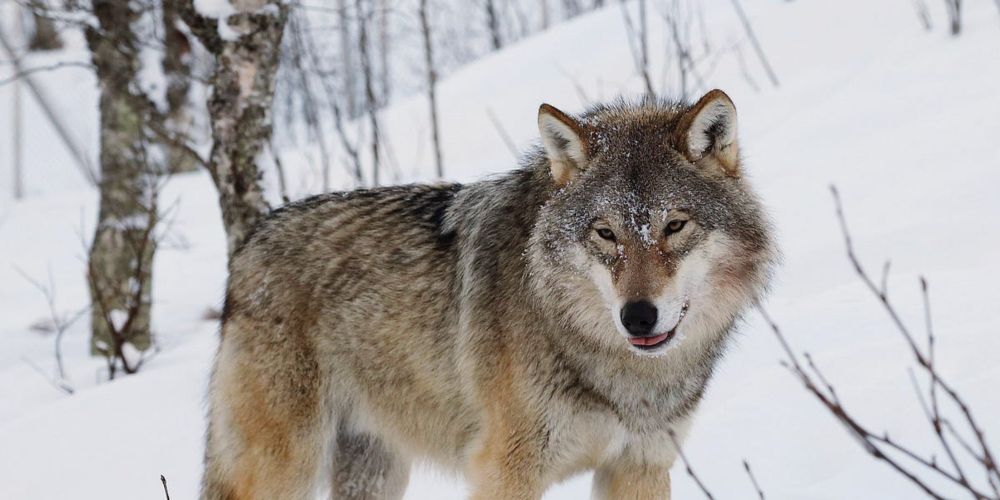
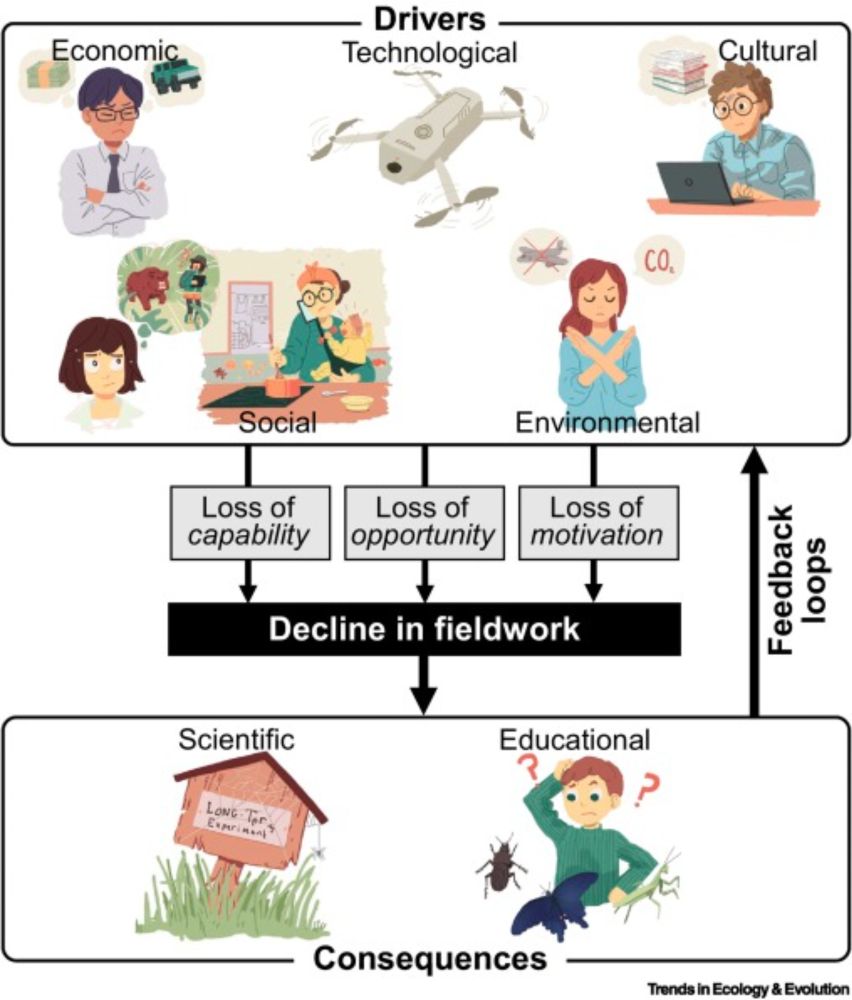
Heritability of intrinsic human life span is about 50% when confounding factors are addressed
How heritable is human life span? If genetic heritability is high, longevity genes can reveal aging mechanisms and inform medicine and public health. However, current estimates of heritability are low...
Heritability = a statistical description of sources of interindividual variation in a specific set of people under a specific set of environmental conditions. It doesn't index a fixed underlying feature of human biology. A few lines in this paper acknowledge that but its overall framing may mislead.
30.01.2026 15:36
👍 38
🔁 11
💬 1
📌 1
Vital point, often lost:
"As the team notes, the heritability of any trait isn’t a fixed number that is true for everyone, everywhere, anytime. Rather, it applies to only a specific population in a specific environment."
30.01.2026 13:11
👍 31
🔁 9
💬 2
📌 2
one of the coolest things about ChatGPT is how you can actually just never use it. you can fill your whole entire life with simply not once using it. it's incredible.
25.11.2025 16:15
👍 23057
🔁 6614
💬 249
📌 285

Forskare: ”Den största vetenskapliga krisen någonsin”
Falska, massproducerade och AI-genererade forskningsartiklar skapar en vetenskaplig kris, menar forskare. En ny plan i fyra punkter ska komma åt problemet.
www.dn.se/varlden/fors...
Just nu pågår ”den största vetenskapliga krisen någonsin” som riskerar att urholka grunden för och förtroendet för forskning. I dag presenteras Stockholmsdeklarationen av Dan Larhammar m fl för att komma åt problemet.
05.11.2025 06:29
👍 39
🔁 18
💬 2
📌 0
Agree 100 %. So fun and challenging to teach these brilliant minds!
23.10.2025 21:49
👍 1
🔁 0
💬 0
📌 0
Grattis!
21.10.2025 18:53
👍 1
🔁 0
💬 0
📌 0
Confused writing is usually a symptom of confused thinking. As we struggle to clarify writing, we clarify our thoughts. AI writing aids rob us of that struggle, leaving clean-looking text and thoughts still confused for lack of inspection. Writing is not just a product; it is a diagnostic tool.
05.09.2025 15:20
👍 396
🔁 126
💬 6
📌 15
Opulens - Sveriges dagliga kulturmagasin
Sveriges dagliga kulturmagasin
www.opulens.se
Jag försöker reda ut lite om det här med arv och miljö, samt den nyfunna vurmen för eugenik.
18.07.2025 17:19
👍 0
🔁 0
💬 0
📌 0
On the other hand, Lewontins view of British ecology is on par with this. But funnier.
01.07.2025 17:11
👍 0
🔁 0
💬 1
📌 0

“On the tendency of Species to form Varieties” paper by Wallace and Darwin originally published in the Journal of the Linnean Society of London, Zoology. Read on 1st July 1858 at the Society.

Portrait of Darwin (1809-1882) commissioned by the Society in 1883 which can be found in the Society’s Meeting Room.

Portrait of Alfred Russel Wallace (1823-1913).
Today marks a special anniversary for us. On July 1, 1858, the theory of evolution by natural selection was first presented at a Linnean Society meeting. Papers written by Charles Darwin & Alfred Russel Wallace were read, shaping a groundbreaking idea still powering science today: buff.ly/uBdX7N1
01.07.2025 14:54
👍 97
🔁 42
💬 1
📌 2
Mycket bra!
03.05.2025 10:18
👍 1
🔁 0
💬 1
📌 0

Farshid Jalalvand: Nej, det finns ingen jättevarg
Några gener skapar ingen jättevarg.
Det evolutionära avståndet mellan den utdöda jättevargen (dire wolf) och den vanliga gråvargen är ca lika stor som mellan schimpans och människa. Jag har skrivit om ”återskapandet” av dessa så kallade jättevargar och hur genetik är en symfoni, inte soloslingor.
www.dn.se/sverige/fars...
02.05.2025 06:51
👍 33
🔁 6
💬 6
📌 0
Hahaha!
03.05.2025 10:17
👍 0
🔁 0
💬 0
📌 0

No, dire wolves are not back.
The IUCN SSC Canid Specialist Group cautions that gene-edited grey wolves are not true dire wolves, nor do they offer direct conservation value.
Read the full statement prepared by the IUCN CSG Taxonomic Review Task Force here:
www.canids.org/resources/CS...
18.04.2025 12:48
👍 6
🔁 7
💬 0
📌 1
Grattis!
03.04.2025 16:38
👍 0
🔁 0
💬 1
📌 0
Tack!
23.03.2025 15:32
👍 1
🔁 0
💬 0
📌 0
Check out our new study 👇
With @denovorego.bsky.social and @alexfhart.bsky.social
01.02.2025 09:59
👍 22
🔁 14
💬 0
📌 0

Associate Professor in Animal Ecology with specialization in Evolutionary Ecology - Uppsala University
Associate Professor in Animal Ecology with specialization in Evolutionary Ecology , Department of Ecology and Genetics, Uppsala University
📣 We are recruiting! Please spread the word!
We look to hire an associate professor in animal ecology, specializing in evolutionary ecology. Apply by Feb 7 2025. Come join us in Uppsala, Sweden!
Application page and contact info 🔗👇 #ecology #evolution #job
www.uu.se/en/about-uu/...
11.12.2024 16:36
👍 73
🔁 120
💬 0
📌 7
Huvudregeln är väl att inte underskatta folks intelligens och inte överskatta deras kunskap. Många har noll koll om ett ämne, men kan trots det förstå ganska intrikata förklaringar. Men det är svåra avvägningar.
13.12.2024 16:25
👍 4
🔁 1
💬 1
📌 0
Tackar!
05.12.2024 09:45
👍 1
🔁 0
💬 1
📌 0
Vill inte förstöra atmosfären, men...
Kvartal.se/artiklar/nej-det-bor-inga-hobbitar-pa-flores
05.12.2024 09:29
👍 2
🔁 0
💬 1
📌 0
Grattis!
03.12.2024 18:33
👍 1
🔁 0
💬 1
📌 0
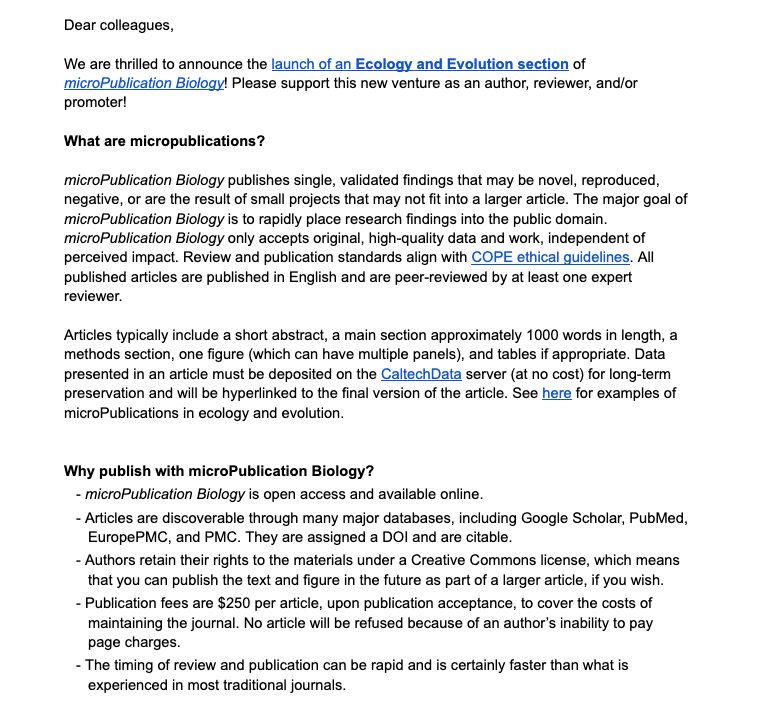
We are thrilled to announce the launch of an Ecology and Evolution section of microPublication Biology! Please support this new venture as an author, reviewer, and/or promoter!
microPublication Biology publishes single, validated findings that may be novel, reproduced, negative, or are the result of small projects that may not fit into a larger article. The major goal of microPublication Biology is to rapidly place research findings into the public domain. microPublication Biology only accepts original, high-quality data and work, independent of perceived impact. Review and publication standards align with COPE ethical guidelines. All published articles are published in English and are peer-reviewed by at least one expert reviewer.
Articles typically include a short abstract, a main section approximately 1000 words in length, a methods section, one figure (which can have multiple panels), and tables if appropriate.
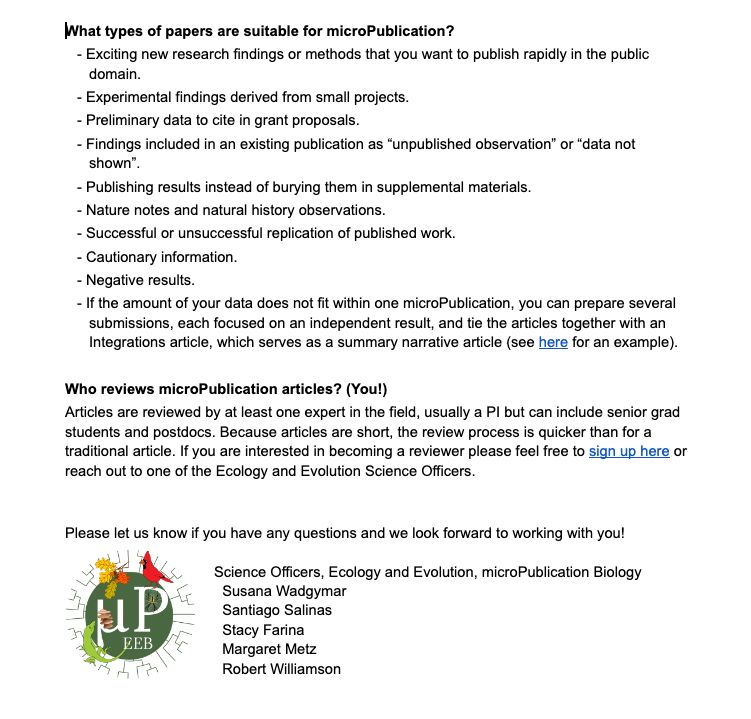
What types of papers are suitable for microPublication?
- Exciting new research findings or methods that you want to publish rapidly in the public domain.
- Experimental findings derived from small projects.
- Preliminary data to cite in grant proposals.
- Findings included in an existing publication as “unpublished observation” or “data not shown”.
- Publishing results instead of burying them in supplemental materials.
- Nature notes and natural history observations.
- Successful or unsuccessful replication of published work.
- Cautionary information.
- Negative results.
- If the amount of your data does not fit within one microPublication, you can prepare several submissions, each focused on an independent result, and tie the articles together with an Integrations article, which serves as a summary narrative article (see here for an example).
mock microPublication logo depicting a cardinal, orb weaver, oak leaves/acorns, anolis, and shelf fungi.
📣 Introducing 📣
microPublications in Ecology and Evolution!
Please help support this effort by spreading the word and submitting and reviewing papers!
#evolution 🌎 🌍 🌏 🧪 #PlantScience #conservation
15.04.2024 13:22
👍 115
🔁 80
💬 1
📌 9
Add me, please! You know me...
25.11.2024 13:18
👍 0
🔁 0
💬 0
📌 0
Sätt upp mig på listan!
19.11.2024 10:58
👍 1
🔁 0
💬 1
📌 0