Congratulations to all the new Berkeley NAE inductees, including our collaborator of ~20y and former @qb3-berkeley.bsky.social director Dave Schaffer! Well-deserved and long overdue!!
12.02.2025 00:36
👍 6
🔁 1
💬 0
📌 0
Terribly sad to learn of Dr. Michael Sheetz's passing. Mike was a foundational figure in mechanobiology and a strong advocate for the field. He also made us all better by holding himself and others to the highest intellectual standards. Condolences and best wishes to Mike's family and friends.
02.02.2025 19:58
👍 9
🔁 1
💬 1
📌 0
Outstanding opportunity to lead a world-class core facility within @qb3-berkeley.bsky.social. Check it out and spread the word!
15.01.2025 22:05
👍 2
🔁 2
💬 0
📌 0
Thank you for another brilliant thread! Extraordinary that you were able to perform this massive service while directing a dept, writing a textbook, and (BTW) running & supporting a world-class research program. Could all be full-time jobs... pls consider future Bluetorial on time management!
19.12.2024 19:28
👍 1
🔁 0
💬 0
📌 0
Please add us if we're not already on. Thank you!!
18.12.2024 04:45
👍 1
🔁 0
💬 1
📌 0
Please add us if we're not already on. Thank you!!
18.12.2024 04:45
👍 0
🔁 0
💬 0
📌 0
Amazing JB thread on JHU biophysics. Despite (because of?) its complexity, the PMB delivered a superb education... The 1st y core course in biophysical chemistry – led in the late 90s by Doug Barrick and Bertrand Garcia-Moreno – laid a rock solid foundation that continues to pay off decades later 🙏
03.12.2024 21:27
👍 4
🔁 0
💬 0
📌 0
And thank you for posting this very thread today! Had no idea the multi-unit history was so complex and dramatic. Makes it all the more impressive that the JHU biophysics ecosystem has been so effective.
03.12.2024 21:15
👍 1
🔁 0
💬 0
📌 0
💯. Not stated enough!
03.12.2024 20:33
👍 1
🔁 0
💬 0
📌 0
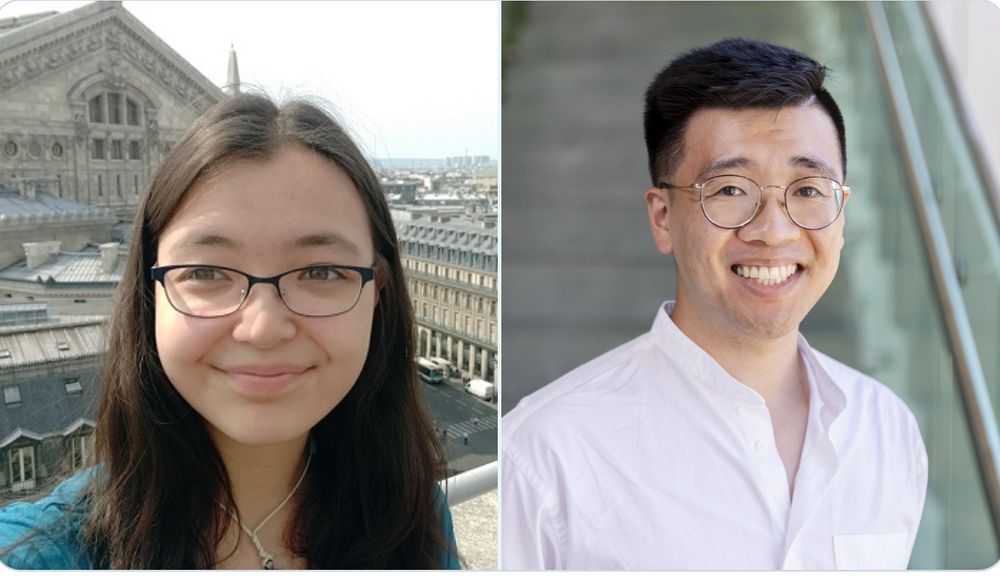
Experimental studies were led by Erika Ding, with Takashi Yokokura conducting hugely insightful SCFT modeling under Prof. Rui Wang's guidance. Erika and Takashi are incredibly talented and motivated ChemE PhD students ... if you see one or both in a future faculty search, give them a close look!
02.12.2024 16:46
👍 0
🔁 0
💬 0
📌 0
This may explain why M makes such important functional contributions in mouse genetic models, and why H is so thoroughly phosphorylated (another longstanding mystery) ... though additional experiments with M and H mutants reveal a much more complex picture - see paper for details.
02.12.2024 16:46
👍 0
🔁 0
💬 1
📌 0
Conversely, H's charges are much more mixed, yielding a more condensed structure. However, H does swell and approach the brush periphery when H is charged via multi-site phosphorylation at its KSP repeats – just as it is typically found in the axon.
02.12.2024 16:46
👍 0
🔁 0
💬 1
📌 0
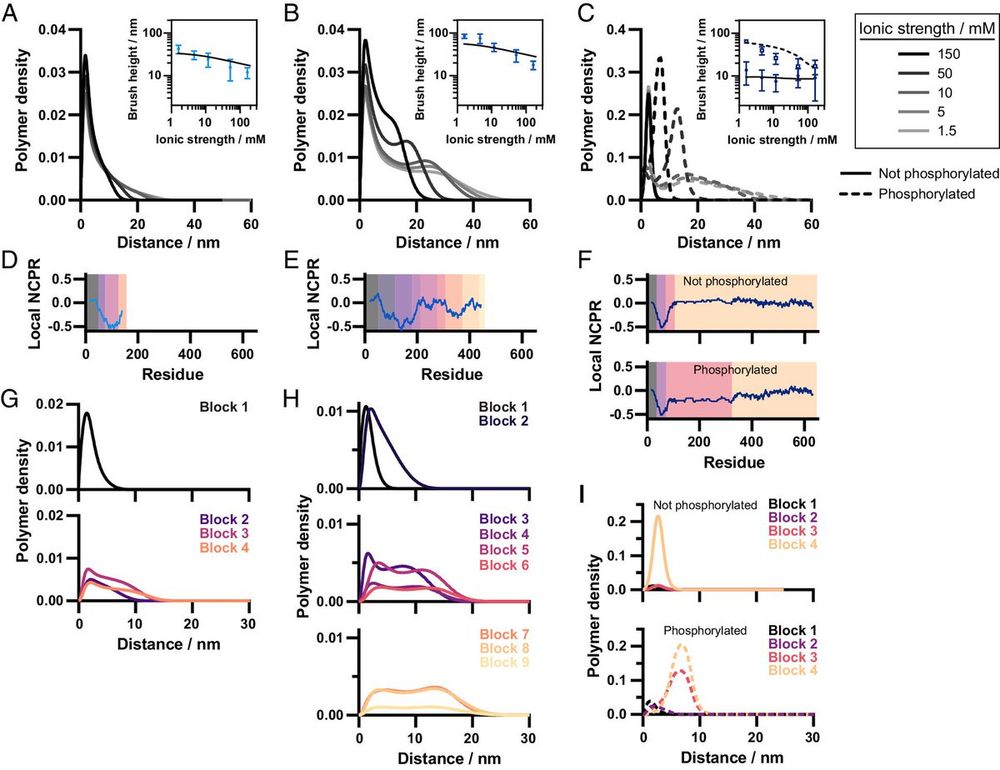
Very briefly, we show that despite M's smaller size, it populates the outer reaches of the brush at physiol ionic strength bc a key portion of the protein has a relatively segregated charge distribution. As a result M behaves like a polyelectrolyte, with charge repulsion driving chain expansion.
02.12.2024 16:46
👍 0
🔁 0
💬 1
📌 0
Since AFM can only measure an aggregate brush height, the expts were also closely coupled to (and guided by) SCFT-based modeling led by Rui Wang's lab to gain insight into internal brush structure.
02.12.2024 16:46
👍 0
🔁 0
💬 1
📌 0
We sought to gain insight into this longstanding paradox by preparing recombinant L, M, and H, assembling them as oriented, mixed-subunit "brushes" on surfaces, and characterizing these brushes w AFM and related surface techniques.
02.12.2024 16:46
👍 0
🔁 0
💬 1
📌 0
As the name implies, H is larger than M and should protrude further from the NF core and drive network assembly. However, mouse genetics studies from the 90s/00s implicates M much more strongly in governing axonal caliber and radial growth. H is practically dispensable. How can this be?
02.12.2024 16:46
👍 0
🔁 0
💬 1
📌 0

NFs are IFs composed of 3 subunits (light, medium, heavy a.k.a. L, M & H) that co-assemble into bottlebrush-like structures. The C terminal IDRs of M and H (and to a lesser extent L) form the "bristles" of the brush and have been long presumed to mediate interactions between adjacent NFs.
02.12.2024 16:46
👍 0
🔁 0
💬 1
📌 0

Excited to share our new paper in @PNASNews on mixed, reconstituted neurofilaments (NFs)! This work was led by ChemE PhD student Erika Ding and done in collab w Prof. Rui Wang and ChemE PhD student Takashi Yokokura here at Berkeley pnas.org/doi/10.1073/...
02.12.2024 16:46
👍 8
🔁 3
💬 1
📌 0
As a JHU trainee of that era, these backstories are riveting. Pls keep them coming! Would love a thread on JHU biophysics... Impressively tight culture given the 2 campus/dept/PhD program setup. And so much informal dialogue, e.g. fac chalk talk dinners. How did it start and what made it work?
30.11.2024 19:24
👍 2
🔁 0
💬 1
📌 0
Please add us. Thanks!
27.11.2024 22:10
👍 0
🔁 0
💬 1
📌 0
Please add us. Thanks!
24.11.2024 20:17
👍 1
🔁 0
💬 1
📌 0
Remember the 2008 call from @jeremymberg.bsky.social well! The DP2 was our first NIH award and key to launching our lab. Fascinating to hear the inside story, and grateful to all who created this remarkable program.
23.11.2024 18:43
👍 2
🔁 1
💬 0
📌 0


What a pleasure visiting the iconic @notredame.bsky.social to give the AME/BioE seminar! Exciting to hear about the push to build in Bioengineering & Life Sciences, including some brilliant recent faculty recruitments and new lab space. Many thanks to @dhpgroup.bsky.social and colleagues ☘️
20.11.2024 15:45
👍 6
🔁 2
💬 0
📌 0
Paper also includes AFM measurements of both normal and tumor-laden brain to help guide material design. Congrats to Emily and other authors!
18.11.2024 15:16
👍 0
🔁 0
💬 0
📌 0


We show that VE matrices support a special leader follower mode of invasion in which leader cells use hyaluronidases to pave paths, with followers then exploit. Invasive morphologies closely resemble those previousy seen by intravital imaging
18.11.2024 15:16
👍 1
🔁 1
💬 1
📌 0