How is developmental speed regulated ? 🪰
Happy to share my PhD story from Schweisguth Lab @devstempasteur.bsky.social. Here we show that cellular NAD+ availability and redox constrain developmental speed in the fly eye.
www.biorxiv.org/content/10.1...
A big thanks to everyone involved!
22.09.2025 19:07
👍 34
🔁 13
💬 4
📌 1
Check out my first #preLight on the work of Sokol's team exploring PCP and mechanosensation! It was so much fun to pick a preprint, read it, write about it, and even get to ask the authors questions directly. I have a feeling this is just the beginning of many more preLight posts to come! 🙌
04.07.2025 13:38
👍 14
🔁 5
💬 0
📌 0
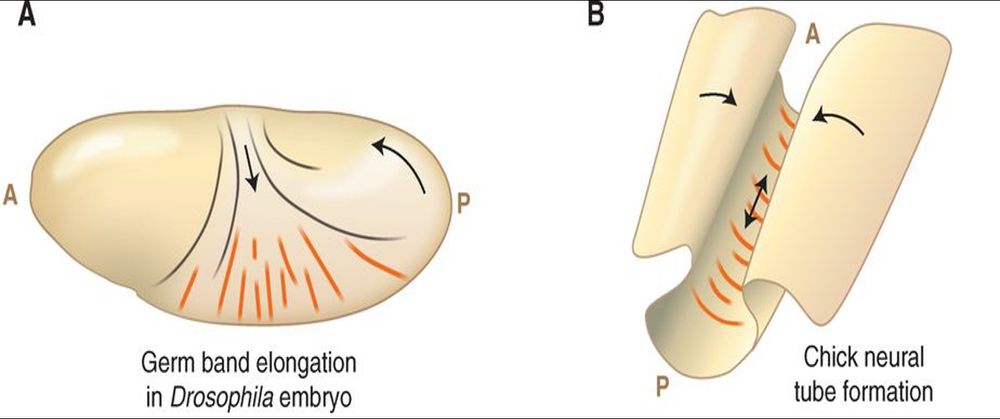
Epithelial morphogenesis is all about how epithelial tissues develop unique shapes and structures! I'm @nehaghosh.bsky.social and will share some research in this area.
29.06.2025 06:44
👍 32
🔁 11
💬 1
📌 2
This project was definitely a joint effort by multiple people. A huge thank you to all the members of Brian Mitchell’s lab at Northwestern University, and a very special thank you to the other co-first authors, Jennifer Sheridan and Julia Dorr!
21.05.2025 13:13
👍 0
🔁 0
💬 0
📌 0
Our work suggests that although AK7 localizes at cilia, it has a non-ciliary function too, related to centriole maturation. We propose that the centriolar defects underlie much of the reduction in cilia number, contributing to the loss of mucociliary flow in AK7-depleted tissues, indicative of PCD.
21.05.2025 13:13
👍 0
🔁 0
💬 1
📌 0

We observed that AK7 depletion leads to defects in centriole docking, with centrioles remaining sub-apical and therefore failing to nucleate motile cilia.
21.05.2025 13:13
👍 0
🔁 0
💬 1
📌 0

The mechanism? Centrioles!
Cilia are anchored to the apical surface of MCCs via 150-200 centrioles, also known as basal bodies. These structures are generated close to the nucleus and then migrate apically, where they dock at the cell surface and subsequently give rise to cilia.
21.05.2025 13:13
👍 0
🔁 0
💬 1
📌 0

We also performed SEM imaging and observed that ciliary structures are impaired when AK7 is lacking, with reductions in both cilia number and length.
21.05.2025 13:13
👍 0
🔁 0
💬 1
📌 0
Loss of AK7 was related to PCD-like phenotypes, with decreased fluid flow and reduced beat frequency of MCCs. One of the challenges was to find a way to visualize live ciliary beating with a good enough spatiotemporal resolution (tipically cilia are around 15μm long with beating frequency of 15Hz).
21.05.2025 13:13
👍 1
🔁 0
💬 2
📌 0
Primary ciliary dyskinesia (PCD) is a condition characterized by impaired mucociliary flow. Mutations in the AK7 gene have been found in patients, but AK7’s role in flow was unclear. We investigated this matter in flow-generating multiciliated cells (MCCs) in the skin epithelium of Xenopus embryos.
21.05.2025 13:13
👍 1
🔁 0
💬 1
📌 0
This project was definitely a joint effort by multiple people. A huge thank you to all the members of Brian Mitchell’s lab at Northwestern University, and a very special thank you to the other co-first authors, Jennifer Sheridan and Julia Dorr!
21.05.2025 12:59
👍 0
🔁 0
💬 0
📌 0
Our work suggests that although AK7 localizes at cilia, it has a non-ciliary function too, related to centriole maturation.
We propose that the centriolar defects underlie much of the reduction in cilia number, contributing to the loss of mucociliary flow in AK7-depleted tissues, indicative of PCD.
21.05.2025 12:59
👍 0
🔁 0
💬 1
📌 0

We observed that AK7 depletion leads to defects in centriole docking, with centrioles remaining sub-apical and therefore failing to nucleate motile cilia.
21.05.2025 12:59
👍 0
🔁 0
💬 1
📌 0

The mechanism? Centrioles!
Cilia are anchored to the apical surface of MCCs via 150-200 centrioles, also known as basal bodies. These structures are generated close to the nucleus and then migrate apically, where they dock at the cell surface and subsequently give rise to cilia.
21.05.2025 12:59
👍 0
🔁 0
💬 1
📌 0
We also performed SEM imaging and observed that ciliary structures are impaired when AK7 is lacking, with reductions in both cilia number and length.
21.05.2025 12:59
👍 0
🔁 0
💬 1
📌 0
Loss of AK7 was related to PCD-like phenotypes, with decreased fluid flow and reduced beat frequency of MCCs. One of the challenges was to find a way to visualize live ciliary beating with a good enough spatiotemporal resolution (tipically cilia are around 15μm long with beating frequency of 15Hz).
21.05.2025 12:59
👍 0
🔁 0
💬 1
📌 0
Primary ciliary dyskinesia (PCD) is a condition characterized by impaired mucociliary flow. Mutations in the AK7 gene have been found in patients, but AK7’s role in flow was unclear. We investigated this matter in flow-generating multiciliated cells (MCCs) in the skin epithelium of Xenopus embryos.
21.05.2025 12:59
👍 1
🔁 0
💬 1
📌 0
The effector caspases drive cell death, but their activation can often be survived, so how do cells make this decision? Our new preprint from @levayerr.bsky.social shows that instantaneous caspase activity is important, but past activation has a key role to play!
www.biorxiv.org/content/10.1...
21.05.2025 08:52
👍 29
🔁 14
💬 1
📌 2
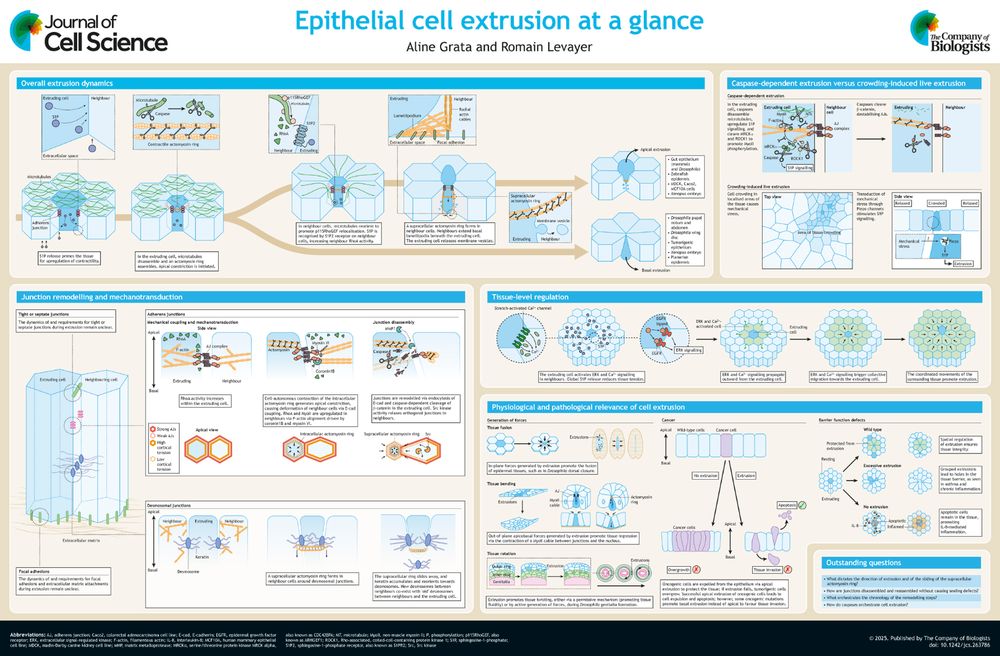
Epithelial cell extrusion at a glance Icon for The Forest of Biologists
In collection: Adhesion , Cytoskeleton , Mechanobiology
Aline Grata, Romain Levayer
In their Cell Science at a Glance article, @alinegrata.bsky.social & @levayerr.bsky.social @pasteur.fr describe the remodelling steps that take place within dying or extruding cells, outlining the commonalities & variations between tissues &organisms.
journals.biologists.com/jcs/article/...
28.04.2025 14:02
👍 12
🔁 7
💬 0
📌 0
We tried to cover everything we could - from the overall dynamics of extrusion, to the junction remodeling it requires, until the tissue-scale regulations and its physiological and clinical implications.
…I might be biased, but how fascinating is it to see how much there is still to discover?🤩
24.04.2025 15:24
👍 2
🔁 0
💬 0
📌 0

Epithelial cell extrusion at a glance
Summary: Cell extrusion is a conserved process that leads to seamless expulsion of epithelial cells from tissues. This Cell Science at a Glance describes the functions and underlying mechanisms of cel...
So happy to share that our review on epithelial cell extrusion is out! @levayerr.bsky.social
Extrusion is such a plastic, context-dependent process, so capturing it visually in the poster that accompanies the article was a super challenging but fun task!
journals.biologists.com/jcs/article/...
24.04.2025 15:24
👍 11
🔁 7
💬 1
📌 0


Just wrapped up an amazing 2-week Principles and Applications of Fluorescent Microscopy #PAFM course @pasteur.fr!
Built a microscope, designed a confocal, attended great talks, and got hands-on with the latest tech🔬💡
Great mix of theory and practice. 10/10, highly recommend!🤩
#microscopy #biology
25.03.2025 09:24
👍 10
🔁 2
💬 0
📌 0
Check out this great article 🫶🏼
Whales, oceans, hearts adaptations, and whatnot🔬✨
Also available in French 🇫🇷 !
@piplettesmagazine.bsky.social
18.01.2025 09:45
👍 3
🔁 0
💬 0
📌 0