6/6
CANVAS turns minimal TIM barrels into blank canvases for enzyme design. This approach could be applied to other minimal folds, enabling de novo enzymes for virtually any reaction while keeping stable, well-behaved scaffolds. The goal: bespoke enzymes for chemistries nature hasn’t explored yet!
17.02.2026 18:46
👍 0
🔁 0
💬 0
📌 0

5/6
Molecular dynamics simulations helped dissect structural determinants of catalysis. Our catalytic‑competency score, i.e. the fraction of snapshots with both key catalytic contacts formed, tracks well with experimental activity across variants.
17.02.2026 18:46
👍 0
🔁 0
💬 1
📌 0

3/6
We solved the KempTIM1 crystal structure (blue) bound to a transition‑state analogue. The designed lid (magenta) shows excellent agreement with the model, and the ligand binds in a similar pose to the design model, enabling the intended catalytic contacts.
17.02.2026 18:46
👍 0
🔁 0
💬 1
📌 0

2/6
After reviewer feedback, we boosted activity and hit rate. Keeping the same active‑site design, we improved solubility and expression via surface redesign, yielding KempTIM1, one of the most active first‑round de novo enzymes reported to date (kcat/KM = 21,000 M⁻¹ s⁻¹).
17.02.2026 18:46
👍 0
🔁 0
💬 1
📌 0

1/6
Thrilled to announce our updated preprint on the CANVAS method for de novo enzyme design, in collaboration with @birtehoecker.bsky.social. We show how CANVAS builds custom lids onto minimal TIM barrels, transforming them into efficient catalysts.
www.biorxiv.org/content/10.1...
17.02.2026 18:46
👍 5
🔁 2
💬 1
📌 0

Announcement for the 6th Protein Engineering Canada Conference, to be held June 22nd-24th in Ottawa, Canada. The image shows a protein structure in front of a picture of Parliament Hill and Chateau Laurier in Ottawa.
1/
Save the date!
The 6th Protein Engineering Canada Conference will be held on June 22-24 in Ottawa, Canada.
Abstract submission and registration are open!
More information here: event.fourwaves.com/pec2026/pages
04.12.2025 16:32
👍 5
🔁 3
💬 1
📌 0

2/
Speakers of the 6th Protein Engineering Canada Conference include:
Bill DeGrado
Joelle Pelletier
Tim Whitehead
Anastassia Vorobieva
Lucy Colwell
Ai Niitsu
@joannas.bsky.social
@nickpolizzi.bsky.social
@possuhuanglab.bsky.social
@paolalaurino.bsky.social
@stephanhammer.bsky.social
and more!
04.12.2025 16:32
👍 3
🔁 2
💬 0
📌 0
Announcement for the 6th Protein Engineering Canada Conference, to be held June 22nd-24th in Ottawa, Canada. The image shows a protein structure in front of a picture of Parliament Hill and Chateau Laurier in Ottawa.
1/
Save the date!
The 6th Protein Engineering Canada Conference will be held on June 22-24 in Ottawa, Canada.
Abstract submission and registration are open!
More information here: event.fourwaves.com/pec2026/pages
04.12.2025 16:32
👍 5
🔁 3
💬 1
📌 0
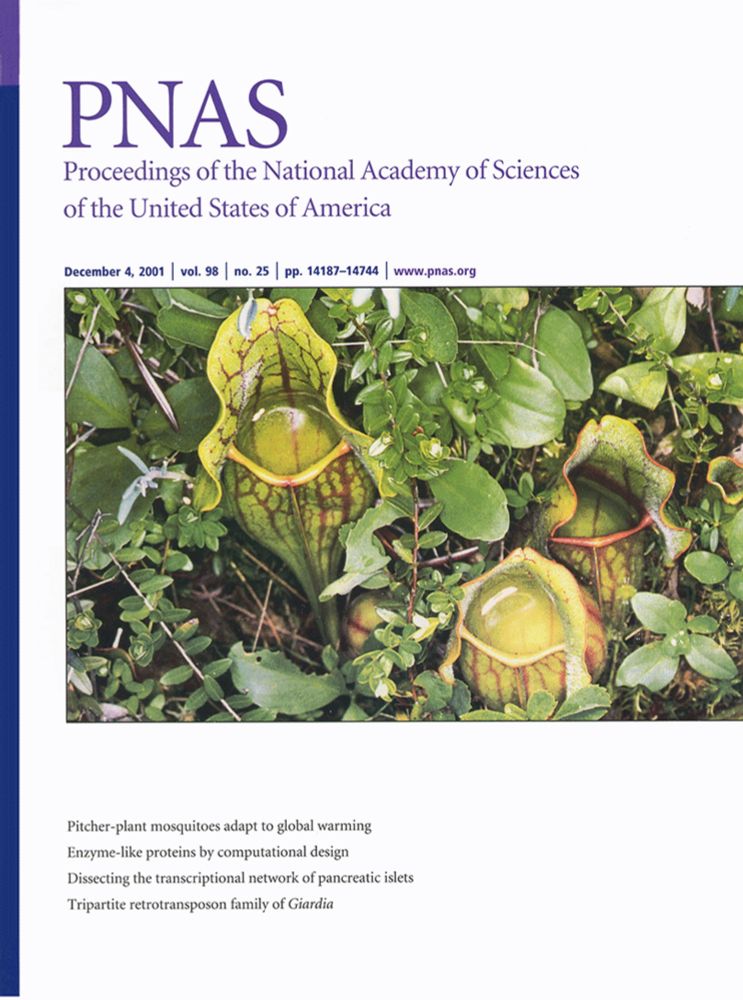
Enzyme-like proteins by computational design | PNAS
We report the development and initial experimental validation of a
computational design procedure aimed at generating enzyme-like protein
catalys...
Similarly, enzyme function can be designed de novo by creating a new active site within a natural protein scaffold that lacks the target activity, even if that catalytic function exists in nature.
See below for an early example:
www.pnas.org/doi/full/10....
31.07.2025 22:10
👍 2
🔁 0
💬 0
📌 0
Overall, our study:
✅ Introduces a new strategy to transform minimal protein scaffolds into biocatalysts
✅ Provides mechanistic insights from crystallography & molecular dynamics
✅ Opens the door to designing custom lids for more complex reactions, which we’re now exploring
Thanks for reading! 🧵🧬
29.07.2025 18:33
👍 2
🔁 0
💬 1
📌 0
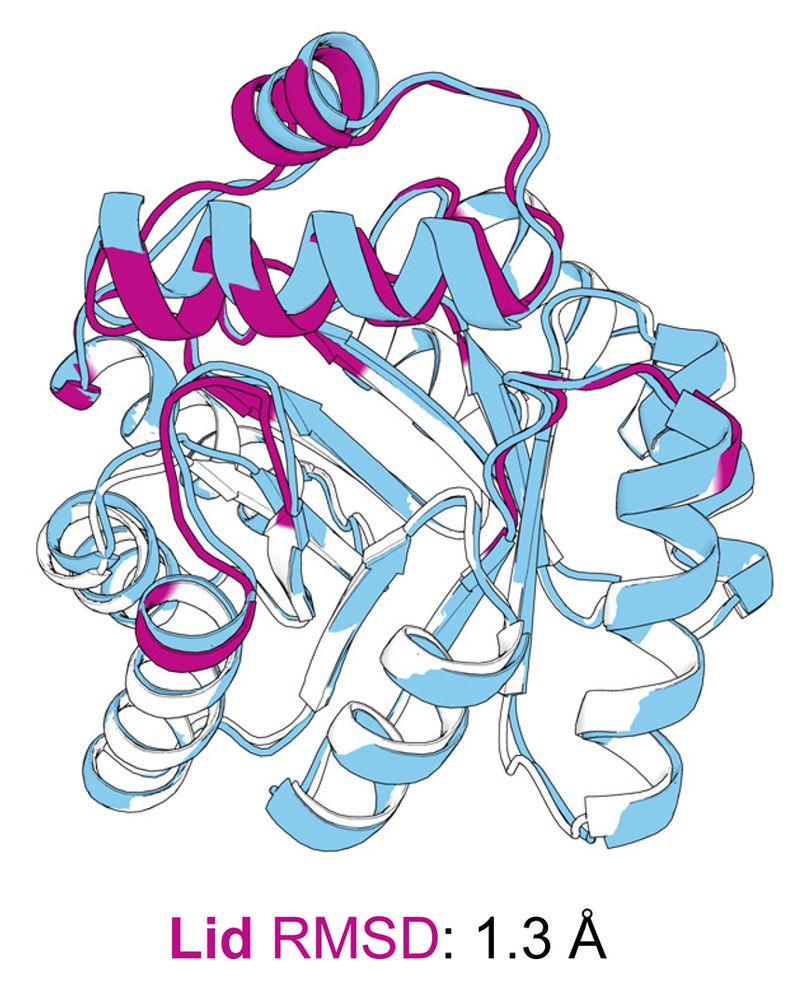
The crystal structure (blue) aligns closely with the design model (minimal TIM barrel and lid colored white and magenta, respectively).
Our crystal structure validated the designed fold, confirming that the lid was correctly folded.
However, a subtle 1.8 Å lid shift disrupted a key catalytic contact, likely contributing to the modest activity. But structural analysis reveals paths to improve activity in the next round of design!
29.07.2025 18:33
👍 2
🔁 0
💬 1
📌 0
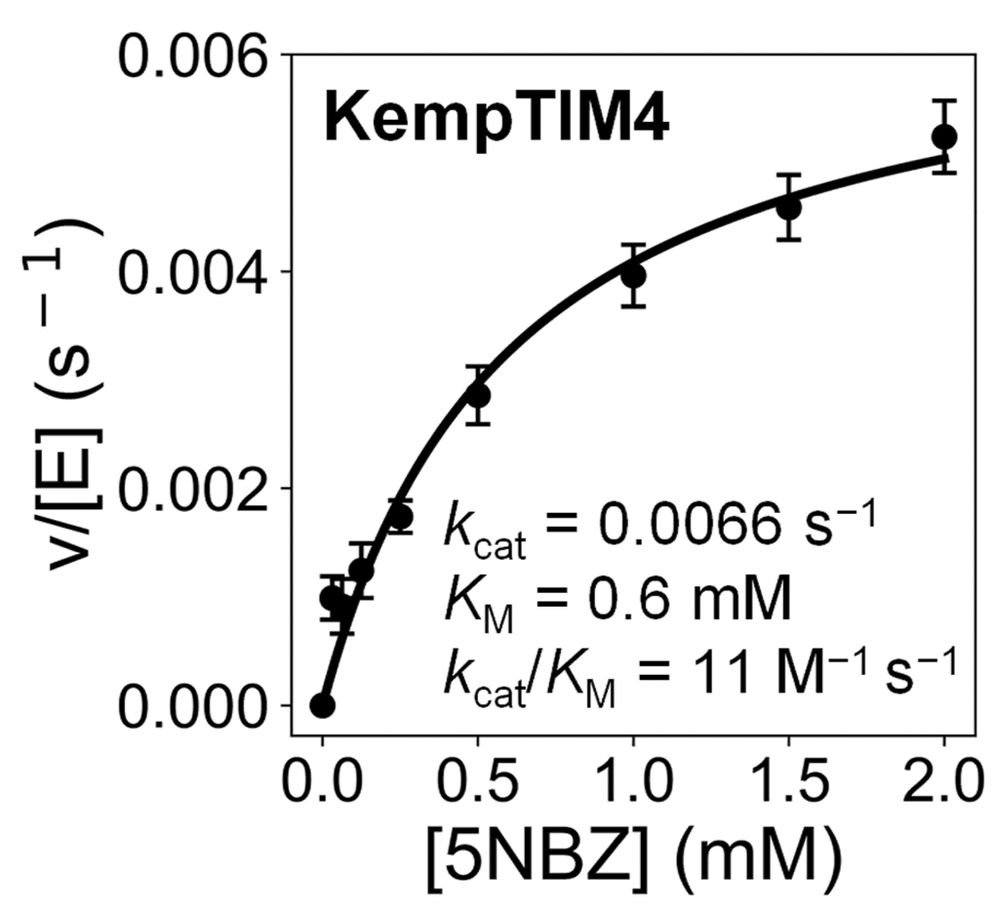
Michaelis-Menten plot of KempTIM4 showing saturation kinetics.
One of our designs, KempTIM4, showed catalytic efficiency comparable to many first-round de novo Kemp eliminases generated by traditional methods.
29.07.2025 18:33
👍 1
🔁 0
💬 1
📌 0
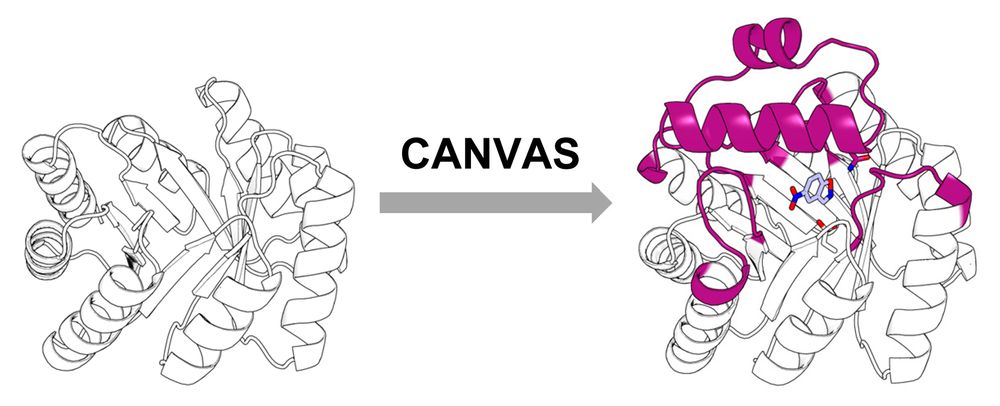
Building a custom lid onto a minimal, de novo TIM barrel using CANVAS.
Using CANVAS, we designed a structural lid onto a minimal, de novo TIM barrel to anchor catalytic residues and create an active site for the Kemp elimination reaction.
29.07.2025 18:33
👍 1
🔁 0
💬 1
📌 0
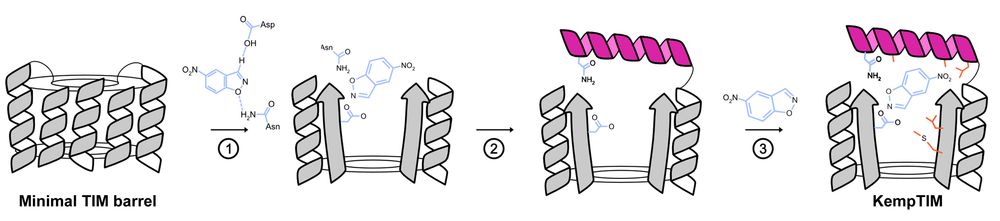
De novo enzyme design using CANVAS.
TIM barrels are among nature’s most powerful enzyme scaffolds but making them from scratch with catalytic function has been a challenge.
Enter CANVAS: a computational pipeline combining Triad, RFdiffusion & ProteinMPNN to customize minimal TIM barrels into functional enzymes.
29.07.2025 18:33
👍 1
🔁 0
💬 1
📌 0
Congratulations! Looking forward to seeing all the exciting science that will come out of your lab! 🧪
25.07.2025 15:50
👍 1
🔁 0
💬 0
📌 0

Research Position (PhD) in organic chemistry and b...
<div style="text-align: justify;">The research group „Organic Chemistry and&nb...
Join us! We are looking for a new team member (PhD student) with strong background in organic chemistry.
🙏 RETWEET (We want to recruit internationally)
Organic chemistry meets #DirectedEvolution
Highly interdisciplinary & passionate research group
uni-bielefeld.hr4you.org/job/view/433...
27.06.2025 21:13
👍 6
🔁 7
💬 0
📌 0

Non-canonical amino acid from PDB ID 8W3Z shown chelating to a magnesium ion. Image made with PyMol.
https://www.rcsb.org/structure/8W3Z
https://www.pymol.org
Protein Engineering, Design & Selection (PEDS) invites contributions to a Special Collection titled, “Non-Canonical Amino Acids", with guest editors Prof. Huiwang Ai (Virginia) and Prof. Peng Chen (Peking). Send us your best work!
academic.oup.com/peds/pages/c...
15.05.2025 00:25
👍 12
🔁 4
💬 0
📌 0

Guess what? TPS has extended the deadline to March 19 to submit abstracts for poster presentations and speaking opportunities at our 39th Annual Symposium. Join us in San Francisco June 26 - 29 for 3.5 days of scientific talks.
hashtag#proteinscience hashtag#annualsymposium
lnkd.in/g7VKqX7C
06.03.2025 18:27
👍 3
🔁 5
💬 0
📌 0
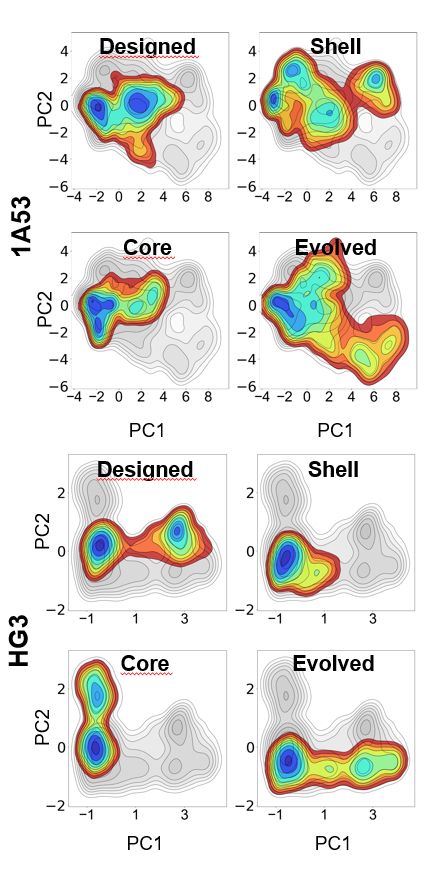
Molecular dynamics simulations showed that distal mutations enhance active-site accessibility—either by loosening loops covering the active site or widening bottlenecks for substrate entry & product exit. The enzyme breathes more efficiently! 🌬️ (5/6)
28.02.2025 17:17
👍 0
🔁 0
💬 1
📌 0

Kinetic solvent viscosity effects & stopped-flow experiments showed that distal mutations don’t just tweak structure—they accelerate substrate binding & product release. (4/6)
28.02.2025 17:17
👍 0
🔁 0
💬 1
📌 0
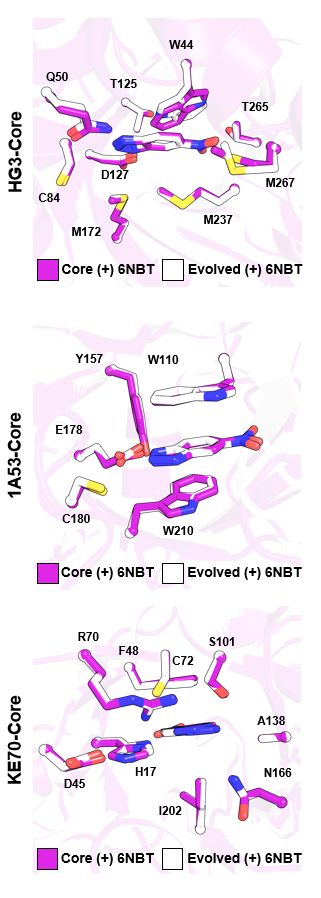
Crystal structures showed that active-site mutations pre-organize the catalytic machinery. But distal mutations? They subtly tune conformational dynamics—enhancing productive substates & reshaping the energy landscape of the catalytic cycle. (3/6)
28.02.2025 17:17
👍 0
🔁 0
💬 1
📌 0