My team at @cbitoulouse.bsky.social is recruiting a postdoc #bioinformatics with solid experience in metagenomic analyses.
Interest in evolution, ecology & MGEs is important.
The offer stands until the perfect candidate is found, and it could be you 🫵
🔁 🙏
#microSky #phagesky #UTIsky
@cnrs.fr
15.01.2026 11:19
👍 27
🔁 55
💬 1
📌 0
Llevo muchos años en esto y creo que es la mejor entrevista que he visto sobre el impacto real del accidente de Chernóbil.
Una fascinante conversación con @gorizaola.bsky.social, zoólogo, investigador y divulgador, que ha trabajado varios años en la zona de exclusión.
youtu.be/1fiJacjjW2s?...
14.01.2026 21:21
👍 17
🔁 6
💬 0
📌 0
No worries, it's impossible to keep up with all the literature at the moment ;)
12.01.2026 15:27
👍 2
🔁 0
💬 0
📌 0
Exactly! :) We discuss the dinoflagellate mucosphere (from Larsson et al) in our study. The problem (or charm!) studying Radiolaria is that they don't reproduce in culture, so much of their biology and ecology is based almost only on field observations.
12.01.2026 07:33
👍 1
🔁 0
💬 1
📌 0
Indeed! The Cambrian explosion reflects a change in the preservation of fossils or the sudden development of fossilizable structures (among other things). See our discussion on the "Sppil‐Rongis" effect and refs, for example. Or the development of skeleton in e.g. Radiolaria doi.org/10.1016/j.cu...
15.12.2025 14:09
👍 5
🔁 0
💬 0
📌 0
Looking forward! 🤓
15.12.2025 13:56
👍 1
🔁 0
💬 1
📌 0
In brief, all major eukaryotic supergroups were already established in the Proterozoic, and early eukaryote evolution was far more dynamic than directly read by the fossil record. For further details:
www.biorxiv.org/content/10.6...
15.12.2025 08:19
👍 10
🔁 1
💬 0
📌 0
This work started more than 5 years ago and combines molecular phylogenetics, diversification models, paleoecology and micropaleontology, requiring ~136 CPU-years 🧬💻! A lovely interdisciplinary collaboration with @phoebefossil.bsky.social, Hélèn Morlon and @fburki.bsky.social.
#ProtistsOnSky
15.12.2025 08:19
👍 10
🔁 1
💬 1
📌 1

We find steady diversification during the not-so-boring billion. Archaeplastida diversified early and remained the most diverse group, likely boosted by the first plastid endosymbiosis. Discoba, Amoebozoa and Rhizaria also diversified early, implying complex Proterozoic ecosystems and interactions.
15.12.2025 08:19
👍 9
🔁 0
💬 1
📌 0

New preprint out! Using ~75k environmental OTUs + 77 fossil calibrations, we reconstructed a Proterozoic timeline of eukaryote evolution. Our results show crown eukaryotes were already diversifying >1.6 Ga, long before the first undisputed fossils (~1.05 Ga).
🔗 DOI: www.biorxiv.org/content/10.6...
15.12.2025 08:19
👍 110
🔁 54
💬 4
📌 4
We find steady diversification during the not-so-boring billion. Archaeplastida diversified early and remained the most diverse group, likely boosted by the first plastid endosymbiosis. Discoba, Amoebozoa and Rhizaria also diversified early, implying complex Proterozoic ecosystems and interactions.
15.12.2025 08:11
👍 0
🔁 0
💬 0
📌 0

Built from and for ecologists, molecular biologists, and bioinformaticians working with high-throughput or environmental sequencing data, this tool will ease the tedious work of designing specific oligonucleotides at all different users expertise.
07.11.2025 12:54
👍 6
🔁 1
💬 0
📌 0
With just two FASTA files (targets & non-targets), oligoN-design identifies taxon-specific oligonucleotides. No alignments, phylogenetic trees, or reference databases required.
It integrates smoothly with tools like BLAST, VSEARCH, and MAFFT, and runs efficiently even on personal computers.
07.11.2025 12:54
👍 5
🔁 0
💬 1
📌 0

Oligonucleotide design meets big data:
We present oligoN-design, a simple, reproducible and versatile open-source tool to design specific primers and probes directly from large environmental DNA datasets.
🔗 DOI: doi.org/10.1101/2025...
👉 github.com/MiguelMSandi...
07.11.2025 12:54
👍 24
🔁 11
💬 1
📌 1

On the quest for novelty in ecology
Ottaviani, Gianluigi1, 2, 3, 4 ; Martínez, Alejandro5 ; Petit Bon, Matteo1, 6 ; Mammola, Stefano4, 5, 7 1 Institute of Botany, The Czech Academy of Sciences, Třeboñ, Czech Republic 2 Department of…
Now published in Peer Community Journal, #ecology section: On the quest for novelty in ecology
29.05.2025 10:01
👍 13
🔁 9
💬 0
📌 0
Unsolicited listicle: My list of the most criminally underused/underappreciated phylogenetic comparative methods. Note, I am not involved in ANY of these methods; but I see them as things people are often asking of comparative data but have been surprised at how infrequently they have been cited.
21.05.2025 20:06
👍 149
🔁 67
💬 4
📌 0
With the « Life of Retaria » we do podcasts! Listen to the first one during which we interviewed @fabnot.bsky.social #protistsonsky
12.05.2025 17:37
👍 18
🔁 5
💬 0
📌 0
The Life of Retaria Experience
My friends in the Life of Retaria group decided to make a podcast! In the first episode, they interview @fabnot.bsky.social about his journey as a scientist. I loved the first episode, hope you do too! @juliemeilland.bsky.social @sandinmm.bsky.social et al.
thelifeofretaria.github.io/podcast.html
12.05.2025 17:29
👍 11
🔁 7
💬 0
📌 3
#protistsonsky
08.05.2025 13:39
👍 0
🔁 0
💬 0
📌 0
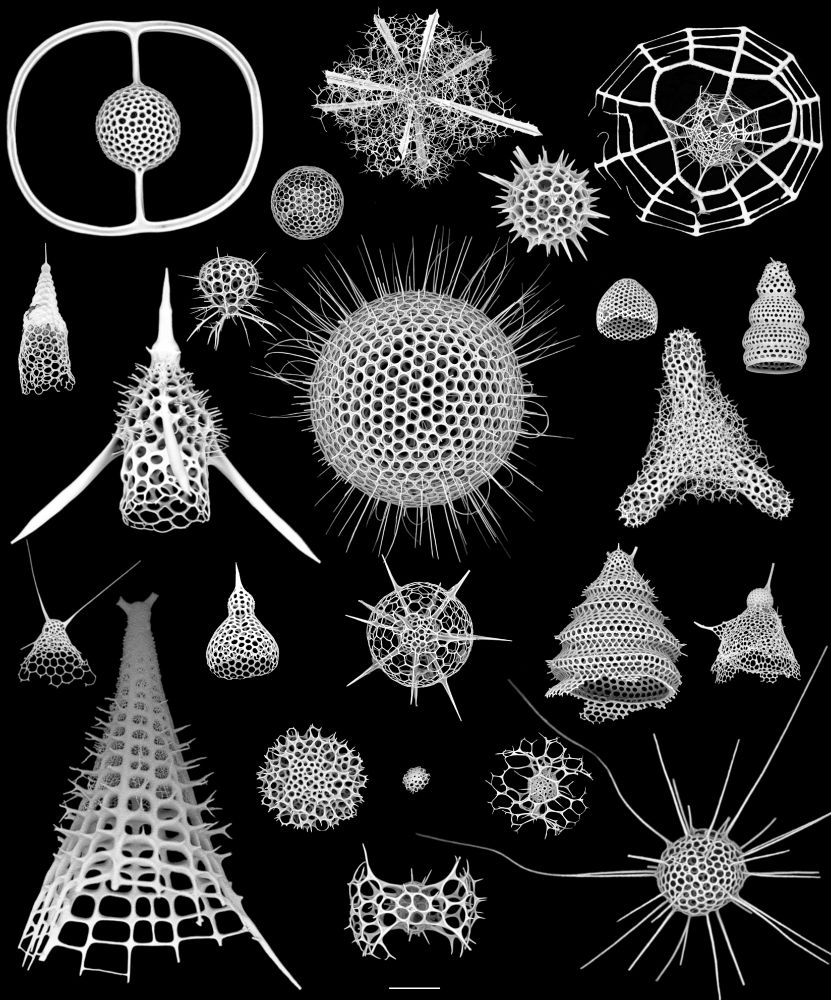
A lovely collaboration with @plannapus.bsky.social, Noritoshi & @fabnot.bsky.social, where we merged the extensive groundwork on the Polycystine fossil record with extant molecular diversity to trace the evolutionary history of Radiolaria from their appearance ~760 million years ago
08.05.2025 13:37
👍 13
🔁 0
💬 2
📌 0
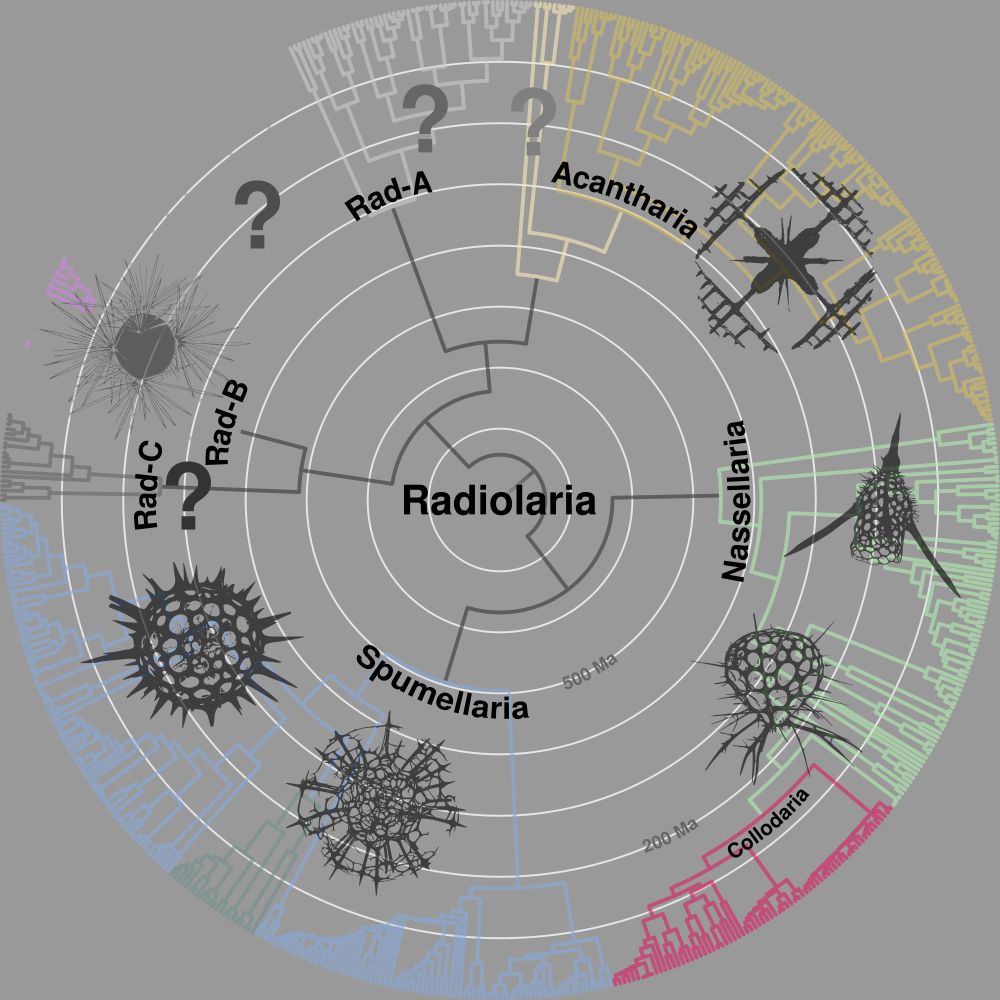
Despite 150+ years of Radiolaria diversity research, we have just scratched the surface. Nearly half of Radiolaria diversity might be naked hiding in plain sight! We unveiled the diversity and evolution of Radiolaria beyond "the stars of the ocean"
doi.org/10.1016/j.cu...
08.05.2025 13:37
👍 41
🔁 16
💬 1
📌 1
Now published online in Current Biology! www.cell.com/current-biol...
07.05.2025 07:17
👍 38
🔁 11
💬 0
📌 2
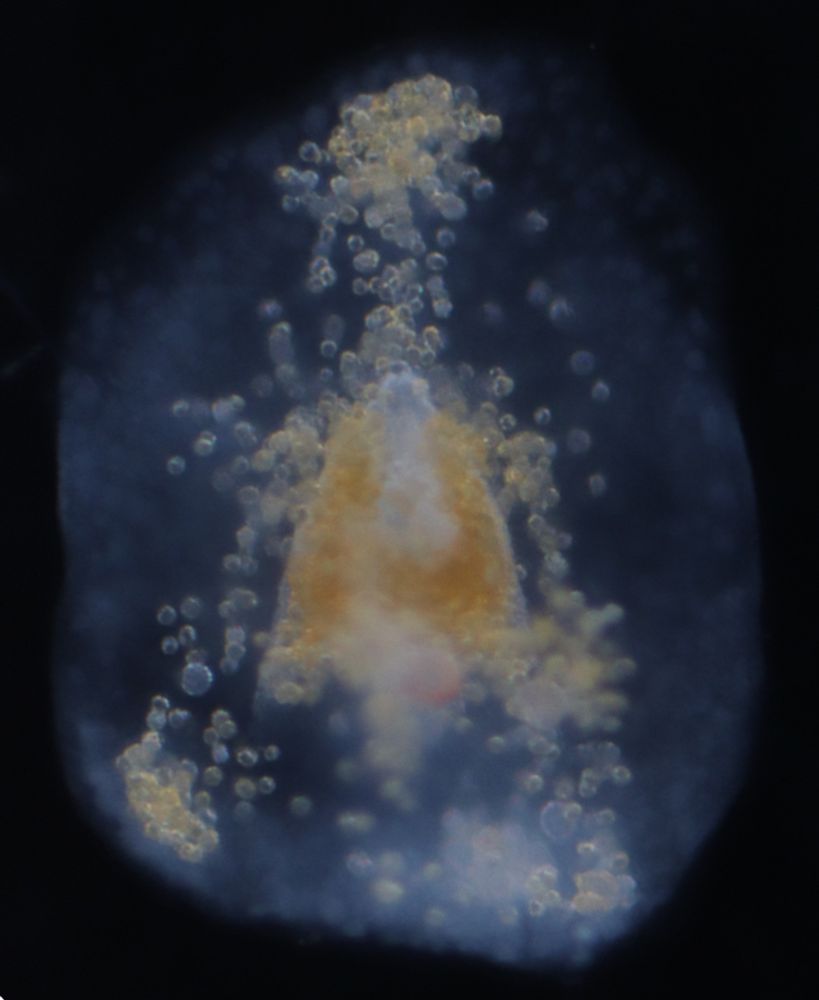
Ah! And if you arrived until here and were wondering about the little golden dots, yes, they are photosynthetic symbionts identified as Scrippsiella. A common dinoflagellate found in symbioses with other planktonic groups like Acantharia (also Radiolaria) or the jellyfish Vellela
05.05.2025 16:24
👍 8
🔁 0
💬 1
📌 0
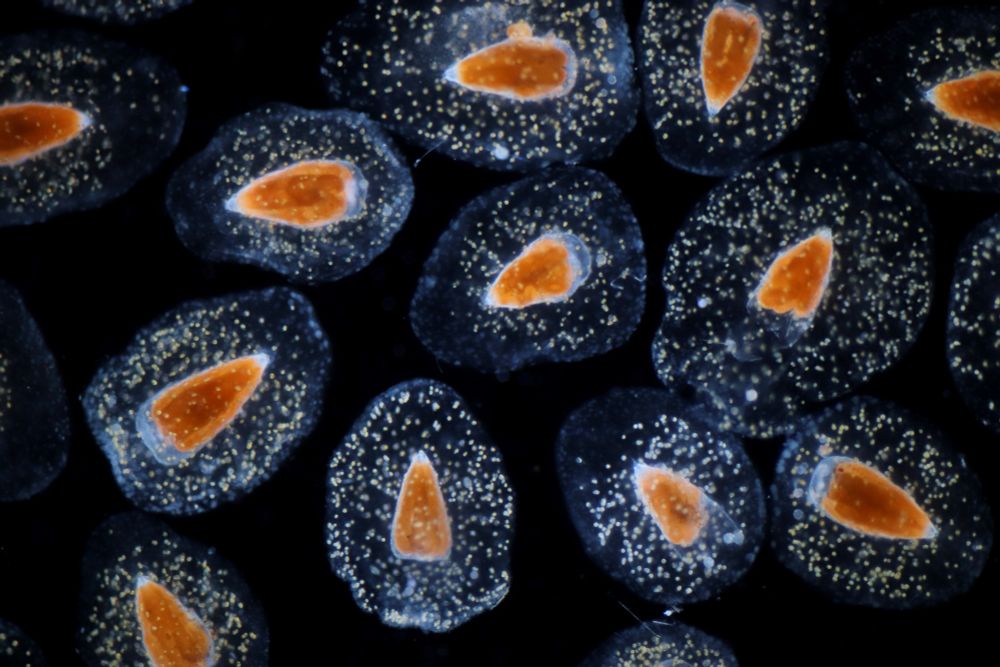
We hypothesize that such a trait could increase the effective volume to weight ratio favoring prey contact and capture, and provide an advantageous microenvironment for symbionts, enhancing ecological success in nutrient-depleted waters.
Pictures credit of @n-llopis-m.bsky.social, by the way!
05.05.2025 16:24
👍 7
🔁 0
💬 1
📌 0
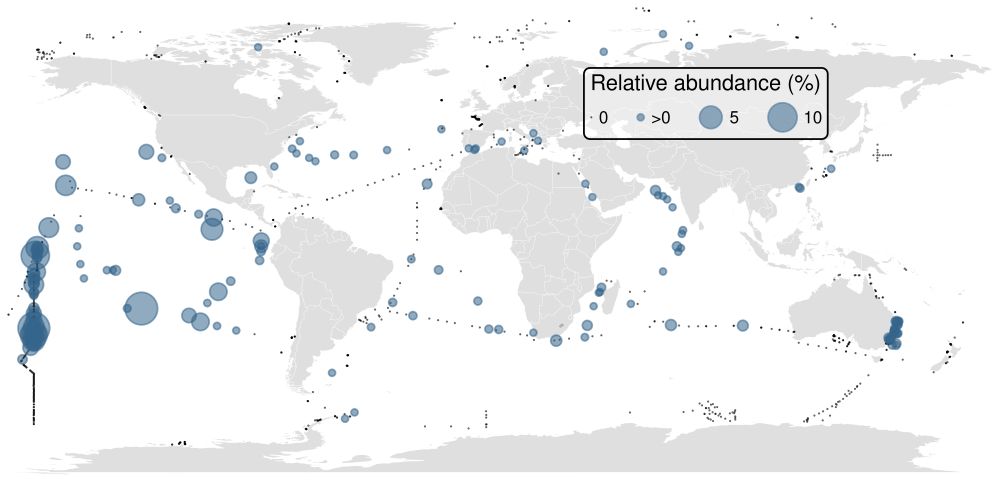
Despite Phlebarachnium was rarely observed, metabarcoding analyses revealed a strong biogeographic affinity to oligotrophic water masses and co-occurrence with other gelatinous-bearing Radiolaria, reaching relative abundances of more than 13% to the total eukaryotic reads in specific samples
05.05.2025 16:24
👍 3
🔁 0
💬 1
📌 0
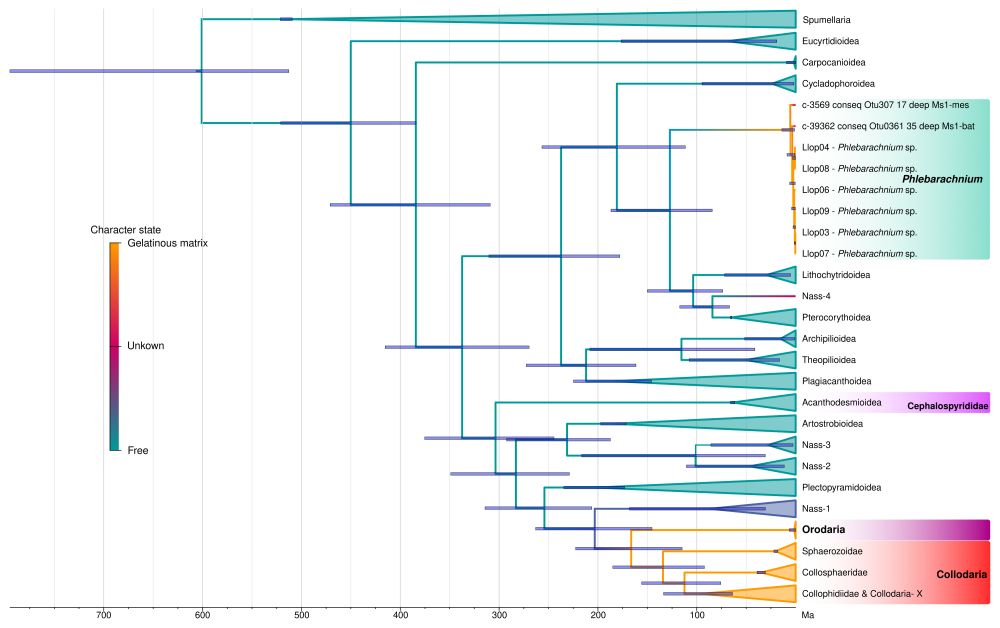
We introduce the first molecular characterization of Phlebarachnium, one of the few Radiolaria known to live within a gelatinous matrix besides Collodaria. Yet these lineages of Nassellaria developed independently the ability to produce the gelatinous matrix ∼150 million years ago
05.05.2025 16:24
👍 4
🔁 0
💬 1
📌 0
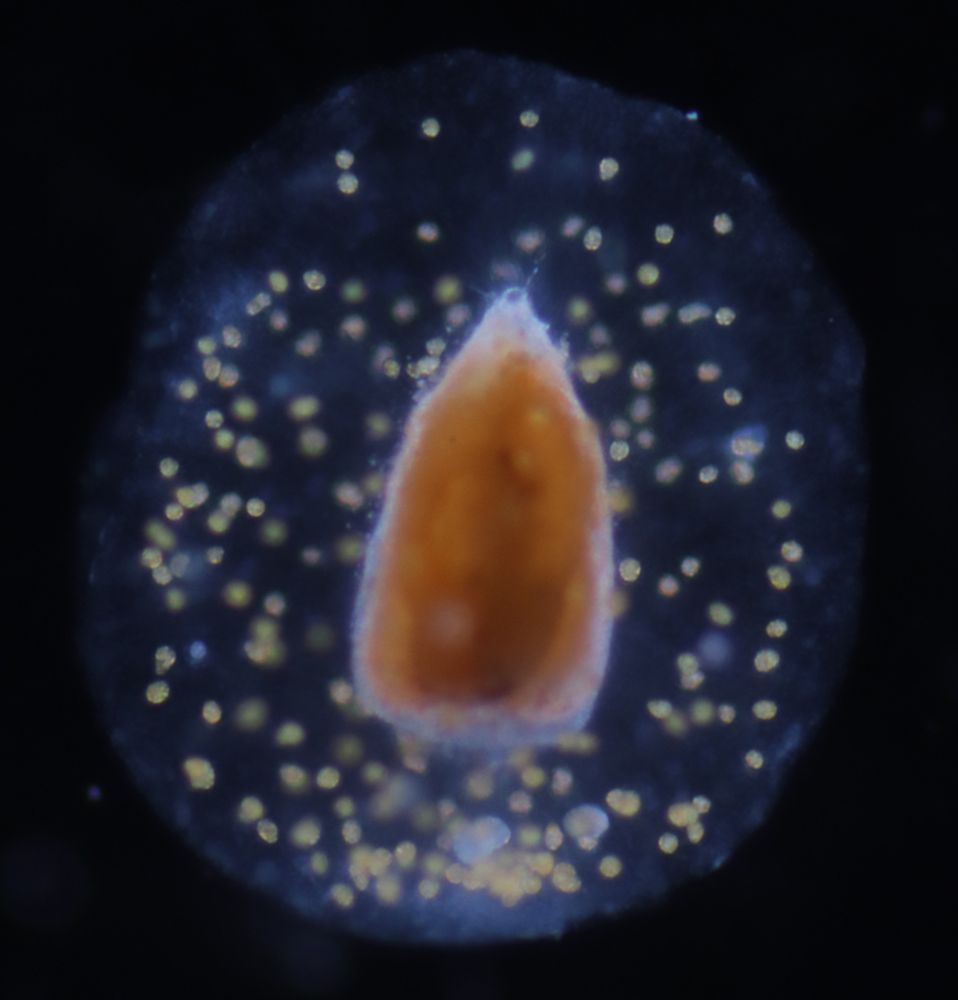
Why do some planktonic protists develop a gelatinous matrix? We suggest that this original adaptation is a strategy to cope with ocean oligotrophy: doi.org/10.1111/1462...
Led by @n-llopis-m.bsky.social, and thanks to all co-authors, I'm very happy to finally see it out!
#protistsonsky
05.05.2025 16:24
👍 64
🔁 27
💬 3
📌 2
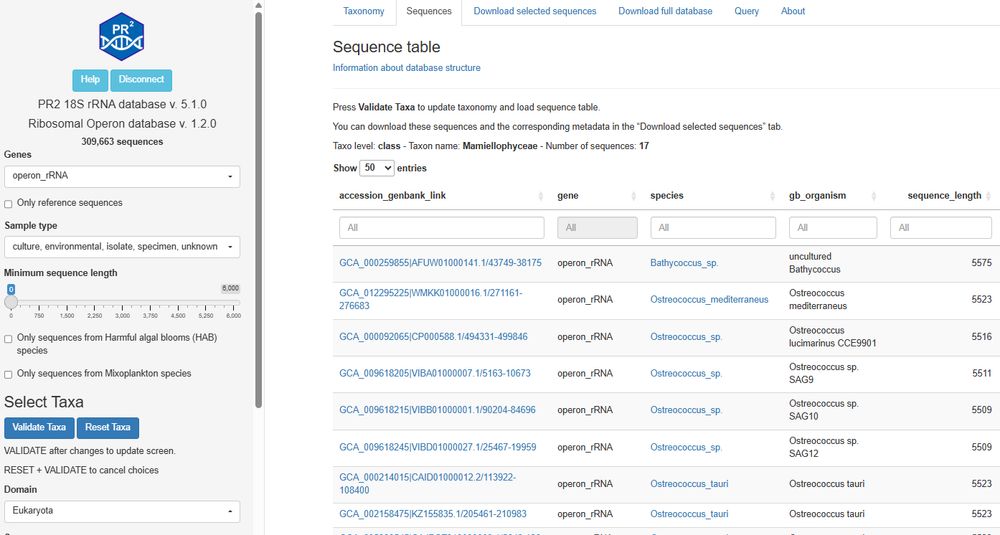
Announcing the new release of the PR2 database, version 5.1.
pr2-database.org/post/news/20...
Very big thanks to all the contributors: @fonamental.bsky.social @ambonacolta.bsky.social @krabberod.bsky.social and more...
A few highlights:
03.04.2025 10:53
👍 25
🔁 20
💬 1
📌 2

The Rise of Algae promoted eukaryote predation in the Neoproterozoic benthos
The rise of marine algae stimulated microbial predation at the seafloor, rerouting carbon and energy to the earliest animals.
Adding planktonic algae to anoxic marine sediments promotes the anaerobic growth of phagotrophic #eukaryotes. The #Neoproterozoic Rise of Algae may have similarly promoted benthic phagotrophs, directing carbon, energy, and nutrients to early animals. #ProtistsOnSky
www.science.org/doi/10.1126/...
19.02.2025 19:06
👍 22
🔁 6
💬 2
📌 0