📢Magda Koziol @epigenome.bsky.social will be speaking at the DPZ @primatenzentrum.bsky.social in Göttingen this Wednesday.
🗓️11 March ⏰13:00
Join us for an exciting seminar! 👇👇
09.03.2026 08:37
👍 2
🔁 1
💬 0
📌 1

Figure 1.(A) Classical gel electrophoresis experiments showing mono-, di-, tri-, tetra-, and further multinucleosome bands upon chromatin digestion. (B) The nucleosome repeat length (NRL) is defined as the genomic distance between the centres of two neighbouring nucleosomes.

Figure 2.Nucleosome mapping using MNase-seq versus ATAC-seq. (A) In MNase-seq, nucleosomes in both open and tightly packed genomic regions are accessible to digestion. MNase preferentially cleaves DNA between nucleosomes and digests DNA until it encounters a histone octamer, which provides a footprint of nucleosome-protected DNA regions. (B) Bulk MNase-seq results in averaged maps across millions of cells, effectively capturing all possible nucleosome positioning configurations. (C) Single-cell MNase-seq (scMNase-seq) results in a noisier and sparser signal. The resulting footprints still represent nucleosome-protected regions, but not all nucleosomes are represented. (D) In ATAC-seq, open regions can be accessed by the enzyme Tn5 transposase, which can insert primers in regions free from the binding of nucleosomes and transcription factors (TFs). (E) For open chromatin regions, nucleosome maps can be obtained from ATAC-seq similar to MNase-seq. (F) Closed, tightly packed chromatin regions may be less represented in ATAC-seq nucleosome maps.

Figure 5.Molecular mechanisms affecting nucleosome spacing. (A) Linker histones H1 and nonhistone chromatin proteins which compete with H1s and modulate nucleosome spacing through structural and electrostatic mechanisms. (B) Chromatin remodellers actively reposition nucleosomes following context-dependent rules. (C) Cell state-dependent chromatin boundaries formed by CTCF and other structural proteins, as well as associated recruitment of chromatin remodellers which space nucleosomes. (D) Gene activity associated with remodeller action and RNA polymerases transcribing through the nucleosomes, leading to smaller distances between nucleosomes in regulatory regions and gene bodies. (E) DNA sequence repeats of different types.
![Figure 6. Examples of NRL changes in biological systems. (A) Cell differentiation leads to NRL changes between different cell types, e.g. mouse dorsal root ganglia neurons (NRL ∼165 bp) versus cortical astrocytes (NRL ∼183 bp) [175]. Schematic cell shapes are adapted from an image created in BioRender (https://BioRender.com/89trj2t). (B) Paired normal versus tumour breast tissues show NRL shortening in cancer (figure adapted from [36] under the CC BY 4.0 licence (https://creativecommons.org/licenses/by/4.0/)). (C) Nucleosome positioning derived from cfDNA of human volunteers shows NRL increase with age (figure reprinted from [79] under the CC BY 4.0 licence (https://creativecommons.org/licenses/by/4.0/)).](https://cdn.bsky.app/img/feed_thumbnail/plain/did:plc:7rjg5hcnnloxgwuvwi23aixu/bafkreihl7mkdtxojw23qoqxm7yt57frzc24mjjllszhbohbvb67ffguccy)
Figure 6. Examples of NRL changes in biological systems. (A) Cell differentiation leads to NRL changes between different cell types, e.g. mouse dorsal root ganglia neurons (NRL ∼165 bp) versus cortical astrocytes (NRL ∼183 bp) [175]. Schematic cell shapes are adapted from an image created in BioRender (https://BioRender.com/89trj2t). (B) Paired normal versus tumour breast tissues show NRL shortening in cancer (figure adapted from [36] under the CC BY 4.0 licence (https://creativecommons.org/licenses/by/4.0/)). (C) Nucleosome positioning derived from cfDNA of human volunteers shows NRL increase with age (figure reprinted from [79] under the CC BY 4.0 licence (https://creativecommons.org/licenses/by/4.0/)).
Nucleosome aficionados! Our new review "Nucleosome spacing across cell types, diseases, and ages" is out in NAR: academic.oup.com/nar/article/...
A huge effort to pull together what we’ve learned about nucleosome spacing in many systems. Enjoy!
@milena-bikova.bsky.social @chrsclrksn.bsky.social
05.03.2026 21:33
👍 46
🔁 18
💬 0
📌 1

Considerations for the future of in vitro gametogenesis in fertility care - @hannahlandecker.bsky.social @uclacrshe.bsky.social @uclamcdb.bsky.social @uclastemcell.bsky.social go.nature.com/4l2e9en
27.02.2026 16:33
👍 3
🔁 4
💬 0
📌 0

Institut Pasteur (@pasteur.fr) is recruiting new young PIs to open new groups in the Institute. Deadline is February 9th! Don't miss the opportunity!
27.01.2026 18:56
👍 34
🔁 49
💬 0
📌 0
Do not miss this great symposium in Utrecht! Stellar speakers, free registration and fun audience in a great institute!! 🤩 Registration is open now
18.12.2025 18:45
👍 7
🔁 4
💬 0
📌 0

Doctoral hat surrounded by icons representing genome science fields: math, bioimaging, genomics, bioinformatics & more. Logos for Uni Göttingen, GönomiX & IMPRS-GS.
Want to shape the future of genome science? 🧬 PhD positions available at Max Planck Institute & Uni Göttingen (IMPRS-GS/GönomiX)! Join a vibrant, interdisciplinary research community. Apply by Jan 14, 2026: www.uni-goettingen.de/de/applicati... #GenomeScience #Research
28.11.2025 12:23
👍 6
🔁 5
💬 0
📌 0

We're very excited to welcome Dr. @sumrubayin.bsky.social from the @gurdoninstitute.bsky.social onto the next episode of the podcast! 🎉
Her lab studies the mouse #cerebellum to better understand the regulation of #neural stem cell behavior. 🧠
10.11.2025 21:46
👍 14
🔁 8
💬 0
📌 1
Our latest paper on comparative analysis of HiChIP data is now online! HiChIP is one of the most useful/practical assays to profile 3D genome organization and chromatin loops but has its challenges in the data analysis especially when it comes to comparative analysis.
04.11.2025 22:58
👍 12
🔁 3
💬 1
📌 0

Frontiers in Stem Cell Innovation 2026
Join leading academics and industry professionals exploring cutting-edge stem cell technologies and disease modelling for drug discovery
🚨 Exciting conference for stem cell aficionados!
‘Frontiers in Stem Cell Innovation’ will bring together experts in stem cell biology from academia & industry to discuss key developments as well as challenges in regenerative medicine and disease modelling.
fisci2026.eventbrite.co.uk
Please repost 🙏
01.11.2025 20:56
👍 4
🔁 5
💬 1
📌 0

Happy to share our latest publication, in which we show that the arrangement of nucleosomes around CTCF sites contributes to higher-order organisation of chromatin into TADs: www.embopress.org/doi/full/10....
27.10.2025 11:49
👍 71
🔁 31
💬 0
📌 2

bioRxiv - An unbiased survey of distal element-gene regulatory interactions with direct-capture targeted Perturb-seq
New preprint from our lab!
What can we learn about the properties of gene regulatory elements by CRISPR’ing a random set of accessible sites in human cells?
Find out here: www.biorxiv.org/content/10.1...
👇
1/
19.09.2025 03:03
👍 58
🔁 17
💬 1
📌 1

Thrilled to share that our Group Leader Prof. Azim Surani, together with Prof. Davor Solter, has been awarded the 2026 Paul Ehrlich & Ludwig Darmstaedter Prize 🎉 for discovering genomic imprinting—a breakthrough that reshaped genetics and launched modern epigenetics.
18.09.2025 13:20
👍 37
🔁 13
💬 0
📌 0
Most read, I hear!
Here is your chance to read what @mariekeoudelaar.bsky.social and I had in mind when writing this together.
10.09.2025 13:21
👍 11
🔁 4
💬 0
📌 0

Dear Fly Community,
In May 2025, the NIH terminated all grant funding to Harvard University, including the NHGRI grant that supported FlyBase. This grant also funded FlyBase teams at Indiana University (IU) and the University of Cambridge (UK), and as a result, their subawards were also canceled.
The Cambridge team has secured support for one to two years through generous donations from the European fly community, emergency funding from the Wellcome Trust, and support from the University of Cambridge. At IU, funding has been secured for one year thanks to reserve funds from Thom Kaufman and a supplement from ORIP/NIH to the Bloomington Drosophila Stock Center (BDSC).
Unfortunately, the situation at Harvard is far more critical. Harvard University had supported FlyBase staff since May but recently denied a request for extended bridge funding. As a result, all eight employees (four full-time and four part-time) were abruptly laid off, with termination dates ranging from August to mid-October depending on their positions. In addition, our curator at the University of New Mexico will leave her position at the end of August. This decision came as a shock, and we are urgently pursuing all possible funding options.
To put the need into perspective: although FlyBase is free to use, it is not free to make. It takes large teams of people and millions of dollars a year to create FlyBase to support fly research (the last NHGRI grant supported us with more than 2 million USD per annum).
To help sustain FlyBase operations, we have been reaching out to you to ask for your support. We have set up a donation site in Cambridge, UK, to which European labs have and can continue to contribute, and a new donation site at IU to which labs in the US and the rest of the world can contribute. We urge researchers to work with their grant administrators to contribute to FlyBase via these sites if at all possible, as more of the money will go to FlyBase. However, we appreciate that some fu…

https://wiki.flybase.org/wiki/FlyBase:Contribute_to_FlyBase
Our immediate goals are:
1. To maintain core curation activities and keep the FlyBase website online
2. To complete integration with the Alliance of Genome Resources (The Alliance).
Integration with the Alliance is essential for FlyBase’s long-term sustainability. For nearly a decade, NHGRI/NIH has supported the unification of Model Organism Databases (MODs) into the Alliance, which we aim to achieve by 2028. Therefore, securing bridge funding to sustain FlyBase over the next three years is crucial for successful integration and the long-term access to FlyBase data.
At present, our remaining funds will allow us to keep the FlyBase website online for approximately one more year. Beyond that, its future is uncertain unless new funding is secured. We will, of course, continue pursuing additional grant opportunities as they arise.
Given the uncertainty of future NIH or alternative funding sources, we are relying on the Fly community for support. Your contributions will directly help us retain the staff needed to complete this transition and to secure ongoing fly data curation into the Alliance beyond 2028.
We at FlyBase are incredibly grateful for the outpouring of support from the community during this challenging time. Your encouragement has strengthened our resolve and underscores how vital this resource remains to Drosophila research worldwide.
Sincerely,
The FlyBase Team
The community of Drosophila researchers is amazing, mutually supportive and collaborative. Right now a key resource for our community, @flybase.bsky.social , is threatened by the cancellation of its NIH grant and is seeking community help in raising short term funds 1/n 🧪 please share
23.08.2025 12:18
👍 150
🔁 127
💬 1
📌 6
H3K4me3 amplifies transcription at intergenic active regulatory elements
A biweekly scientific journal publishing high-quality research in molecular biology and genetics, cancer biology, biochemistry, and related fields
New paper on the role of H3K4me3 at enhancers! We (led by Haoming Yu) used dCas9 epigenome editing to add H3K4me3 to intergenic enhancers. This was (1) sufficient to turn up transcription at open, active regions and (2) has no effect on target gene transcription. genesdev.cshlp.org/content/earl...
20.08.2025 01:28
👍 84
🔁 33
💬 3
📌 1
Great honor to be nominated as one of the top 10 Falling Walls Foundation Science Breakthroughs of the Year 2025 in the Life Sciences. A big thank you to @ovarylab.bsky.social & @tabeamarx.bsky.social for their outstanding contributions, & to everyone else who helped move this project forward.
14.08.2025 11:33
👍 8
🔁 1
💬 0
📌 0
🤩 Very excited to share our new work! We have derived euploid and aneuploid trophoblast organoids and extra-embryonic mesoderm cell lines from early human embryos. In doing so, we have characterised the tissue requirements for their specification. If you want to know more, continue reading….
09.08.2025 08:03
👍 37
🔁 11
💬 1
📌 0
Check out this exciting meeting and register! Fantastic line-up of speakers on cell biology of the nucleus and a great venue 🔥
01.08.2025 06:42
👍 28
🔁 16
💬 0
📌 1

Group Leader - Genome Biology Unit
Are you ready to lead groundbreaking research in Genome Biology? Join us at EMBL! We are seeking a motivated scientist to lead an independent research group addressing exciting and original biological...
To all post-docs: The Genome Biology dept @embl.org
has an Independent faculty position. Fantastic place to set up your lab –great package: core funding, fantastic Ph.D. students, cutting edge core facilities & great colleagues. Closing date Sept 19th
embl.wd103.myworkdayjobs.com/en-US/EMBL/j...
30.07.2025 13:41
👍 192
🔁 225
💬 0
📌 9
Delighted to see this work published! Congrats to Chris Todd and everyone involved - happy to have been part of the team.
30.07.2025 08:54
👍 5
🔁 1
💬 0
📌 0
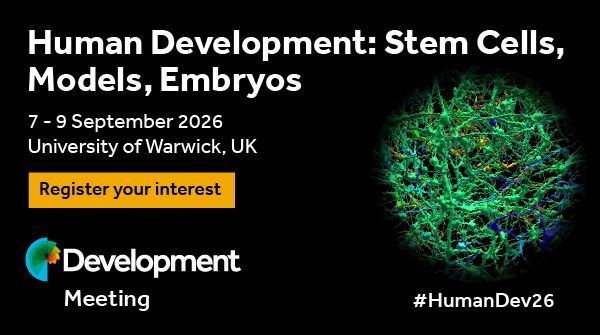
Human Development: Stem Cells, Models, Embryos. 7 - 9 September 2026 University of Warwick, UK. Resgiter your interest. #HumanDev26. Image credit: Susanna Narkilahti, Tampere University, Finland
Save the Date!
Development has teamed up with the Wellcome-funded consortium the Human Developmental Biology Initiative to co-organise a meeting on #HumanDevelopment.
📅7 - 9 Sep 2026
📍University of Warwick, UK
Register your interest for #HumanDev26: www.biologists.com/meetings/dev...
11.07.2025 07:46
👍 29
🔁 13
💬 0
📌 3
Please pread the word.
We have just launched the Hubrecht International PhD Program (HIPP).
Are you looking for a PhD position in molecular and developmental biology or related subject in an international, very supportive and collaborative environment?
Then apply to the HIPP!! 👇
10.07.2025 18:56
👍 24
🔁 18
💬 0
📌 0

Join the VGZT Eastern KEYNOTE lecture ☀️☕ TOMORROW
🗓️ Wednesday July 09
⏰ 13:30 IST / 17:00 JST / 8:00 UTC / 10:00 CET
Featuring:
1) Maithreyi Narasimha
👉Positioning tissues during Drosophila morphogenesis
Jose Silva @josesilvalab.bsky.social
👉From founder cells to organogenesis-stage embryo model
08.07.2025 10:54
👍 11
🔁 5
💬 0
📌 1