Job opportunities...
Newly launched Quantitative Biology Initiative in the Department of Biology at the University of Maryland, College Park seeks applications for three collaborative postdoctoral fellowships. Best consideration date 3/14.
Full Details:
umd.wd1.myworkdayjobs.com/en-US/UMCP/j...
11.02.2026 20:13
👍 20
🔁 30
💬 3
📌 0
Society for Modeling and Theory in Population Biology - How the papers are made: look behind the scenes of publishing models and theory in population biology with current journal editors
Please join us for a @smtpb.bsky.social panel discussion about publishing theory in biology w/ @joshuasweitz.bsky.social (Co-Chief Editor of J Theor Biol), Mark Lewis (Advising Editor for J Math Biol & Bull Math Biol), and me (Theor Pop Biol)
13 Feb 2026 9:00AM–10:00AM PST
smtpb.org/event-6520871
21.01.2026 18:34
👍 21
🔁 16
💬 0
📌 2
I personally learned a lot from both projects; the first authors have put a lot of work into them (of course, all other authors too 😀). End of 🧵
30.01.2026 08:07
👍 1
🔁 0
💬 1
📌 0
However, for nonlinear games, we find that any form of (endowment) inequality is detrimental, because it renders successful coordination more difficult.
30.01.2026 08:07
👍 1
🔁 0
💬 1
📌 0

Social dilemmas among unequals - Nature
A framework that includes inequality shows that extreme inequality prevents cooperation, but overall welfare is maximized when endowments and productivities are aligned such that more-productive indiv...
For linear games, we find that certain forms of inequality can be advantageous: the largest surplus is achieved when more productive participants receive larger endowments. This confirms previous results among western online participants, doi.org/10.1038/s415...
30.01.2026 08:07
👍 0
🔁 0
💬 1
📌 0
To explore this question, Xiaomin studied a large sample of Chinese lab participants (N>1,500) to explore contributions in public good games. We varied group size, endowments, productivities, and whether the public goods game leads to linear or non-linear rewards (using a threshold function).
30.01.2026 08:07
👍 0
🔁 0
💬 1
📌 0

The second paper, with Xiaomin Wang and Boyu Zhang focuses on an empirical question: to which extent do different asymmetries between players affect their ability to cooperate and coordinate?
30.01.2026 08:07
👍 0
🔁 0
💬 1
📌 0
A space S is "best reply complete" if any strategy p in S has a best reply in S. The space is "payoff complete" if any payoff achievable against p (with an arbitrary strategy) can be realized with a strategy in S. Both notions address whether strategies outside S can outperform strategies within S.
30.01.2026 08:07
👍 0
🔁 0
💬 1
📌 0
The question is this: if some strategy p is superior in a restricted space S, how would we know whether this strategy would still perform well if we allowed for more complex strategies than those in S? To address this question, Philip introduces two notions of "complete strategy spaces".
30.01.2026 08:07
👍 0
🔁 0
💬 1
📌 0

The paper with @plaporte.bsky.social, @nikoletaglyn.bsky.social and Martin Nowak asks an important theoretical question. Repeated games allow for (uncountably) many strategies. To facilitate an analysis, researchers often study simplified subspaces. To which extent are such results reliable?
30.01.2026 08:07
👍 2
🔁 0
💬 1
📌 0

Depiction of a public good game among two players
Yesterday, two papers appeared in @pnas.org, to which I contributed to. Both papers deal with strategic behavior in repeated games. Apart from that, they are quite different. A 🧵
doi.org/10.1073/pnas...
doi.org/10.1073/pnas...
30.01.2026 08:07
👍 17
🔁 3
💬 1
📌 0

Exact conditions for evolutionary stability in indirect reciprocity under noise
Author summary Understanding how cooperation can evolve and be sustained is a central question in evolutionary biology and social science. One prominent explanation is indirect reciprocity, where indi...
🗞️📣 New paper "Exact conditions for evolutionary stability in indirect reciprocity under noise" with @chilbe.bsky.social & @yohm.bsky.social
How can cooperation persist in large groups of unrelated individuals? Reputation 🗣️ But which social norms make this stable, even when mistakes happen?
🧵(1/6)
03.11.2025 10:54
👍 18
🔁 5
💬 1
📌 0
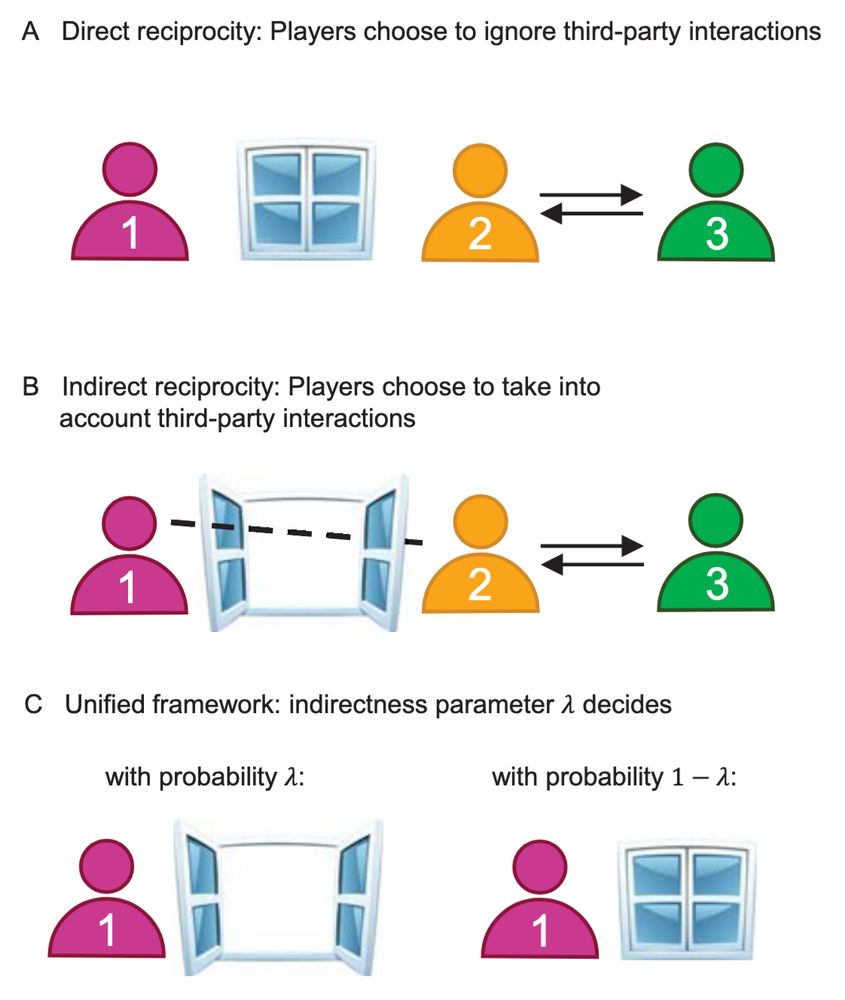
Strategies of reciprocity differ in whether players (here, player 1) take into account third-party interactions (here, between players 2 and 3). According to direct reciprocity, player 1 ignores third-party interactions. According to indirect reciprocity, player 1 takes such third-party interactions into account. The study's framework also allows for intermediate cases, where player 1 considers third-party interactions with some fixed probability λ.
A model of direct and indirect reciprocity—in which people act more favorably to people with good reputations—finds that full cooperation can always be sustained as a Nash equilibrium. In PNAS Nexus: academic.oup.com/pnasnexus/ar...
23.06.2025 20:46
👍 7
🔁 1
💬 1
📌 0
Although I'm formally a co-author of this paper, I actually learned quite a bit myself about both complex systems and multiagent learning while working on this project. Thanks Wolfram for leading this really nice effort to bring fields closer together!
18.06.2025 12:28
👍 3
🔁 0
💬 0
📌 0
How to cooperate for a sustainable future? We don't know (yet), but I'm thrilled to share that our new perspective piece has just been published in @pnas.org. Bridging complexity science and multiagent reinforcement learning can lead to a much-needed science of collective, cooperative intelligence.
17.06.2025 10:29
👍 11
🔁 6
💬 1
📌 2
This is a great opportunity to work with @yohm.bsky.social, one of the leading researchers in evolutionary game theory these days. 🙂
I can only recommend applying ⬇️
21.05.2025 08:50
👍 6
🔁 2
💬 0
📌 0
Texts
A little text about my journey with bipolar disorder. Seeing scientists speak openly about their experiences encouraged me to help break the stigma too. A part of me feels insecure about sharing this, but it also feels like the right thing to do.
adileyasar.github.io/one-of-these...
11.05.2025 11:06
👍 19
🔁 1
💬 2
📌 2
Reconciling ecology and evolutionary game theory or “When not to think cooperation” | PNAS
Evolutionary game theory (EGT)—overwhelmingly employed today for the study of cooperation
in various systems, from microbes to cancer and from inse...
Corina Tarnita and I have discussed the relation between theoretical ecology and evolutionary game theory since my sabbatical in 2022. Now the paper is out, doi.org/10.1073/pnas... Cooperation in nature may not be mysterious when there are growth differences- questioning the notion of cooperation.
09.04.2025 15:57
👍 27
🔁 8
💬 1
📌 0

How valuable is memory? In my very first paper, now published in Economics Letters, together with @chilbe.bsky.social and @nikoletaglyn.bsky.social, we give sufficient conditions under which a player can afford to remember less than their opponent. 🧵
📜 doi.org/10.1016/j.ec...
06.04.2025 12:17
👍 38
🔁 5
💬 4
📌 2

Rep2SI: Reputation & the Reproduction of Social Inequality. A Leverhulme-funded project based at the LSE, combining ethnography, economic games, and modelling. We're looking for a modeller to join our core team as a two-year postdoctoral research officer.
🚨Job alert! Two-year postdoc to join the Rep2SI project at @lsemethodology.bsky.social! We're looking for a modeller to join our team of ethnographers & experimentalists studying the role of reputation and reputational concern in perpetuating social inequality.
Apply by 4 May: tinyurl.com/yjccd3vv
01.04.2025 20:41
👍 43
🔁 45
💬 1
📌 2
Awesome news, congrats! 🙂
17.03.2025 07:12
👍 2
🔁 0
💬 1
📌 0
🚨 POSTDOC WANTED 🚨
Join the Behavioral Economics of Crime & Conflict Group at MPICSL in Freiburg!
We're seeking a behavioral scientist with PhD in economics, psychology, or related. Experience with experiments is key.
Full time, 2 years, no teaching. Apply now!
tinyurl.com/FGR251
#EconSky
14.02.2025 13:44
👍 21
🔁 21
💬 1
📌 3
Thanks for making me aware of the paper! I'm wondering whether the choice of game makes the difference here (volunteer's dilemma versus prisoner's dilemma). Either way, I'll have to read the paper more closely! :-)
16.02.2025 21:00
👍 1
🔁 0
💬 1
📌 0
Thanks for making me aware! It seems to me the two studies have slightly different setups (in ours, participants keep their co-player for many rounds, and they "only" engage in two different versions of a prisoner's dilemma). But I like your setup and your results a lot!
12.02.2025 10:27
👍 1
🔁 0
💬 1
📌 0
Thanks David!
12.02.2025 07:28
👍 0
🔁 0
💬 0
📌 0
When individuals engage in several games, there can be spillovers from one game to another. In principle, such spillovers could be used strategically to promote cooperation across games. However, our experiment suggests people in concurrent games cooperate less, compared to a control treatment.
12.02.2025 02:32
👍 3
🔁 0
💬 1
📌 0
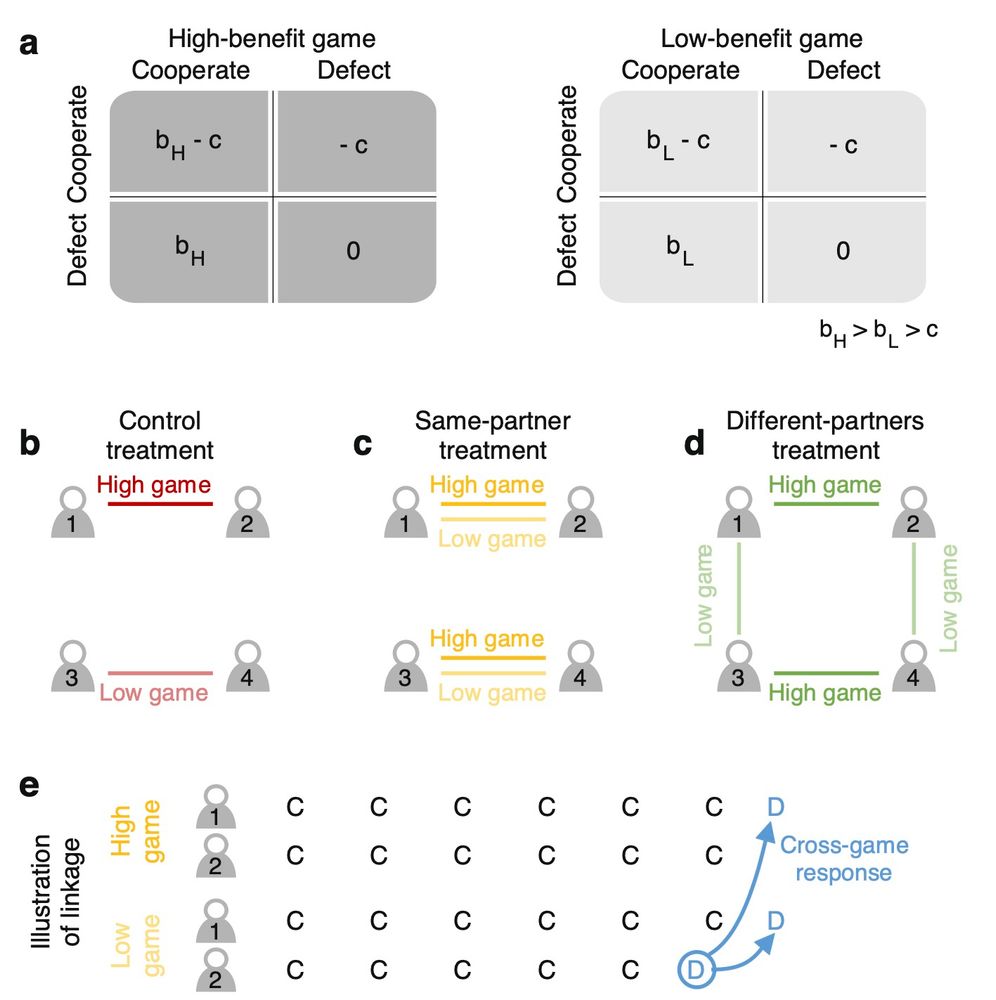
In game theory, we often assume that people only interact in one game at a time. In a new paper, we explore theoretically and experimentally how people cooperate when they engage in two games concurrently, either with the same partner or with different partners, www.nature.com/articles/s41...
12.02.2025 02:32
👍 45
🔁 15
💬 5
📌 0