OSF
More detail here: osf.io/preprints/ps.... Huge thanks to @teresadelbianco.bsky.social, Emily, Mairéad, Roberto, @pdbright.bsky.social, Atsushi, Evelyne, and our funders: @ucl.ac.uk, @leverhulme.ac.uk, @wellcometrust.bsky.social, ESRC, & @britishacademy.bsky.social (3/3).
10.05.2025 07:19
👍 2
🔁 0
💬 0
📌 0
We found that after initially looking at faces & mouths, biling infants disengaged more than monos to view other areas of the scene (7-18mo, n=131). In contrast, biling toddlers increased mouth-looking more over stimulus time than monos (18-34mo, n=745 from dHCP) (2/3).
10.05.2025 07:19
👍 2
🔁 0
💬 1
📌 0
How does early bilingualism affect social attention strategies? 👀 In our new preprint, we use within-trial growth curve analysis to test differences in how monolingual and bilingual children allocate their attention over time to static faces and dynamic mouths. (1/3)
10.05.2025 07:19
👍 2
🔁 4
💬 1
📌 0
Looking forward to it! 🧠
17.04.2025 10:04
👍 1
🔁 1
💬 0
📌 0
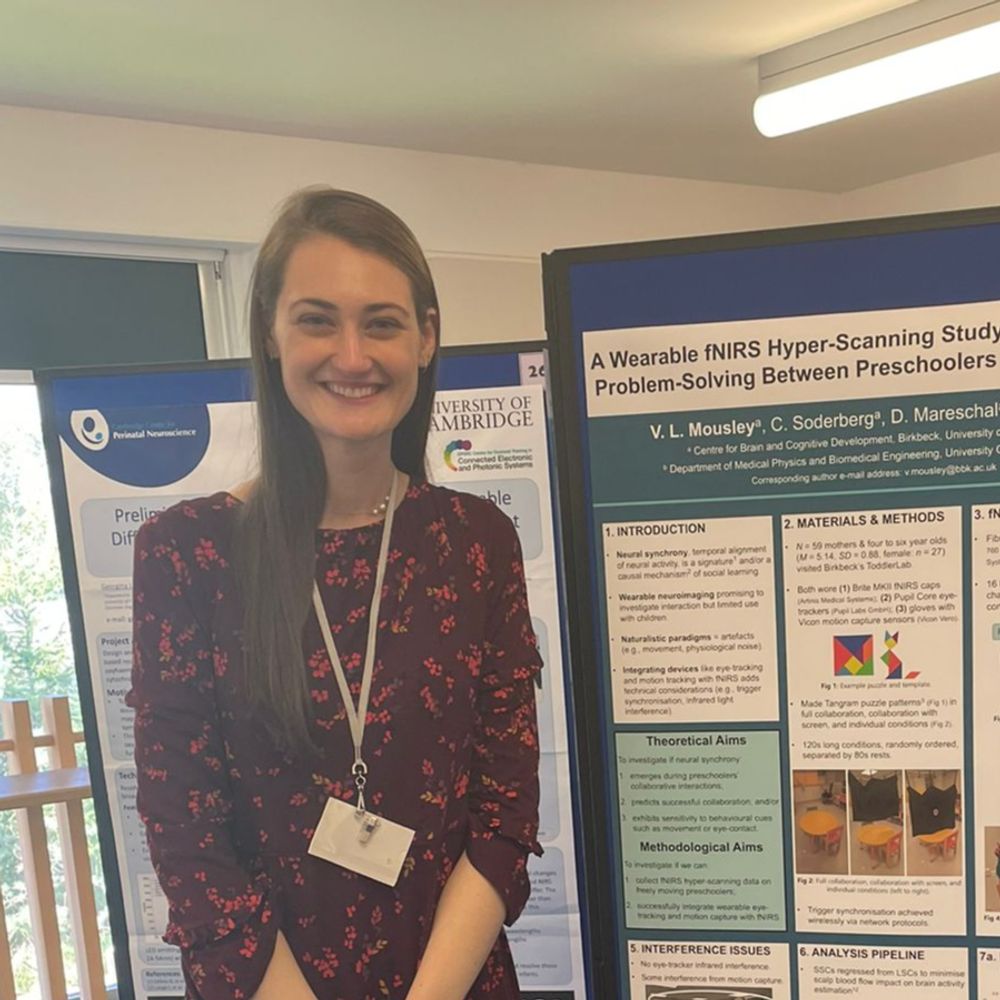
We show that NIRS signals are contaminated by non-neural signals that, if not removed, can artificially inflate brain-to-brain synchrony measurement. It is also likely that some degree of synchrony is driven by perception of a shared task/environment. To examine this, (2/4)
24.03.2025 15:21
👍 0
🔁 0
💬 1
📌 0
Happy to share our new study on neural synchrony during children's collaborative problem-solving! We use wearable fNIRS (@artinis.bsky.social) to replicate findings that synchrony emerges between 4-6yos and parents during collaboration & provide new insight into what it might mean. (1/4)
24.03.2025 15:21
👍 3
🔁 3
💬 1
📌 0
we create a pseudodyad distribution that preserves task-related frequencies whilst disrupting temporal information in the signal. Results suggest synchrony is at least partially related to patterns of social interaction & isn't driven entirely by a shared task/environment. (3/4)
24.03.2025 15:21
👍 0
🔁 0
💬 1
📌 0