
Our package estar for quantifying ecological stability is out: MEE @britishecologicalsociety.org! Provides 11 stability metrics for measuring stability at different levels of organization, from individuals to populations, communities + ecosystems. besjournals.onlinelibrary.wiley.com/doi/10.1111/...
02.03.2026 16:49
👍 11
🔁 5
💬 1
📌 0

📢 You look for a student #Job? You'd like to contribute to current research topics about birds🪶🐦 & #WestNileVirus?
Then be part of a consortium on "Combating #WNV through an integrated #OneHealth approach" #TUBerlin , #Charite, #FUBerlin, #UniBayreuth ... Apply here at #IZW:
short.sg/j/63072339
24.02.2026 17:06
👍 0
🔁 1
💬 0
📌 0
Suggestions for how to develop systematic approaches to create equitable futures for individuals with disabilities in higher education
https://www.mdpi.com/2076-0760/15/2/94
🧵 by author:
04.02.2026 15:28
👍 2
🔁 1
💬 0
📌 0

Led by Viktoriia Radchuk, an international collaboration shows phenological shifts in response to changing temperatures allow populations to remain stable or even increase in numbers.
Support from #sDiv @idiv-research.bsky.social
18.01.2026 11:16
👍 29
🔁 16
💬 1
📌 5

Our findings reveal how social structure and non-random dispersal generate hidden genetic structure and result in heterogenous rates of adaptive evolution.
Led by the *brilliant* Kasha Strickland!
#longterm
17.11.2025 16:13
👍 1
🔁 0
💬 0
📌 0

This demonstrates adaptive benefits of gene flow and no evidence for selection against males from outside the Crater.
Finally, additive genetic variance in fitness differed among clans. This is cool because it shows that evolutionary potential is unevenly distributed across the population.
3/4
17.11.2025 16:13
👍 2
🔁 0
💬 1
📌 0

The differences were best explained by asymmetric dispersal between clans. This indicates that social processes drive population stratification.
We also found that hyenas with more foreigner ancestry (i.e., from outside the #Ngorongoro Crater) had higher fitness.
2/4
17.11.2025 16:13
👍 0
🔁 0
💬 1
📌 0
How do social structure and male-biased dispersal shape genetic structure and evolutionary potential?
We analysed 29yrs of demographic + genome-wide data from >1100 #hyenas.
We found consistent genetic differentiation in our 8 study clans. This reflects cryptic population genetic structure.
1/4
17.11.2025 16:13
👍 6
🔁 0
💬 1
📌 0

Photo with a blue tit and information text of how to apply for the announced postdoc position.
📢 #Postdoc (75%) 3+2 years on identifying #West-Nile-Virus wildlife hosts and #modelling spatial risk factors.
Be part of a consortium on "Combating #WNV through an integrated #OneHealth approach" w #TUBerlin , #Charite, #FUBerlin, #UniBayreuth and health authorities
▶️ tinyurl.com/yuhfwpdr
16.10.2025 14:53
👍 8
🔁 9
💬 2
📌 2

We are hiring - PDRA position exploring how information access shapes social dynamics in killer whales. Collaboration with @samellisq.bsky.social @drwhale.bsky.social Prof Dan Franks (York) start 1st Nov (or ASAP) end 31st Oct 2028. Apps close on 19th Oct.
www.jobs.ac.uk/job/DOT336/p...
23.09.2025 18:29
👍 32
🔁 44
💬 1
📌 5

Please RT!
📢 #Doctoral / #PhD position available with us at Leibniz-IZW for 4 years working at the interface of #wildlife + #disease #ecology, #veterinary sciences and #modelling.
🐗🐗🐗🐦🐦🐦
Training within #DFG #RTG 3069 led by @freieuniversitaet.bsky.social
▶️Apply here for P7: tinyurl.com/j2ehtz7m
19.09.2025 10:09
👍 10
🔁 21
💬 1
📌 0
Come and work with us! Three new academic posts (including Animal Behaviour) and superb facilities in the new Life & Mind Building
15.09.2025 12:54
👍 31
🔁 31
💬 2
📌 0
Five misunderstandings in animal social network analysis
🐒🕸️ New preprint! Confused about how to model animal social networks?
ASNA can be confusing—but also full of opportunity. We break down 5 common misunderstandings in animal social network analysis and share solutions from behavioural ecology, anthro, stats, & network science. Hope it helps!
A 🧵
04.08.2025 16:21
👍 47
🔁 23
💬 2
📌 3
I think this thread might be the most fascinating read on Bluesky right now!
28.07.2025 14:28
👍 19
🔁 15
💬 0
📌 0

Published 📖 🥳 In a new meta-analysis @mariusgrabow.bsky.social studied whether subtle infection, traditionally often considered as relatively benign, affect phenotypic and demographic traits. Using avian blood parasites, causing #avianmalaria as an example, we performed a systematic review 🧵
16.07.2025 15:30
👍 6
🔁 4
💬 2
📌 0
Our #study finds that #male #dominance isn't the norm among #primates, and starts to unravel what shapes flexibility in intersexual power
paper (OA) https://www.pnas.org/doi/10.1073/pnas.2500405122
press release https://www.mpg.de/24986976/0630-evan-beyond-the-alpha-male-150495-x?c=2249
08.07.2025 13:55
👍 75
🔁 50
💬 3
📌 2

Screenshot of the online app, showing the sliders for the settings of different social parameters on the left and the result relatedness and competition patterns on the right. The settings reflect the case we found for chimpanzees.
Want to explore the expected relatedness in different social groups - and how this can affect competition? Check out the neat app L. White did for our paper: https://bsky.app/profile/drlozwhite.bsky.social/post/3lsgieizk4k2a
paper: https://royalsocietypublishing.org/doi/10.1098/rsos.250385
25.06.2025 13:46
👍 7
🔁 3
💬 0
📌 0

Two of the scientific graphs from the linked paper. The left side shows that as female chimpanzees get older, their relatedness to the males in their community increases because they now include their sons. The relatedness to other females however stays low, because new unrelated females constantly join the community. The graph on the right shows that these age-related changes in relatedness mean that females are expected to act selfish when they are young, but care about others in the group when they are older.
We have a new paper:
"intergenerational conflict among females may play a role in the evolution of #chimpanzee #menopause"
https://royalsocietypublishing.org/doi/10.1098/rsos.250385
25.06.2025 10:39
👍 17
🔁 10
💬 0
📌 0
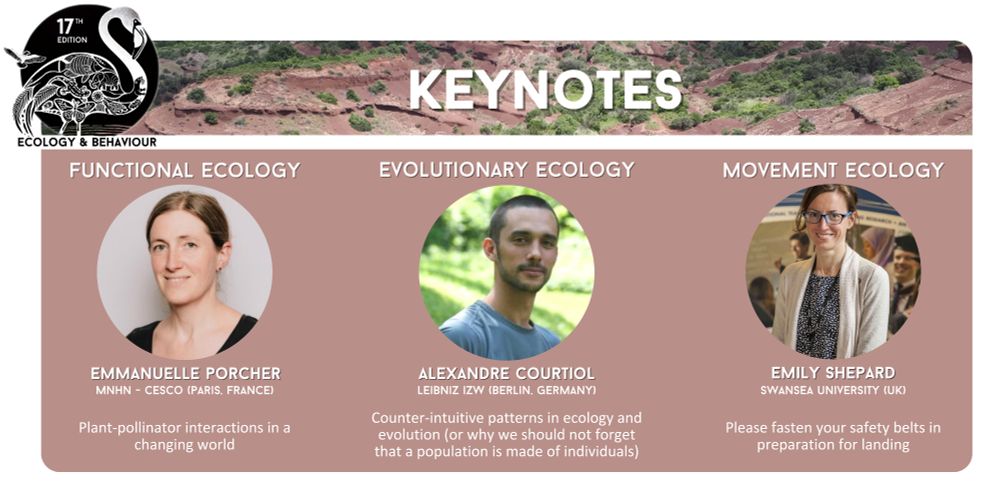
We are delighted to introduce the first three keynote speakers
Emmanuelle Porcher cesco.mnhn.fr/fr/annuaire/...
Alexandre Courtiol www.izw-berlin.de/en/alex-cour...
Emily Shepard www.swansea.ac.uk/staff/e.l.c....
➡️For more details on their research ecobhvr2025.sciencesconf.org?lang=en
More to come!
26.05.2025 15:32
👍 13
🔁 8
💬 2
📌 1
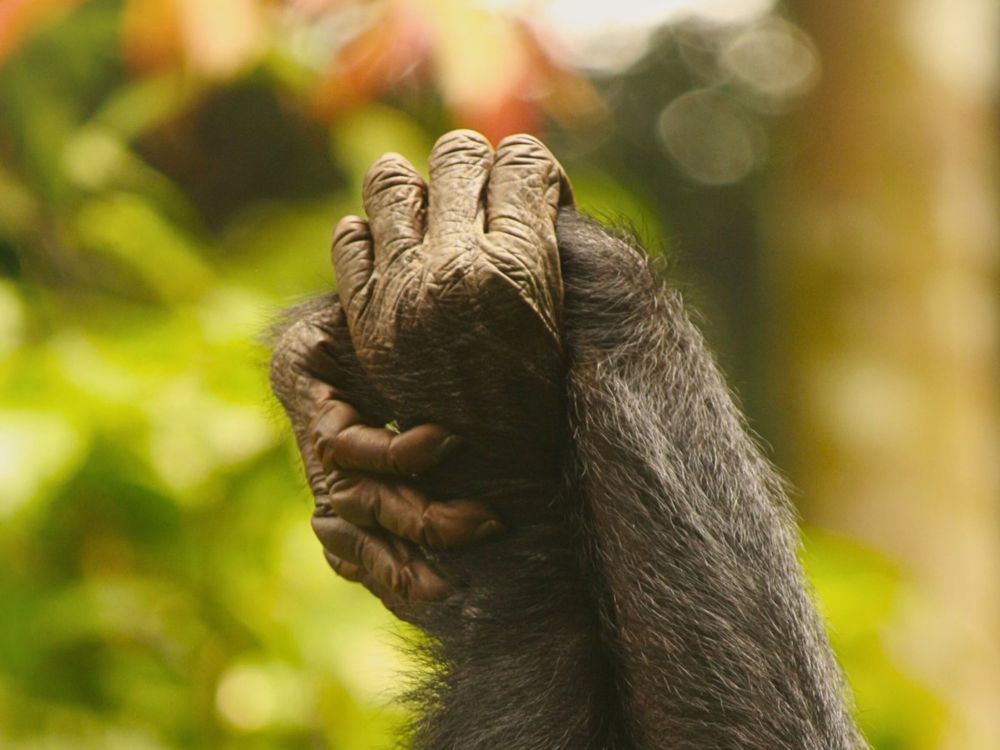
Female solidarity keeps male bonobos in check
Study on wild bonobos reveals that females team up to maintain power in their societies
Bonobo societies are famous for being “female dominant.” But females are weaker than males, so how can this be? Study by Barbara Fruth and Martin Surbeck on wild bonobos explains how.
Hint: it has to do with female solidarity.
Paper ▶️ www.nature.com/articles/s42...
www.ab.mpg.de/673281/news_...
24.04.2025 16:11
👍 98
🔁 39
💬 1
📌 12
New paper out by @mariusgrabow.bsky.social studying movement behaviour of European Starlings equipped with high resolution ATLAS tags. Some individuals were naturally infected with avian blood parasites, decreasing their movements behaviour and increasing their resting behaviour 🧵
#movementecology
10.04.2025 16:04
👍 3
🔁 1
💬 1
📌 0
Two year postdoc position to build mathematical and agent-based models to understand the role of reputation in social inequality (deadline 4 May)
02.04.2025 10:25
👍 9
🔁 12
💬 0
📌 0
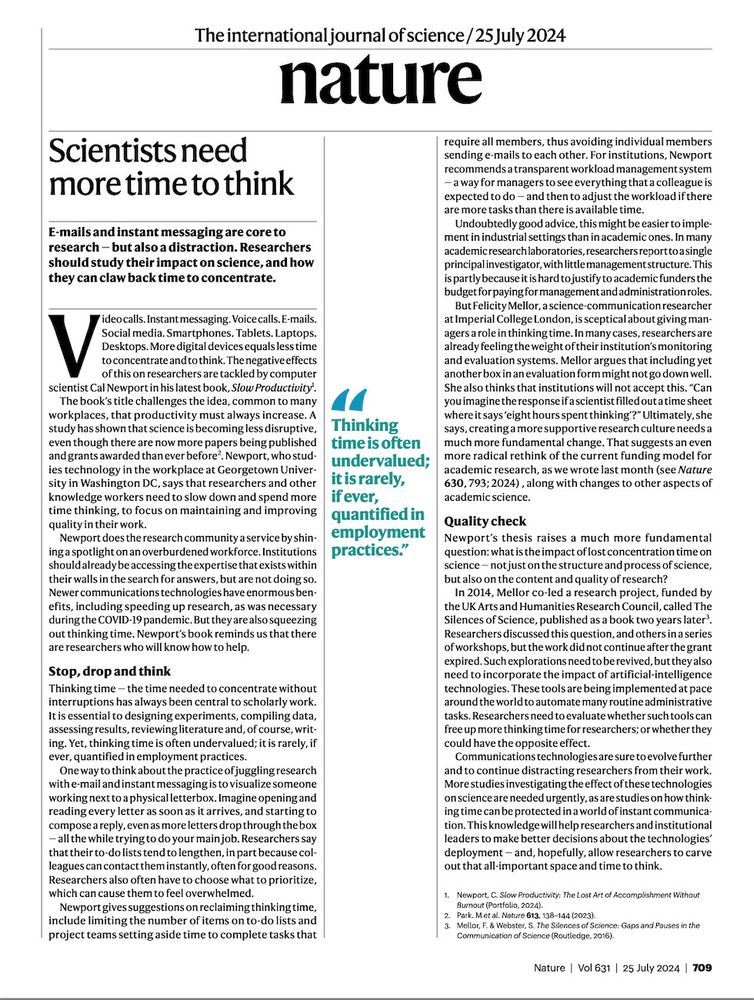
Scientists need more time to think
Good piece by @natureportfolio.bsky.social. The erosion of thinking time—driven by admin, bureaucracy, industry agendas, and unrealistic output targets—stifles curiosity-led science. These pressures undermine innovation and the intellectual freedom vital for real progress. 🧪🌱🌍 #ScienceIsNotBusiness
26.12.2024 14:52
👍 381
🔁 116
💬 14
📌 10


