
Markets and Mobility: How Employers Structure Economic Opportunity

Intergenerational mobility, measuring the ability to achieve economic success regardless of family background, is a critical reflection of a society’s commitment to equality of opportunity. Rising income inequality has raised concerns about the potential erosion of upward mobility. While education has traditionally been viewed as the path to mobility, its transformative power is facing challenges in a rapidly evolving job market. This project reorients the focus of intergenerational mobility research by highlighting the labor market as an arena for the reproduction of advantage. It employs a comparative approach, using administrative data from four countries: Sweden, Austria, England, and the United States. It also incorporates evidence from a broader set of nations through cross-national surveys, longitudinal household surveys, labor force surveys, secondary data, and digital trace data. The project employs cutting-edge empirical methods, including quasi- experimental designs, event studies, within-family comparisons, decomposition analyses, counterfactual simulations, and diagnostic checks to rigorously assess the extent of inequalities in the labor market. The research investigates how family background influences the sorting of individuals to employers and workplaces, accounting for education and occupation, and explores variations in career progression within and between employers. It comprehensively catalogues and assesses mechanisms shaping workplace inequality, contributing to the development of social closure theory. Additionally, the project evaluates intervention strategies, encompassing both employer practices and government actions, to promote fair opportunity in the labor market.
JOB! I'm hiring a postdoc for 2 years on my ERC MaMo project.
Looking for someone with strong quant methods, ongoing work close to the project's aims, and a desire to publish in sociology. Start flexible in the next 12 months.
Formal call out shortly, but contact me first.
21.01.2026 12:32
👍 101
🔁 109
💬 0
📌 6
Everyone talks about the "credibility revolution", but I think one of the most valuable shifts in econ over the last decade has been the rise of rigorous descriptive historical work like this in top journals:
18.01.2026 11:45
👍 74
🔁 14
💬 3
📌 0

I really want to stay optimistic about how LLMs can revolutionize social science research. But the fact that I can't get GPT-5.2 to perform a simple word count really makes me wonder about the flurry of papers coming that heavily relies on LLMs for analyzing unstructured data.
09.01.2026 15:23
👍 4
🔁 0
💬 0
📌 0
Free tip for authors who want to speed up publication: make it make sense. An untold source of delay is reviewers struggling to understand what you even mean.
08.01.2026 10:39
👍 30
🔁 3
💬 2
📌 2

It’s kind of ironic that the Toner-Rodgers paper on AI and chemical science was entirely correct, even though it was completely made up.
06.01.2026 05:03
👍 1
🔁 0
💬 0
📌 0

Can state-building disrupt rather than stabilize society? In a new @apsrjournal.bsky.social article, @victorgayeco.bsky.social and I show that the expansion of state communication networks spurred rebellion for decades in France before the Revolution
👉 Article: doi.org/10.1017/S000...
🧵1/X
05.01.2026 20:43
👍 43
🔁 18
💬 1
📌 3
New edition of our workshop, with @essobecker.bsky.social as keynote. Join us in Uppsala on May 28/29 and please repost if you can!
01.12.2025 10:42
👍 5
🔁 1
💬 0
📌 1
See you in Uppsala 🇸🇪 🎉
01.12.2025 10:40
👍 11
🔁 1
💬 0
📌 0
The deadline for our workshop in economic history with Elias Papaioannou as keynote speaker is approaching fast, make sure to apply!
13.01.2025 07:42
👍 12
🔁 11
💬 0
📌 3
That's like four economics awards in a row with a substantial economic-history component, right? That strikes me as a remarkable shift. www.nobelprize.org/prizes/lists...
13.10.2025 10:02
👍 60
🔁 22
💬 5
📌 5

Examining the social construction of race during the US Reconstruction Era finds that people with the same skin tone were racialized based on their wealth, setting a path for racial stratification, from @aadukia.bsky.social, Hornbeck, Keniston, and Lualdi https://www.nber.org/papers/w33502
27.02.2025 14:00
👍 39
🔁 16
💬 0
📌 3
Awesome!
30.01.2025 21:15
👍 1
🔁 0
💬 0
📌 0
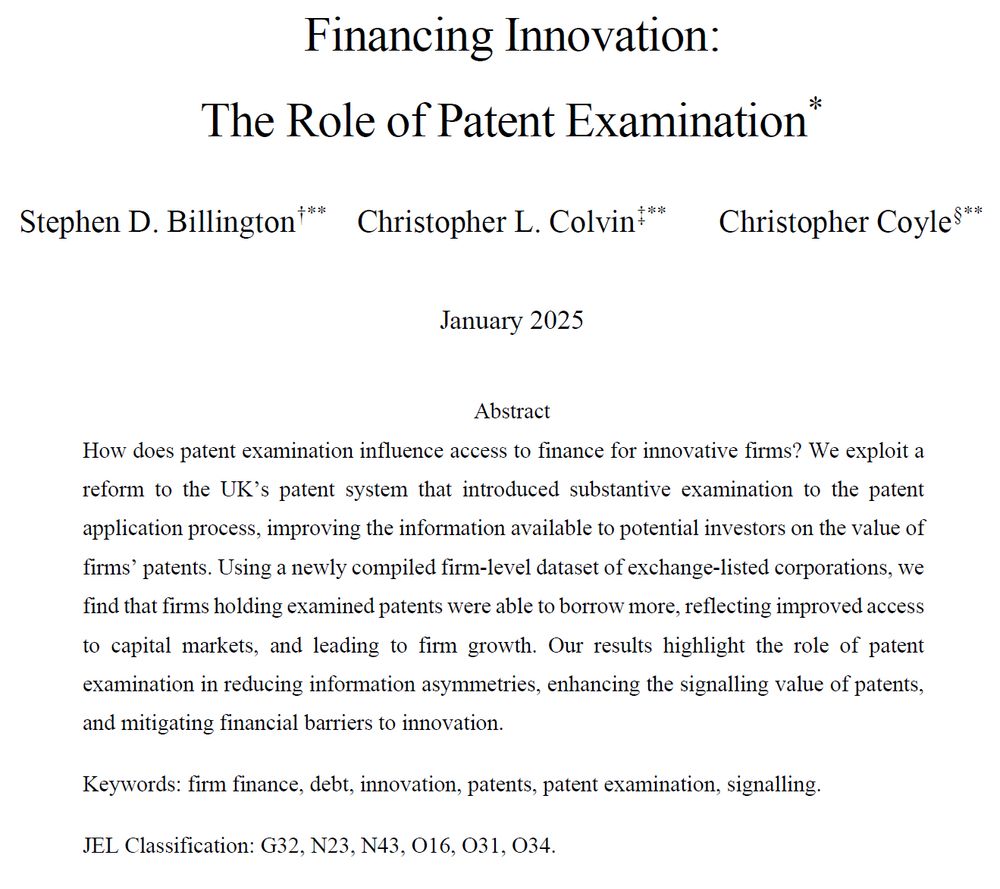
Financing Innovation: The Role of Patent Examination.
Stephen D. Billington, Christopher L. Colvin and Christopher Coyle.
How does patent examination influence access to finance for innovative firms? We exploit a reform to the UK’s patent system that introduced substantive examination to the patent application process, improving the information available to potential investors on the value of firms’ patents. Using a newly compiled firm-level dataset of exchange-listed corporations, we find that firms holding examined patents were able to borrow more, reflecting improved access to capital markets, and leading to firm growth. Our results highlight the role of patent examination in reducing information asymmetries, enhancing the signalling value of patents, and mitigating financial barriers to innovation.
New working paper alert: "Financing Innovation: The Role of Patent Examination". @steve-bill-econ.bsky.social, Christopher Coyle and I have been working on this for quite a while now. We are excited to have a full draft for your enjoyment! www.quceh.org.uk/uploads/1/0/...
28.01.2025 15:28
👍 12
🔁 6
💬 2
📌 3

🚨 New Working Paper 🚨
w/ @pdavidboll.bsky.social and @jvoth.bsky.social
Do you run regressions on spatial data? Then keep reading!
We present a guide and Stata package for methods by Müller and Watson (2024 ECTA) to deal with Spatial Unit Roots in Regressions.
Link in 🧵 (1/n)
22.01.2025 12:38
👍 70
🔁 26
💬 1
📌 2
Thanks for the clarification @alexanderdonges.bsky.social!
17.01.2025 11:17
👍 1
🔁 0
💬 0
📌 0
I thought several German states had general incorporation laws already in the 1860s and that it became Reich law from 1871? I also think I recall talks about a "Gründerboom" in the early 1870s as a result of the legislative changes?
16.01.2025 19:21
👍 1
🔁 0
💬 1
📌 0
Inventors among the “Impoverished Sophisticate” | The Journal of Economic History | Cambridge Core
Inventors among the “Impoverished Sophisticate” - Volume 84 Issue 4
New Publication! 🎉 Congratulations to @erikprawitz.bsky.social and @thorberger.bsky.social for publishing their paper "Inventors among the 'Impoverished Sophisticate'" in the prestigious Journal of Economic History! 🤩
29.11.2024 13:48
👍 6
🔁 2
💬 0
📌 0
Thanks for your interest, Alice - I'll send you a copy!
27.11.2024 12:50
👍 1
🔁 0
💬 0
📌 0
Göran Greider har 660 följare (@gorangreider.bsky.social). Expressens kulturchef Victor Malm har dubbelt så många (@victormalm.bsky.social), men Projekt Runeberg (@runeberg-org.bsky.social) har ännu bara ett ensiffrigt antal. Hur ska vi ändra på det? Dela vidare!
17.11.2024 20:58
👍 19
🔁 30
💬 2
📌 2

Maybe 19th-century technological change wasn't deskilling after all:
21.11.2024 18:11
👍 4
🔁 0
💬 0
📌 0

När klockan är 12 i Stockholm, hvad är den då på andra orter i Sverige? Nödvändig kunskap 1858 eller bara ett kuriosum? runeberg.org/svea/1858/02... Västra stambanan invigdes 1862. Enhetlig normaltid infördes 1879.
20.11.2024 10:54
👍 42
🔁 17
💬 0
📌 6
I made a quick starter pack on scholars working/having worked on historical political economy (wide definition). go.bsky.app/Hz9LmgL
(please make [self]suggestions to improve the starter pack)
21.11.2024 10:01
👍 30
🔁 10
💬 4
📌 1

Today and tomorrow we will celebrate the life and work of the late Nick Crafts ❤️
Nick was a fantastic colleague, friend, and founding director of @cagewarwick.bsky.social
Today's Crafts Lecture will be given by the wonderful Leah Boustan.
Full program 👇
warwick.ac.uk/fac/soc/econ...
20.11.2024 08:08
👍 60
🔁 14
💬 0
📌 3


