Camille Grasso's Avatar

Camille Grasso

@grassocamille

Cognitive neuroscientist at LPNC / CNRS (France) & Wake Forest University (USA). Focused on subjective experience of duration, conceptual and neural geometry of time, EEG, iEEG, and voltammetry. https://grassocamille.netlify.app/

654
Followers
357
Following
18
Posts
12.09.2023
Joined
Posts Following

Latest posts by Camille Grasso @grassocamille

Objects warp space in our mind, and events warp time in our mind. @samiyousif.bsky.social and I teamed up to review the work in these two literatures and suggest that there may be deep connections across them (with analogous influences of objects on space and events on time).

27.02.2026 16:02 πŸ‘ 20 πŸ” 4 πŸ’¬ 1 πŸ“Œ 0

1/6 Happy to share our new paper with @grassocamille.bsky.social and @virginievanw.bsky.social: "Nested contextual change and the temporal compression of episodic memory". www.biorxiv.org/content/10.6...

27.02.2026 18:25 πŸ‘ 25 πŸ” 11 πŸ’¬ 1 πŸ“Œ 1
Preview
Pace of ecology drives the tempo of visual perception across the animal kingdom Nature Ecology & Evolution - Using phylogenetic comparative methods across 237 species from disparate phyla, the authors show that species with fast-paced ecologies have higher temporal...

Our new paper is now out showing how time perception in animals is linked to their ecology. Using data from 237 species we show temporal perception is faster in species that fly and pursuit predators www.nature.com/articles/s41... 🌐

24.02.2026 13:22 πŸ‘ 138 πŸ” 60 πŸ’¬ 3 πŸ“Œ 2

AND I’ve been awarded a Global Marie SkΕ‚odowska-Curie Postdoctoral Fellowship πŸŽ‰ with Dr. Kishida and @nfaivre.bsky.social to pursue MIND: combining voltammetry & ephys to test how phasic dopamine fluctuations shape perceived duration and neural dynamics.
Feeling unbelievably lucky and grateful 🫢⏱️

17.02.2026 18:21 πŸ‘ 9 πŸ” 1 πŸ’¬ 1 πŸ“Œ 0

I’ve just moved to the US to train in human voltammetry with Dr. Kishida and Dr. @nfaivre.bsky.social, as part of Nathan's VOLTA project, to study the neurochemical x electrophy' bases of the felt duration of conscious experience. Feeling truly grateful to be here, and for the trust and support.

17.02.2026 18:21 πŸ‘ 2 πŸ” 0 πŸ’¬ 1 πŸ“Œ 0

I can’t quite believe I’m writing this, but… πŸ‡ΊπŸ‡Έβœ¨

17.02.2026 18:21 πŸ‘ 1 πŸ” 0 πŸ’¬ 1 πŸ“Œ 0

Are you sure there’s no mosquito in the room?
With @matanmazor.bsky.social, Chichi DΓ©zier, @nfaivre.bsky.social & Louise Goupil, we study how we combine multiple sensory sources to be confident in presence and absence: While detection rely on one modality, confidence requires both channels to align!

26.01.2026 06:49 πŸ‘ 14 πŸ” 10 πŸ’¬ 0 πŸ“Œ 1
Preview
Making sense of principal component analysis, eigenvectors & eigenvalues In today's pattern recognition class my professor talked about PCA, eigenvectors and eigenvalues. I understood the mathematics of it. If I'm asked to find eigenvalues etc. I'll do it correctly li...

still one of the best explanations of principal component analysis (pca), explained at different levels from layman to the more math inclined stats.stackexchange.com/a/140579/132...

13.01.2026 15:51 πŸ‘ 63 πŸ” 18 πŸ’¬ 1 πŸ“Œ 1

Modeling Speed–Accuracy Trade-Offs in the Stopping Rule for Confidence Judgments! Now out in #PsychologicalReview (aka we can finally say we do comp models)! Led by @stefherregods.bsky.social @lucvermeylen.bsky.social @pierreledenmat.bsky.social

Paper: desenderlab.com/wp-content/u... Thread ↓↓↓

16.12.2025 15:52 πŸ‘ 31 πŸ” 15 πŸ’¬ 1 πŸ“Œ 0
Preview
Modelling time-resolved electrophysiological data with Bayesian generalised additive multilevel models Providing utility functions for fitting Bayesian generalised additive multilevel models (BGAMMs) to time-resolved data (e.g., M/EEG, pupillometry, mouse-tracking, etc) and identifying clusters.

If you analyse time-resolved data (M/EEG, iEEG, pupillometry, force recordings…) and feel limited by cluster-based permutation tests (CBPTs); especially when trying to determine when an effect starts or ends; you may want to try our new R package: lnalborczyk.github.io/neurogam/
#rstats #brms #EEG

11.12.2025 11:38 πŸ‘ 69 πŸ” 28 πŸ’¬ 6 πŸ“Œ 1
Post image

Hey, listen! Very excited for the next @timingresforum.bsky.social virtual Journal Club!

Farzaneh Najafi will be giving a talk on her recent work on intrinsic timing and ramping dynamics in visual and parietal cortices. Registration link below!

Wed 12/10 @ 10am EST

mailchi.mp/864719714f87...

05.12.2025 15:23 πŸ‘ 8 πŸ” 4 πŸ’¬ 0 πŸ“Œ 1

Our review on intracranial research on consciousness is now out as a preprint: arxiv.org/abs/2510.08736. I believe that intracranial recordings provide one of the most exciting avenues for research on consciousness right now! If you agree, I think you will find the review interesting πŸ€“

13.10.2025 15:34 πŸ‘ 11 πŸ” 3 πŸ’¬ 1 πŸ“Œ 0
Video thumbnail

If you attend #TRF4 in Tokyo and always wondered how humans represent durations, make sure to check out @grassocamille.bsky.social’s talk on Sunday morning!

Spoiler: Durations are mentally organised along (at least) three interpretable dimensions! More complex structure than we previously assumed.

17.10.2025 00:41 πŸ‘ 10 πŸ” 1 πŸ’¬ 0 πŸ“Œ 0
Preview
Impact of Task Similarity and Training Regimes on Cognitive Transfer and Interference Learning depends not only on the content of what we learn, but also on how we learn and on how experiences are structured over time. To investigate how task similarity and training regime interact dur...

🚨 New preprint! Impact of Task Similarity and Training Regimes on Cognitive Transfer and Interference 🧠

We compare humans and neural networks in a learning task, showing how training regime and task similarity interact to drive transfer or interference.

www.biorxiv.org/content/10.1...

23.09.2025 11:58 πŸ‘ 22 πŸ” 11 πŸ’¬ 1 πŸ“Œ 0
Preview
Intrinsic interval timing, not temporal prediction, underlies ramping dynamics in visual and parietal cortex, during passive behavior Neural activity following regular sensory events can reflect either elapsed time since the previous event (temporal signaling) or temporal predictions and prediction errors about the next event (tempo...

Very exciting article by Farzaneh Najafi (not on Bsky?) on interval timing as an intrinsic property of visual cortex!

Intrinsic interval timing, not temporal prediction, underlies ramping dynamics in visual and parietal cortex, during passive behavior

www.biorxiv.org/content/10.1...

29.09.2025 14:26 πŸ‘ 2 πŸ” 2 πŸ’¬ 0 πŸ“Œ 0
Post image

Very excited to have @brynnsherman.bsky.social join us for the next @timingresforum.bsky.social Virtual Journal Club! Please join us for what should be a very interesting talk on her recent work! Sign-up details below:

mailchi.mp/28692b147cb0...

10.09.2025 17:20 πŸ‘ 16 πŸ” 5 πŸ’¬ 0 πŸ“Œ 1
Post image

Great to have another paper with @chazfirestone.bsky.social @ianbphillips.bsky.social and the brilliant Hanbei Zhou out! In this paper we demonstrate that stimuli within events are perceived further apart in time β€” an event-based analog of β€œobject-based warping”. psycnet.apa.org/record/2026-...

04.09.2025 16:27 πŸ‘ 84 πŸ” 20 πŸ’¬ 3 πŸ“Œ 3

Job announcement πŸ“’

@shawnrhoadsphd.bsky.social and I are looking for a joint postdoc interested in computational models of social interaction!

Interested? If you’ll be at #rlc2025 (or I missed you at #cogsci2025) feel free to reach out with any questions!

apply.interfolio.com/165809

04.08.2025 17:35 πŸ‘ 25 πŸ” 17 πŸ’¬ 0 πŸ“Œ 0
Preview
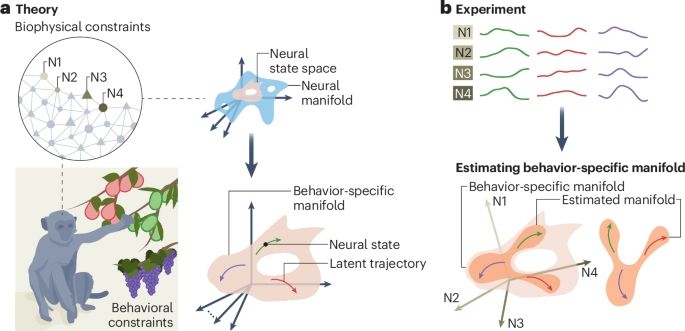
A neural manifold view of the brain - Nature Neuroscience Recent advances in neuroscience have revealed how neural population activity underlying behavior can be well described by topological objects called neural manifolds. Understanding how nature, nurture...

www.nature.com/articles/s41...

29.07.2025 11:32 πŸ‘ 29 πŸ” 4 πŸ’¬ 0 πŸ“Œ 0
Preview
Seeing the Mind, Educating the Brain

If you are in Paris on October 1-3 : we are organizing a fantastic cognitive neuroscience conference at Collège de France, on topics ranging from language to math, education and consciousness, with many of my favorite scientists !
Full program here:
www.unicog.org/seeing-the-m...

23.07.2025 14:46 πŸ‘ 78 πŸ” 33 πŸ’¬ 4 πŸ“Œ 2

Happy to have contributed together with @lgrabot.bsky.social to discuss #traveling_waves and cognition!

23.07.2025 05:16 πŸ‘ 20 πŸ” 7 πŸ’¬ 0 πŸ“Œ 0
Preview
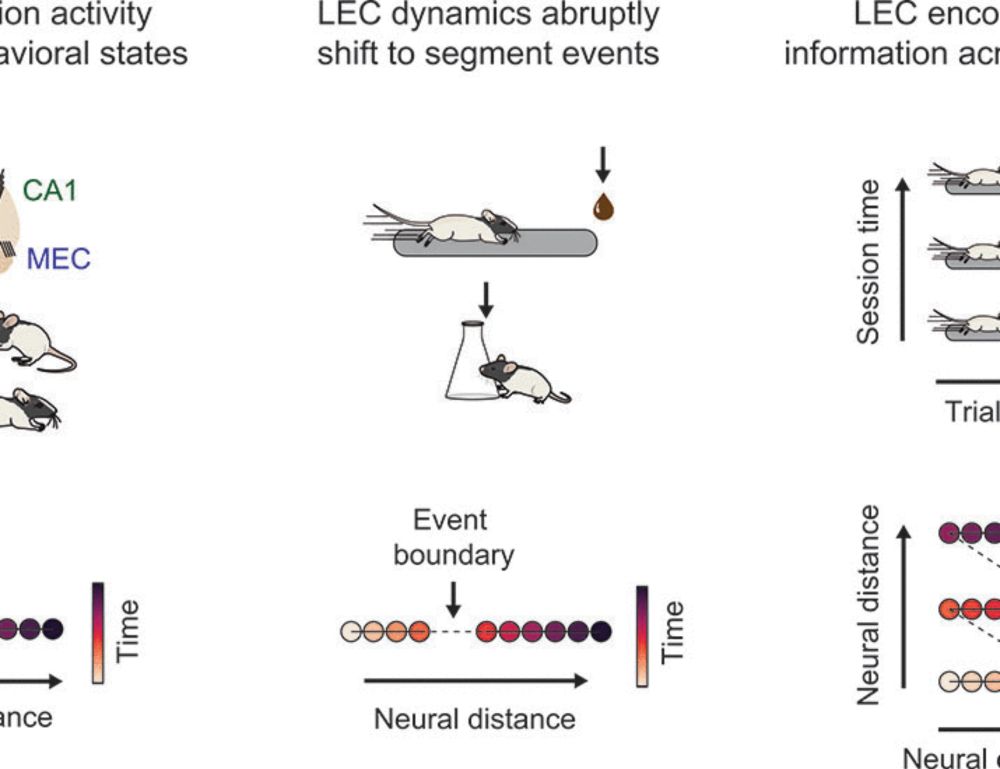
Event structure sculpts neural population dynamics in the lateral entorhinal cortex Our experience of the world is a continuous stream of events that must be segmented and organized at multiple timescales. The neural mechanisms underlying this process remain unknown. In this work, we...

Your brain doesn’t just passively track time ⏳ - it structures it.
In @Science.org we show that activity in 🧠 memory circuits (LEC) drifts constantly, but makes sharp jumps at key moments, segmenting life into meaningful events. (1/2)

πŸ‘‰ www.science.org/doi/10.1126/...

26.06.2025 18:06 πŸ‘ 207 πŸ” 58 πŸ’¬ 5 πŸ“Œ 6
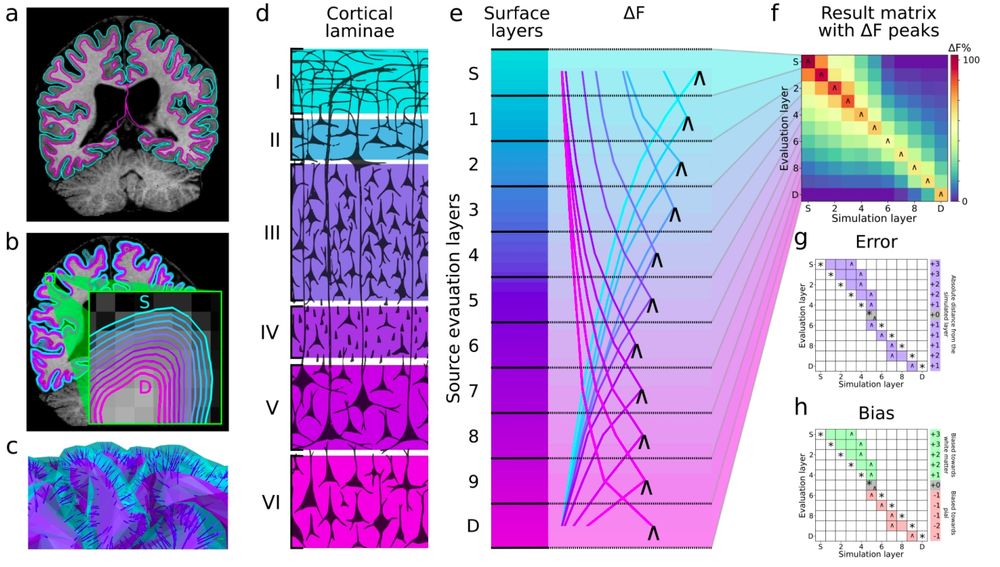
Overview of the simulation strategy and analysis. a) Pial and white matter boundaries
surfaces are extracted from anatomical MRI volumes. b) Intermediate equidistant surfaces are
generated between the pial and white matter surfaces (labeled as superficial (S) and deep (D)
respectively). c) Surfaces are downsampled together, maintaining vertex correspondence across
layers. Dipole orientations are constrained using vectors linking corresponding vertices (link vectors).
d) The thickness of cortical laminae varies across the cortical depth (70–72), which is evenly sampled
by the equidistant source surface layers. e) Each colored line represents the model evidence (relative
to the worst model, Ξ”F) over source layer models, for a signal simulated at a particular layer (the
simulated layer is indicated by the line color). The source layer model with the maximal Ξ”F is
indicated by β€œΛ„β€. f) Result matrix summarizing Ξ”F across simulated source locations, with peak
relative model evidence marked with β€œΛ„β€. g) Error is calculated from the result matrix as the absolute
distance in mm or layers from the simulated source (*) to the peak Ξ”F (Λ„). h) Bias is calculated as the
relative position of a peak Ξ”F(Λ„) to a simulated source (*) in layers or mm.

Overview of the simulation strategy and analysis. a) Pial and white matter boundaries surfaces are extracted from anatomical MRI volumes. b) Intermediate equidistant surfaces are generated between the pial and white matter surfaces (labeled as superficial (S) and deep (D) respectively). c) Surfaces are downsampled together, maintaining vertex correspondence across layers. Dipole orientations are constrained using vectors linking corresponding vertices (link vectors). d) The thickness of cortical laminae varies across the cortical depth (70–72), which is evenly sampled by the equidistant source surface layers. e) Each colored line represents the model evidence (relative to the worst model, Ξ”F) over source layer models, for a signal simulated at a particular layer (the simulated layer is indicated by the line color). The source layer model with the maximal Ξ”F is indicated by β€œΛ„β€. f) Result matrix summarizing Ξ”F across simulated source locations, with peak relative model evidence marked with β€œΛ„β€. g) Error is calculated from the result matrix as the absolute distance in mm or layers from the simulated source (*) to the peak Ξ”F (Λ„). h) Bias is calculated as the relative position of a peak Ξ”F(Λ„) to a simulated source (*) in layers or mm.

🚨🚨🚨PREPRINT ALERT🚨🚨🚨
Neural dynamics across cortical layers are key to brain computations - but non-invasively, we’ve been limited to rough "deep vs. superficial" distinctions. What if we told you that it is possible to achieve full (TRUE!) laminar (I, II, III, IV, V, VI) precision with MEG!

02.06.2025 11:54 πŸ‘ 112 πŸ” 45 πŸ’¬ 4 πŸ“Œ 8
Preview
Dopaminergic processes predict temporal distortions in event memory Our memories do not simply keep time - they warp it, bending the past to fit the structure of our experiences. For example, people tend to remember items as occurring farther apart in time if they spa...

New from our lab: your brain doesn’t just remember time - it bends it.

We show that the dopamine system responds to natural breakpoints in experience, and this relates to more stretched memories of time. Blinking also increases, signaling encoding of new memories.

www.biorxiv.org/content/10.1...

19.05.2025 21:56 πŸ‘ 94 πŸ” 35 πŸ’¬ 3 πŸ“Œ 3
Preview
Alpha power indexes working memory load for durations Timing, that is estimating, comparing, or remembering how long events last, requires the temporary storage of durations. How durations are stored in working memory is unknown, despite the widely held ...

Episode II of how are durations stored in working memory:
Besides replicating our previous findings, we find that
alpha power reflects a universal signature of WM load and mediates recall precision, even for abstract information like duration
www.biorxiv.org/content/10.1...
πŸ”½ co-authors below

15.05.2025 11:15 πŸ‘ 18 πŸ” 8 πŸ’¬ 1 πŸ“Œ 0

Please reach out if you’d like to come to sunny Aix-en-Provence (in the south of France) to work on anything related to the neural and computational bases of inner speech and/or mental/motor imagery!

10.05.2025 14:41 πŸ‘ 15 πŸ” 8 πŸ’¬ 0 πŸ“Œ 0

Please RTπŸ™

Reach out if you want to help understand cognition by modelling, analyzing and/or collect large scale intracortical data from πŸ‘©πŸ’πŸ

We're a friendly, diverse group (n>25) w/ this terrace 😎 in the center of Paris! SeeπŸ‘‡ for + info about the lab

We have funding to support your application!

10.05.2025 14:23 πŸ‘ 39 πŸ” 21 πŸ’¬ 1 πŸ“Œ 0
Preview
Motor Preparation Tracks Decision Boundary Crossing Rather Than Accumulated Evidence in Temporal Decision-Making Interval timing, the ability of animals to estimate the passage of time, is thought to involve diverse neural processes rather than a single central β€œclock” ([Paton and Buonomano, 2018][1]). Each of t...

1/2 ...and another exciting paper alert! Nir Ofir takes a close look at cognitive processes engaged in time estimation using EEG.
www.jneurosci.org/content/45/1...

29.04.2025 23:31 πŸ‘ 4 πŸ” 3 πŸ’¬ 1 πŸ“Œ 0
Preview
Ex vivo cortical circuits learn to predict and spontaneously replay temporal patterns - Nature Communications Because the ability to tell time and make predictions anchor much of cognition, it has been proposed that they are computational primitives. Here, authors directly demonstrated that this is the case b...

"Ex vivo cortical circuits learn to predict and
spontaneously replay temporal patterns"

07.04.2025 12:39 πŸ‘ 13 πŸ” 3 πŸ’¬ 0 πŸ“Œ 1
Post image

Colloquium β€œSeeing the mind, educating the brain” Oct 1-3, 2025, at CollΓ¨ge de France.
www.unicog.org/seeing-the-m...

01.04.2025 15:12 πŸ‘ 8 πŸ” 2 πŸ’¬ 0 πŸ“Œ 0