Time to release the calendar for the second term of our UniCatt Political Economy WIP seminars, jointly organized with Tommaso Colussi, Davide Cipullo and Domenico Rossignoli.
Tuesday, 5pm, Universita' Cattolica. Everyone welcome!
12.01.2026 10:23
👍 2
🔁 1
💬 0
📌 0
Thank you for hosting an article on the paper with @matteogamalerio.bsky.social on anti-revolving door policies, political selection and policymaking.
12.01.2026 10:21
👍 0
🔁 2
💬 0
📌 0
Big picture: Not all “more value to political careers” policies are alike. A wage reduction and a PCO cut both change expected returns, but they hit different politicians differently—so they can have opposite selection effects. Design matters.
19.11.2025 15:42
👍 0
🔁 0
💬 1
📌 0
Takeaways:
1. Cooling-off periods can improve candidate human capital (education ↑).
2. But they can strengthen short-term pandering among lower-HC incumbents (taxes ↓). Anti-revolving-door rules can be a double-edged sword.
19.11.2025 15:42
👍 0
🔁 0
💬 1
📌 0

Who drives this? Exactly who the model predicts: non-graduate, non-term-limited mayors show the strongest tax cuts; graduate or term-limited mayors don’t move. That’s classic pandering under higher loss costs.
19.11.2025 15:42
👍 0
🔁 0
💬 1
📌 0
In-office behavior: among mayors elected before 2013 (so selection is held constant), the reform increases the cost of losing. We see lower local income-tax revenues after 2013 in treated municipalities—consistent with avoiding unpopular tax hikes.
19.11.2025 15:42
👍 0
🔁 0
💬 1
📌 0

Selection result: the reform raises education. Average education of both mayoral candidates and elected mayors increases by ≈ +2 years around the threshold (~+13% vs. a ~15-year mean). “Pay peanuts, get monkeys”? Maybe—but how you pay matters.
19.11.2025 15:42
👍 0
🔁 0
💬 1
📌 0

Also, high education mayors are less likely to take up positions in a SOE immediately after the end of their mandate.
19.11.2025 15:42
👍 0
🔁 0
💬 1
📌 0
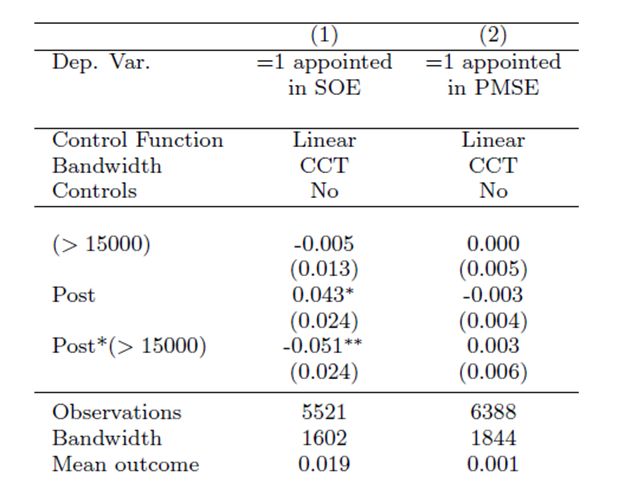
First check: does the law bite? Yes. The reform cuts the chance that mayors land top SOE posts by ~5 percentage points around the threshold, with no effect on firms where the state holds only a minority (placebo).
19.11.2025 15:42
👍 0
🔁 0
💬 1
📌 0
Empirical setting & policy shock: Italy’s Severino Law (2013) introduced 1–2 year cooling-off periods for local politicians moving into top jobs at SOEs/bureaucracy; it applies only above a 15,000-inhabitant threshold—perfect for a difference-in-discontinuity design.
19.11.2025 15:42
👍 0
🔁 0
💬 1
📌 0
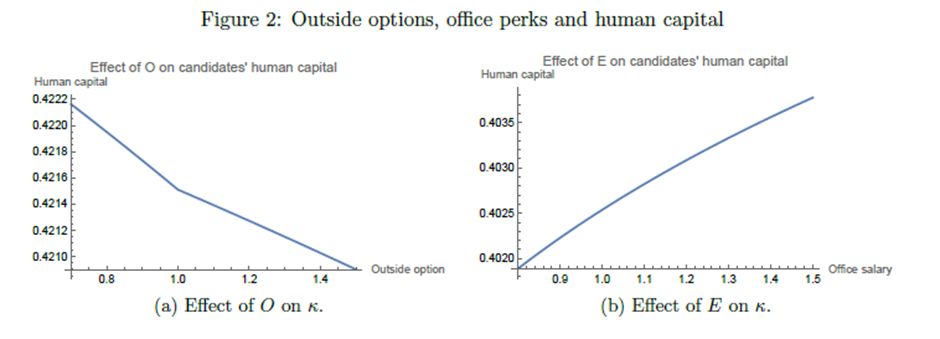
• But PCOs are especially valuable to lower human-capital politicians → reducing them deters those candidates more. Overall: reduction in PCO value and in wage can have opposite effects.
19.11.2025 15:42
👍 0
🔁 0
💬 1
📌 0
Theory result in a nutshell:
• Conditional on holding office, lowering the value of PCOs raises the cost of losing—similar to a wage increase while in office → more incentive to avoid unpopular policies.
19.11.2025 15:42
👍 0
🔁 0
💬 1
📌 0
First, we build a model. Ingredients: standard accountability + endogenous entry + PCOs available to politicians kicked out from office. Assumption: PCOs more attractive for low human capital politicians.
19.11.2025 15:42
👍 1
🔁 0
💬 1
📌 0
Idea: Politicians often have “politically connected outside options” (PCOs)—post-office jobs in the bureaucracy or state-owned firms (SOEs). Cut their value and you change both selection into politics and behavior in office. Is it just like a reduction in office wages? Not really…
19.11.2025 15:42
👍 0
🔁 0
💬 1
📌 0

Do revolving doors shape who runs for office and how they govern? Short answer: yes—and not always the way you’d expect. New version of my paper with @matteogamalerio.bsky.social builds a model and looks at Italy’s 2013 “Severino” reform (cooling-off period). 🧵
19.11.2025 15:42
👍 1
🔁 0
💬 1
📌 1
Takeaways:
1. Cooling-off periods can improve candidate human capital (education ↑).
2. But they can strengthen short-term pandering among lower-HC incumbents (taxes ↓). Anti-revolving-door rules can be a double-edged sword.
19.11.2025 14:57
👍 0
🔁 0
💬 0
📌 0
Who drives this? Exactly who the model predicts: non-graduate, non-term-limited mayors show the strongest tax cuts; graduate or term-limited mayors don’t move. That’s classic pandering under higher loss costs.
19.11.2025 14:57
👍 0
🔁 0
💬 1
📌 0
In-office behavior: among mayors elected before 2013 (so selection is held constant), the reform increases the cost of losing. We see lower local income-tax revenues after 2013 in treated municipalities—consistent with avoiding unpopular tax hikes.
19.11.2025 14:57
👍 0
🔁 0
💬 1
📌 0
Selection result: the reform raises education. Average education of both mayoral candidates and elected mayors increases by ≈ +2 years around the threshold (~+13% vs. a ~15-year mean). “Pay peanuts, get monkeys”? Maybe—but how you pay matters.
19.11.2025 14:57
👍 0
🔁 0
💬 1
📌 0
Also, high education mayors are less likely to take up positions in a SOE immediately after the end of their mandate.
19.11.2025 14:57
👍 0
🔁 0
💬 1
📌 0
First check: does the law bite? Yes. The reform cuts the chance that mayors land top SOE posts by ~5 percentage points around the threshold, with no effect on firms where the state holds only a minority (placebo).
19.11.2025 14:57
👍 0
🔁 0
💬 1
📌 0
Empirical setting & policy shock: Italy’s Severino Law (2013) introduced 1–2 year cooling-off periods for local politicians moving into top jobs at SOEs/bureaucracy; it applies only above a 15,000-inhabitant threshold—perfect for a difference-in-discontinuity design.
19.11.2025 14:57
👍 0
🔁 0
💬 1
📌 0
• But PCOs are especially valuable to lower human-capital politicians → reducing them deters those candidates more. Overall: reduction in PCO value and in wage can have opposite effects.
19.11.2025 14:57
👍 0
🔁 0
💬 1
📌 0
Theory result in a nutshell:
• Conditional on holding office, lowering the value of PCOs raises the cost of losing—similar to a wage increase while in office → more incentive to avoid unpopular policies.
19.11.2025 14:57
👍 0
🔁 0
💬 1
📌 0
First, we build a model. Ingredients: standard accountability + endogenous entry + PCOs available to politicians kicked out from office. Assumption: PCOs more attractive for low human capital politicians.
19.11.2025 14:57
👍 0
🔁 0
💬 1
📌 0
Idea: Politicians often have “politically connected outside options” (PCOs)—post-office jobs in the bureaucracy or state-owned firms (SOEs). Cut their value and you change both selection into politics and behavior in office. Is it just like a reduction in office wages? Not really…
19.11.2025 14:57
👍 0
🔁 0
💬 1
📌 0
Great suff happening in California!
21.10.2025 17:39
👍 0
🔁 0
💬 0
📌 0
Call for Papers | EPSS Belfast 2026 Conference
Submit your abstract or full paper for EPSS Belfast 2026. Share cutting‑edge political science research, network with peers & contribute to academic impact.
Please share!
Call for papers in the formal theory section at EPSS 2026 @epssnet.bsky.social.
Call for papers is open: epssnet.org/belfast-2026...
We welcome individual and panel submissions on all substantive areas of political science!
05.10.2025 12:26
👍 6
🔁 8
💬 0
📌 0

🚨Time to release the calendar for the next term of our Political Economy Work-in-progress seminars! Tuesday, 5-6pm, Universita' Cattolica. You're welcome to join us! #EconBsky #PoliSciBsky
As usual, organized with Davide Cipullo, Tommaso Colussi and Domenico Rossignoli.
01.10.2025 17:54
👍 5
🔁 0
💬 0
📌 0