Our annual meeting hosted this year by @youngryel.bsky.social at Seoul National University, brought together our international team to share research updates, plan our next steps and train our ECRs in remote sensing. A very successful week. Read more 👇
research.reading.ac.uk/lemontree/annu…
18.09.2025 10:41
👍 5
🔁 3
💬 0
📌 0
Thursday, August 14: I will present a poster titled "The power of traits: How population growth rate is shaped by leaf and plant traits across global environmental gradients" in LB 18-239 at 17:00 in the Exhibit Hall (poster)
11.08.2025 13:25
👍 0
🔁 2
💬 1
📌 0

The PhUnFETTy lab will have four presentations at #ESA2025. These will cover plant ecophysiology, trait ecology, eutrophication, water availability, mycorrhizae, demography, theory, modeling, and more!
Check out the flyer and replies below for more details. Hope to see you in Baltimore!
11.08.2025 13:16
👍 15
🔁 6
💬 1
📌 0
Curious about when leaf nitrogen needs are met under dry soils, and how plant carbon economics respond to drought&nutrient stress? 🌿🏵🌧 come see my poster showing our work @nickgregsmith.bsky.social at #ESA2025 tomorrow (Wed) in P29_Climate change, Poster 039!
12.08.2025 19:17
👍 2
🔁 2
💬 0
📌 0
Wednesday, August 13: @alissarcheaib.bsky.social will present "The satisfaction of leaf nitrogen demand under drought is modulated by soil nitrogen availability and drought severity" in PS 29-039 at 17:00 in the Exhibit Hall (poster)
11.08.2025 13:23
👍 1
🔁 2
💬 1
📌 0
This work (w/ @alissarcheaib.bsky.social) explores the power of traits to predict plant population growth as expected from components of Eco-evolutionary optimality theory. The results are new and exciting and I would love to chat with y'all about them!
11.08.2025 13:26
👍 1
🔁 1
💬 0
📌 0
Smith Lab
Website for Smith Ecophysiology Lab at Texas Tech University
The lab has new 2025 pubs on topics including:
- CO2 acclimation
- C4 trait spectra
- Stem respiration
- Phosphorus allocation
- Predicting plant communities
- Acclimation timescales
(full links in replies)
Check out more in a blog on the lab website here! www.smithecophyslab.com/news#mid2025...
03.07.2025 21:09
👍 12
🔁 4
💬 2
📌 0
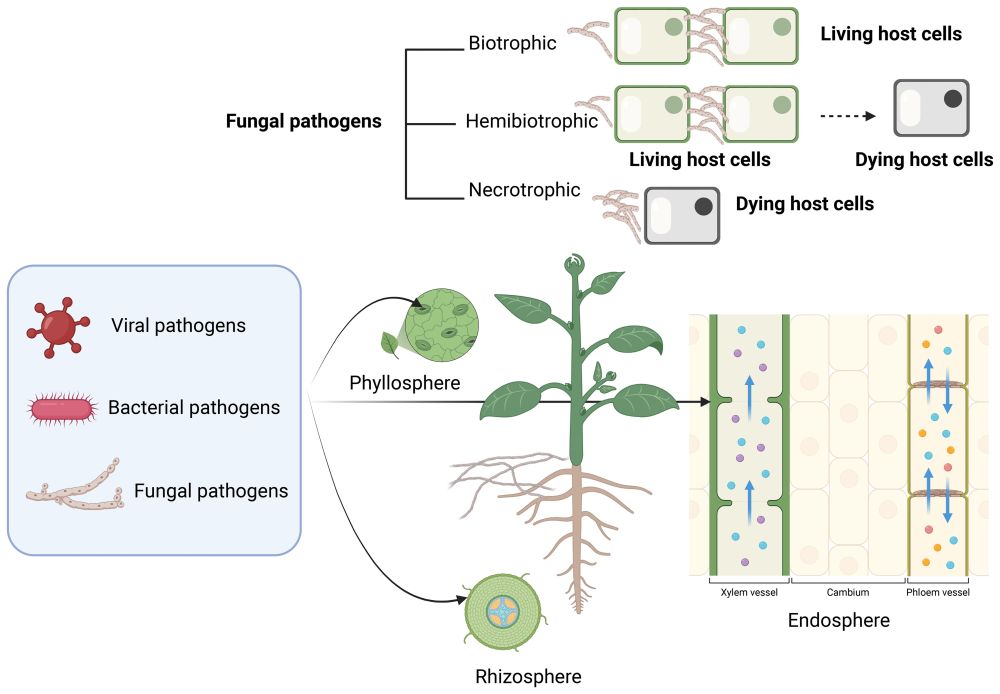
Types of phytopathogens (viruses, bacteria, and fungi) invade plant organs. Pathogens can invade the aboveground organs, the phyllosphere (leaves, stems, branches, and fruits), the roots or rhizosphere, the vascular system (phloem and xylem), or the endosphere. Phytopathogens can be biotrophic feeding on living host cells, necrotrophic feeding on dying host cells, and hemibiotrophic with an initial biotrophic phase and a later necrotrophic stage.
Alissar Cheaib and Nabil Killiny review how pathogens disrupt photosynthesis, from tissue destruction to chlorosis, and how plants adapt. Understanding these interactions is essential for #sustainableagriculture and ecosystem health. ☀️🌱 Learn more: doi.org/10.1094/MPMI... @alissarcheaib.bsky.social
14.04.2025 19:15
👍 4
🔁 3
💬 1
📌 0
Check out this blog post summarizing our recent paper on leaf and whole plant responses to elevated CO2!
26.03.2025 13:58
👍 5
🔁 2
💬 0
📌 0
Thank you for your unconditional support in getting this work done!
20.01.2025 15:59
👍 1
🔁 0
💬 0
📌 0
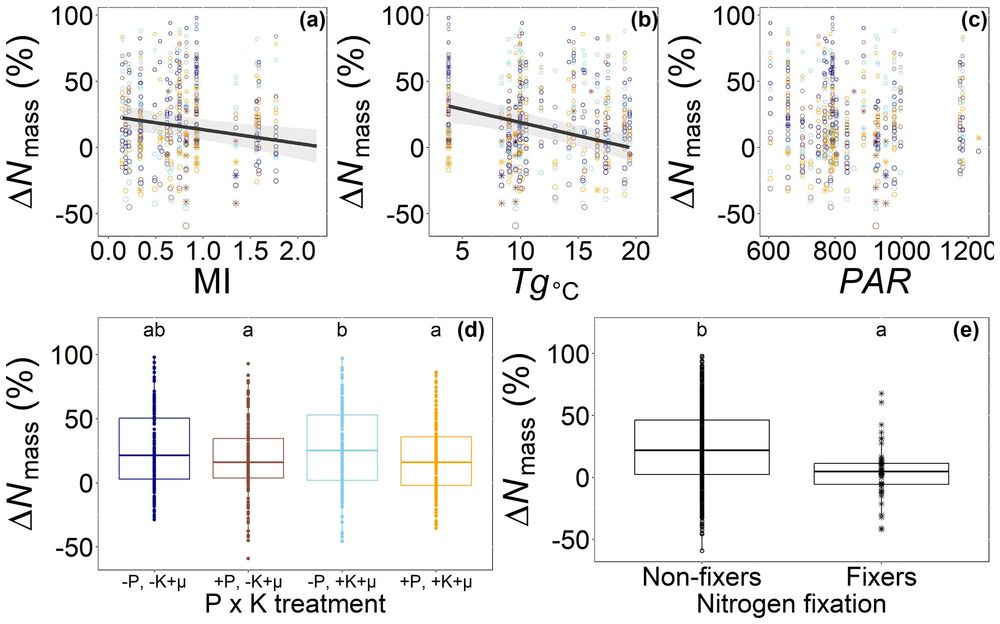
Really excited to see this out! We show that the responsiveness of leaf #nitrogen to soil nitrogen #fertilization is highest where leaf nitrogen demand is greatest.
We put together a short blog on the paper here: www.smithecophyslab.com/news.html#ch...
A quick synopsis also in the thread below...
20.01.2025 14:34
👍 20
🔁 10
💬 1
📌 0
"We are like butterflies who flutter for a day and think it's forever."
- Carl Sagan, in Cosmos (1980)
Visualisation of our galactic cluster 💫😲💫✨💫🌌💫
NASA
22.12.2024 00:34
👍 6179
🔁 1006
💬 127
📌 42