
Now a year later, and yes, we've integrated the SeeStar into the non-major Astro labs.
Our Astro Club also uses them for outreach too!
25.02.2026 00:27
👍 3
🔁 0
💬 0
📌 0
Now a year later, and yes, we've integrated the SeeStar into the non-major Astro labs.
Our Astro Club also uses them for outreach too!
We use the SeeStar in the middle of light polluted Tempe, AZ (Phoenix metro area) and get really lovely images.

90 minutes of the horsehead from Bortle 8 with the Seestar S30 Pro

90 minutes of the horsehead from Bortle 8 with the Seestar S30
Here's the Horsehead Nebula as seen through the Seestar S30 Pro vs the Seestar S30. Both around 90 minutes of data on the same night and processed similarly.
Seestar S30 Pro video here: www.youtube.com/watch?v=KrGw...
#astronomy #astrophotography #space #Seestar

When viewed from Earth, the galaxies lie along a smoothly curved line. Between some of the galaxies there's bright red gas visible, a result of a collision of those galaxies hundreds of millions of years ago. These galaxies are very far away and faint, and the gas is even fainter. The image took around 125 hours of total exposure with a small telescope from my driveway.
It's "galaxy season" for astrophotographers (the Milky Way isn't well visible right now during the night, so a lot of nebulas aren't either).
Here's a "snap" I did two years ago of Markarian's Chain, a stretch of galaxies that forms part of the Virgo Cluster.
🔭🧪 #astrophotography

A cool thing in these JWST 🔭 Uranus infrared images -- ASIDE from the (artificially-blue) polar cap & the dynamic bright clouds -- is the imaging of the aurora! It is the reddish glow extending above the clouds (e.g. 10 o'clock in the image on the right) www.scientificamerican.com/article/new-...

Against a blue background, dotted with crystal stars, planets and moons, the first four LADY ASTRONAUT books by Mary Robinette Kowal arrayed in a cross. From the top, clockwise, THE MARTIAN CONTINGENCY, THE CALCULATING STARS, THE FATED SKY and THE RELENTLESS MOON. The white Solaris logo is in the bottom left corner.
Grab the fourth instalment in @maryrobinettekowal.com 's Hugo and Nebula award-winning #ladyastronaut series - THE MARTIAN CONTINGENCY!
"A deeply personal novel about whether the human race will survive and, if it does, what it will be" - Bookpage
Buy now: geni.us/lamarcon
David Tennant played Eddington in the movie about this!!

you could say that the two historians are crossing swords 👀
www.theguardian.com/world/2025/a...
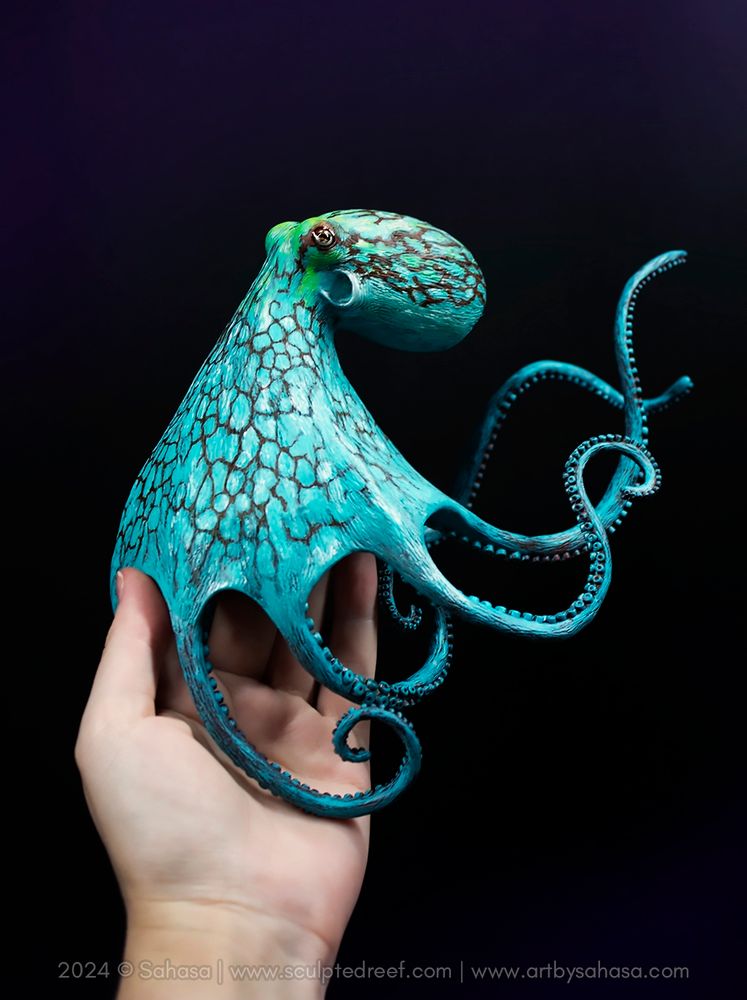
Intricate clay octopus, sculpted and painted by hand. It depicts the species Caribbean Reef Octopus scientifically known as Octopus Briareus. It's a bluish teal color with crimson patterns all over its mantle and arm crown.
#InverteFest 🥳 Sale is LIVE 🐙 24 - 30 April 🪸
Come meet the whole Octopus family here: SculptedReef.com
Find a Desk Buddy 🖥️ or Bookshelf Guardian 📚💙for yourself or a loved one!
🐙 Handmade from clay and lovingly painted 🎨 💕
#ArtYear #Sculpture #Art #OOAK #BSNM #Octopus #Handmade #ArtSale 🦑🐡🦈
Hi, everyone! My name is Alex. I'm a microbiologist/cell biologist/biochemist, and I'm sharing some of my career biography today for #YoungScientistNetworking.
1/

False color image of the Bubble Nebula (NGC 7635) in Cassiopeia.A ghostly blue bubble sits among golden orange clouds of gas, punctuated by sharp violet pinpricks – young stars.

Spiral galaxies NGC 4038 and NGC 4039 –– the Antennae Galaxies. White, blue, and red swirls of stars from two disrupted spiral galaxies captured mid-collision, with messy lanes of dark gas and dust stretching between their bright yellow cores.

The globular cluster NGC 1866 in the Large Magellanic Cloud. A jewel box of tightly clustered white, blue, and red stars.

False color image of the Lagoon Nebula captured by Hubble for its 28th anniversary in 2018. Red, purple, blue, green, yellow, and orange clouds surround a region of active star formation, with our view obscured by dark molecular clouds.
Happy birthday to the Hubble Space Telescope, launched from the Kennedy Space Center #OTD in 1990. Here's to a remarkable 35 years of imaging the Cosmos. 🧪 🔭 ⚛️
Leave your favorite Hubble images in the replies!

a white palm cups a large glass pendant. The center is a series of pink blue and white circles that resemble bullseyes. Around the edges attached with silver wire are iridescent purple pink and blue wings.
I have made the most gloriously ridiculous pendant with @nora.zone glass blob. Behold the biblically accurate trans angel pendant

A 5 strand rosary style rainbow collar neck.
Wrecked my hands for my craft but she real pretty.

Book cover of Virginia Postrel's book, The fabric of Civilization, How textiles made the world
Of course! It's The Fabric of Civilization: How textiles
made the world by Virginia Postrel.
Enjoy!
Oh no! I visited there in 1999 with the NASA Academy.

Artist’s concept of Dragonfly soaring over the dunes of Saturn’s moon Titan. NASA/Johns Hopkins APL/Steve Gribben
NASA’s Dragonfly Passes Critical Design Review
The mission to Saturn’s icy moon Titan will investigate prebiotic chemical processes and complex organic compounds that, on Earth, are the building blocks of life.
science.nasa.gov/blogs/dragon... 🧪🔭 #Dragonfly

Due to maintenance, Research.gov (including access to NSF-PAR, GRFP, PES, and ETAP) will be unavailable from Fri., 4/25 at 10:00 PM ET to Sat., 4/26 at 1:00 PM ET. NSF apologizes for any inconvenience.
🚨 Practical URGENT tip for NSF grantees:
Out of an abundance of caution, I would right now go into Research.gov and…
1. Download your NSF award letters.
2. Print PDF your annual reports.
3. Screenshot the status table for annual reports.
NSF is planning maintenance tomorrow to Research.gov

The image shows a starfield with an oval shaped red and light-blue tinged nebula in the center Please see the explanation for more detailed information.
🔭 Thor's Helmet
Image Credit & Copyright: Brian Hopkins (East Coast Astronomer)
apod.nasa.gov/apod/ap25031...

NASA’s James Webb Space Telescope has provided the clearest look in the infrared yet at the iconic multi-planet system HR 8799. The closest planet to the star, HR 8799 e, orbits 1.5 billion miles from its star, which in our solar system would be located between the orbit of Saturn and Neptune. The furthest, HR 8799 b, orbits around 6.3 billion miles from the star, more than twice Neptune’s orbital distance. Colors are applied to filters from Webb’s NIRCam (Near-Infrared Camera), revealing their intrinsic differences. A star symbol marks the location of the host star HR 8799, whose light has been blocked by the coronagraph. In this image, the color blue is assigned to 4.1 micron light, green to 4.3 micron light, and red to the 4.6 micron light.

Webb’s NIRCam (Near-Infrared Camera) captured this image of 51 Eridani b (also referred to as 51 Eri b), a cool, young exoplanet that orbits 890 million miles from its star, similar to Saturn’s orbit in our solar system. The 51 Eridani system is 97 light-years from Earth. This image includes filters representing 4.1-micron light as red. The background red in this image is not light from other planets, but a result of light subtraction during image processing.
It's been an exciting couple weeks for the exploration of planets around other stars.
First up: *Direct* images of planets orbiting two young, nearby stars. HR 8799 (left) has four super-Jupiters. 51 Eridani (right) has a planet 4 times the mass of Jupiter. 🧪🔭
webbtelescope.org/contents/new...
Our pun made it into New Scientist!
I just checked in at the Atlanta airport and the kiosk wanted me to show a "passport or permanent residence card."
The airline rep who was helping me said "I don't know why it's doing this it's been doing it all morning."

Recorded from 2024 March 10, to 2025 March 1, this composited series of images reveals a pattern in the seasonal drift of the Sun's daily motion through planet Earth's sky. Known to some as an analemma, the figure-eight curve was captured in exposures taken on the indicated dates only at 18:38 UTC from the exact same location south of Stephenville, Texas. The Sun's position on the 2024 solstice dates of June 20 and December 21 would be at the top and bottom of the curve and correspond to the astronomical beginning of summer and winter in the north. Points that lie along the curve half-way between the solstices would mark the equinoxes. The 2024 equinox on September 22, and in 2025 the equinox on March 20 (today) are the start of northern fall and spring. And since one of the exposures was made on 2024 April 8 from the Stephenville location at 18:38:40 UTC, this analemma project also reveals the solar corona in planet Earth's sky during a total solar eclipse.
🔭 The Solar Eclipse Analemma Project
Image Credit & Copyright: Hunter Wells
apod.nasa.gov/apod/ap25032...

Saturn's outer moon system viewed from the north pole of Saturn. Moons orbiting in clockwise (retrograde) orbits have red-colored orbits while moons orbiting counterclockwise (prograde; in the direction of Saturn's spin) are colored blue. With so many irregular moons occupying the same region and intersecting each other, the irregular moon system looks like a donut-shaped vortex surrounding Saturn. Each of the 128 new moons is highlighted in the diagram with a white point representing their location, and a brighter-colored orbit. Previously-known moons of Saturn are included in the diagram, but are colored darker. The regular moons of Saturn are colored turquoise and the outermost regular moons (Titan, Hyperion, and Iapetus) labeled with their name. At the lower left corner are scale indicators to help visualize the scale of Saturn's irregular moon system. A small gray circle at the left left corner is shown to represent the diameter of the Earth-Moon orbital distance. A linear scale bar is labeled "10 million km" (6.2 million mi) to give a standard distance.

View of Saturn's irregular moon system, tilted at an angle to show the toroidal belt-like shape of the system. Each moon is labeled with their names in turquioise. Red orbits = retrograde direction, and blue orbits = prograde direction. Turquoise curves closer to the center are orbits of Saturn's regular moons.

Side view of Saturn's irregular moon system, tilted at an angle to show the toroidal belt-like shape of the system. Red orbits = retrograde direction, and blue orbits = prograde direction. Turquoise curves closer to the center are orbits of Saturn's regular moons. The irregular moons of Neptune (dark green) are also visible in the background to the right of Saturn. The horizontal red line protruding right of Saturn is the orbit path of Saturn.
I spent almost 2 hours painstakingly copying the orbits of all 128 Saturnian moons from the announcement MPEC and reformatting them for visualization...
Behold, here are the orbits of ALL 128 MOONS OF SATURN. This isn't just a moon system—it's a literal asteroid belt around Saturn! 🧪🔭☄️
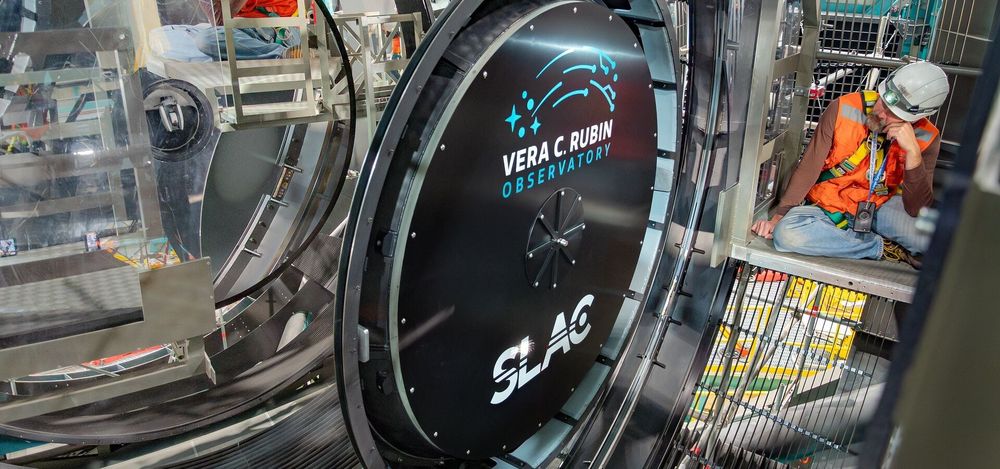
Lights, camera, action!
The world's largest digital camera has been installed at NSF–DOE Rubin Observatory! 🤩
The LSST Camera was the final major component of the observatory. With it in place, Rubin officially enters its final phase of testing!🔭
🔗: rubinobservatory.org/news/lsst-camera-installed
I was sitting on the couch with my cat, and I started singing to myself. This cat put her WHOLE paw in my mouth 😂. She really said “I’ve heard enough. We’ll call you.”
AAAAAAAAAAAAAAAAAAHHHHHHHHHH

Zoomed in photo of eclipse socks featuing the phrases of a solar eclipse

Gold solar eclipse pendant necklace depicting totality with a diamond set to illustrate the diamond ring effect
Speaking of #eclipses... Please check out my eclipse collection with socks and jewelry featuring this 'diamond ring' effect 🔭🧪
sciencesocks.co/collections/...

Screencap of wikipedia page with map showing a red bullseye shape on Yakutat Bay AK, with text reading "Eyewitness Accounts: The most dramatic accounts came from a group of prospectors whose camp was close to a glacial stream about a mile SE of the ice cliff of Hubbard Glacier. After the initial shock on the morning of September 10, they rigged up a seismograph using dangling knives, and counted 52 shocks before the most powerful shock occurred at noon. This was strong enough that the men could not stand, and some of them avoided being thrown about by holding on to the tent pole."
Ended up back on the Wikipedia page for the 1899 Yakutat Bay Earthquakes and now once again can't stop thinking about the knivesmograph.
🐡

A clouded leopard lays on a branch
A lil kitty cat 🦊