

Shifts in Phenology and Species Ranges Synergistically Alter the Timing and Species Composition of the Flowering Season
🔗 buff.ly/ReNSH54
28.11.2025 13:25
👍 3
🔁 3
💬 0
📌 0
Shifts in Phenology and Species Ranges Synergistically Alter the Timing and Species Composition of the Flowering Season
🔗 buff.ly/ReNSH54
PS: Happy to send a PDF to anyone interested without online access!
Together, these results demonstrate that shifts in phenology and species ranges act synergistically to restructure the flowering seasons across the conterminous United States, revealing wide variation in the pace and direction of change among biomes.


Using millions of records, we show that phenological and range shifts affect different attributes of the season: phenological shifts primarily alter the start, end, and duration of the season; range shifts alter co-flowering diversity at seasonal peaks and the network of overlapping flowering pairs

Shifts in phenology and species ranges are likely to have distinct and synergistic effects on community-level flowering patterns. However these processes have typically been studied in isolation largely due to data limitations.

New paper out! Using ~3 million observations across 2,837 species, we studied how shifts in species ranges and flowering phenology jointly impact the timing, species diversity, and network structure of the flowering season across US communities.
doi.org/10.1111/gcb....
🌎

Excited to see the 2nd chapter of my dissertation out on Nature Ecology & Evolution! My co-authors and I evaluated the contributions of plasticity vs. adaptation as drivers of temperature-related variation in flowering phenology in North America 🌎
www.nature.com/articles/s41...
Thanks, Tom! Feel free to reach out with any thoughts or questions
p.s. Huge shoutout to my co-authors Isaac Park, Sydne Record, Charles Davis, Aaron Ellison, and my advisor Susan Mazer for their amazing collaboration on this project!
For more details on / discussion of these and other cool results, you can access the full text in the following link:
rdcu.be/dvJvT
Whether phenological reaction norms to historical T° conditions will remain adaptive under future climatic regimes is unclear. Nonetheless, our results suggest that plasticity might have historically enabled rapid phenological acclimation to a wide range of T° conditions


The predominant role of plasticity was consistent among species distributed across climatic space and among ecoregions of the United States. However, the relative contributions of plasticity and adaptation varied markedly among species flowering at different times of the year
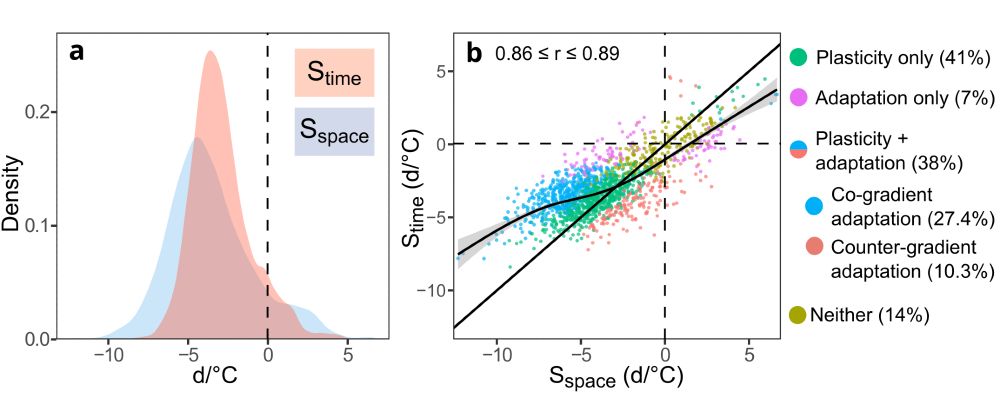
We found that, among species, sensitivity patterns were much more frequently consistent with plasticity than local adaptation, but both plasticity and adaptation jointly mediated clinal variation in phenology in many species


We used >1 million flowering specimens collected over 120yr representing 1,605 species to measure flowering sensitivity to T° over space and time, inferring the relative contributions of plasticity and adaptation to observed variation along T° gradients
Phenology varies widely over space and time due to climate, but it is unclear whether this variation (which often affects fitness) is primarily generated by rapid organismal responses (i.e., plasticity) or local adaptation
Excited to see the 2nd chapter of my dissertation out on Nature Ecology & Evolution! My co-authors and I evaluated the contributions of plasticity vs. adaptation as drivers of temperature-related variation in flowering phenology in North America 🌎
www.nature.com/articles/s41...
@ethanfreedman.bsky.social
Can I be added as a contributor? Thank you!


Our new paper in Methods Ecol Evol announces marineomics.io, a website sharing tools for rigorous, reproducible genomics in non-model & marine species
We outline the site's resources, how they're made, and how you can contribute! besjournals.onlinelibrary.wiley.com/doi/10.1111/...
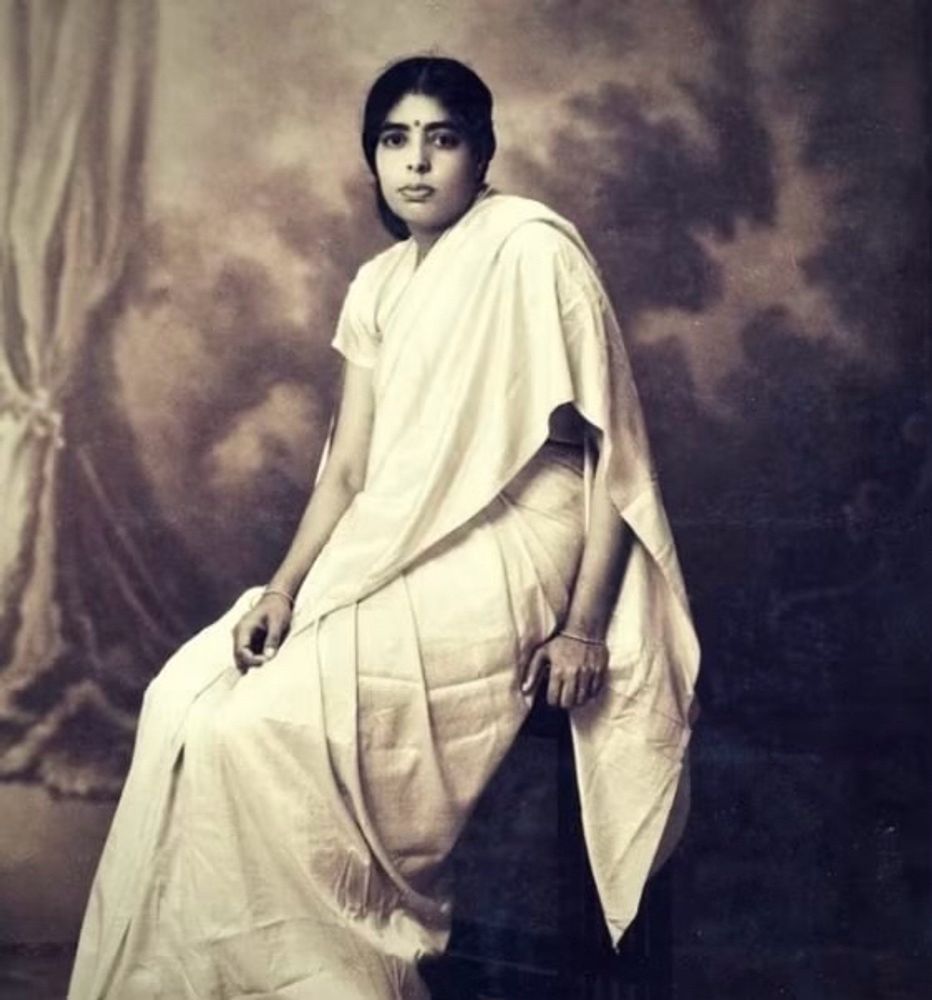
Janaki Ammal
Born in 1897, Janaki Ammal was a trailblazing botanist in plant breeding, genetics & cytogenetics.
She overcame gender & caste discrimination & was the first Indian woman to obtain a PhD in botany in the U.S.
Ammal promoted conservation & was a pioneer of indigenous environmental approaches.
New preprint led by @ajyancy.bsky.social (it's her first paper!!) with @jmheberling.bsky.social, Howie Neufeld, Sara Kuebbing and Michelle Spicer. If you've seen a presentation of mine in the past year, it was probably about this work on spring ephemeral phenological strategy! 🌱🌎

Beautiful crow against a black background
It seems to me that the time is ripe for a Bluesky thread about how—and maybe even why—to befriend crows.
(1/n)

It's fun to get to share our new study in Science tracking nearly 4,000 Galápagos finches using genomics over 30 years! Interested in how genomics can teach us about contemporary evolution? 1/
www.science.org/doi/full/10....
An evolutionary epigenetic clock in plants
www.science.org/doi/10.1126/...
#plantscience
Hey folks, just trying to maximize the number of eyes on this job posting, for which I serve on the search committee. If you work on "genes, genomes, and evolution" writ large, and are on the job market, please apply! Please repost and share widely!
employment.unl.edu/postings/87675


Moderate migration tonight to the west and east, with weather blocking the central movements. #birds #birding #fall #migration 🪶