
You can browse our Anopheles analysis (including an interactive frequency-area plot and searchable data table) here: kr-colab.github.io/spatial_swee...
10.02.2025 19:23
👍 1
🔁 0
💬 0
📌 0
You can browse our Anopheles analysis (including an interactive frequency-area plot and searchable data table) here: kr-colab.github.io/spatial_swee...
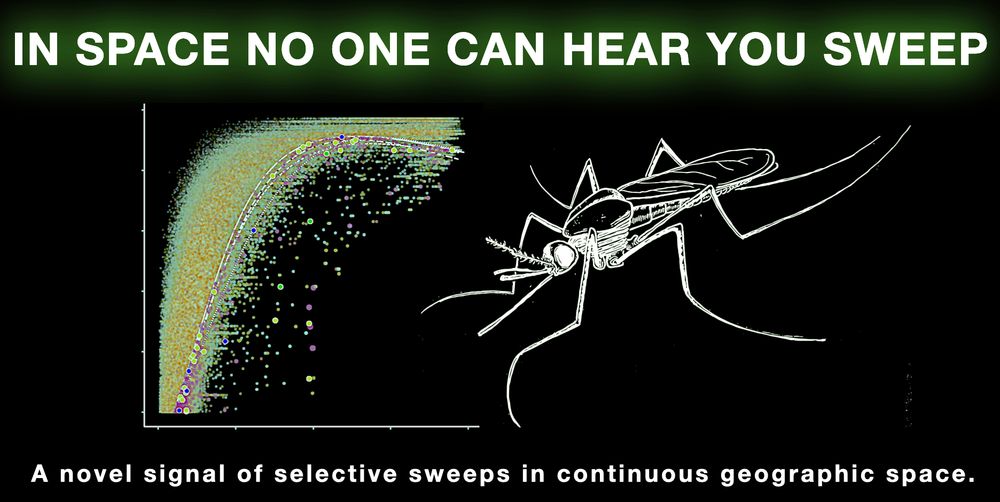
By considering spatial population structure, we ID variants that have not yet been noted by conventional selection scans, generating new hypotheses for avenues of adaptation in An. gambiae and demonstrating our method's potential to identify otherwise-overlooked sweeping alleles.

We find enrichments for sensory processing and drug metabolism functions, uncover numerous variants at known insecticide-resistance loci (including Rdl, Ace1, and Cyp6p) and highlight strong spatial-frequency outliers that may have functional consequences!

With our sims, we demonstrate that this signal can be used to identify variants under positive selection as outliers in the genome-wide joint distribution.
We then leverage this signal to identify potentially-sweeping variants in Anopheles gambiae from West Africa.

This is because selection causes these alleles to increase in frequency faster than they can spread through space - conversely, a neutral allele can diffuse across space while remaining at low or intermediate frequencies.

While simulating sweeps in two-dimensional space, we observed that selection has a huge impact on the relationship between an allele’s frequency and its range across a landscape: beneficial alleles take up less area relative to their frequency within the population!

New preprint! We find a novel signal of positive selection in georeferenced genotype data, then use this signal to identify in-progress selective sweeps in the malaria vector Anopheles gambiae:
www.biorxiv.org/content/10.1...
okay fine