Christopher Mitcheltree, Vincent Lostanlen, Emmanouil Benetos, Mathieu Lagrange: SCRAPL: Scattering Transform with Random Paths for Machine Learning https://arxiv.org/abs/2602.11145 https://arxiv.org/pdf/2602.11145 https://arxiv.org/html/2602.11145
12.02.2026 06:34
👍 1
🔁 3
💬 0
📌 0

A) Dendrogram of the development dataset showing the clustering structure and optimal cut points, and spectrograms of representative calls extracted from cluster 0 and cluster 1. Within the main
clusters, we observed further branching; B) UMAP projection divided into 𝐾 = 2 clusters using HAC.
Our new pre-print shows how unsupervised clustering methods can identify biologically meaningful differences in early vocal production, with no human feedback. @antorrisi.bsky.social
has led this interdisciplinary collaboration based on computational methods + #chicks 🐣 arxiv.org/abs/2601.12203
24.01.2026 13:15
👍 20
🔁 8
💬 1
📌 0

Last ASAB conference of my PhD journey! 🐣
Presenting my poster “Vocal Echo: a closed-loop system for real-time vocal analysis of domestic chicks” at #ASABWinter2025
Come by the poster session to chat and check out the demo via the link below!
@elisabettaversace.bsky.social @emmanouilb.bsky.social
16.12.2025 12:06
👍 14
🔁 3
💬 0
📌 0

Touching Without Contact: We Physically Sense Objects Before Feeling Them - Neuroscience News
A new study shows that humans possess a form of “remote touch,” allowing them to detect hidden objects in sand before making direct contact.
Our new study on remote touch .....✋
Touching Without Contact: We Physically Sense Objects Before Feeling Them - neurosciencenews.com/remote-touch... @zhengqichen.bsky.social @lauracrucianelli.bsky.social @elisabettaversace.bsky.social #LorenzoJamone ✋
--> 📹 youtu.be/6hpuLojesyQ?...
08.11.2025 13:38
👍 9
🔁 7
💬 0
📌 0
Very excited and proud to share my postdoctoral research with @neurrriot.bsky.social looking at the context-specific encoding of social behavior 💃🕺 in hormone-sensitive, large-scale brain networks in mice!
www.biorxiv.org/content/10.1...
#neuroskyence #compneurosky 🧪
1/12
25.09.2025 16:45
👍 194
🔁 51
💬 8
📌 9
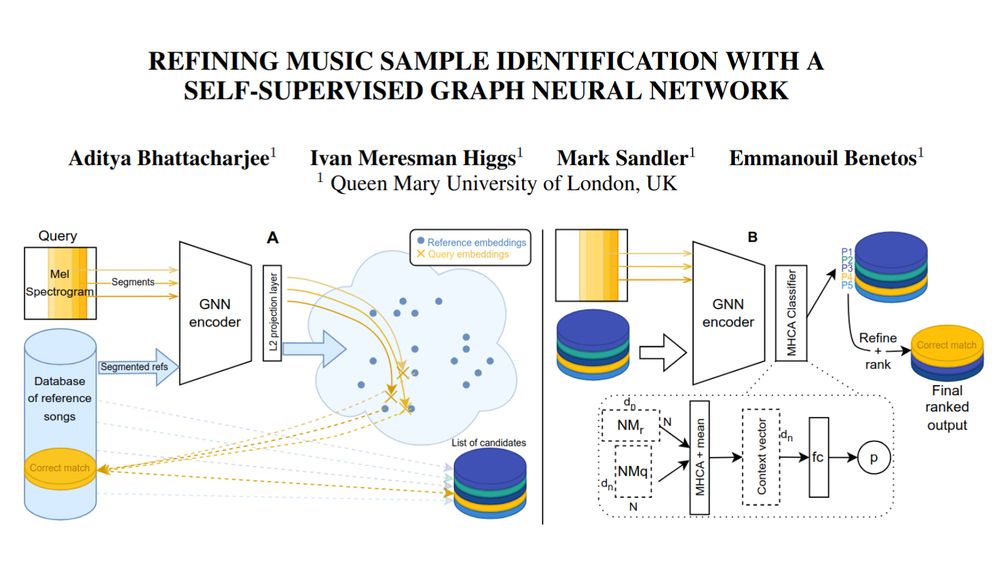
Image with the name of the paper "REFINING MUSIC SAMPLE IDENTIFICATION WITH A SELF-SUPERVISED GRAPH NEURAL NETWORK", names of the authors (Aditya Bhattacharjee, Ivan Meresman Higgs, Mark Sandler, and Emmanouil Benetos from Queen Mary University of London, UK), and a figure with the illustrated ASID methodology (2 stages): (A) Given a query, we compute segment-level embeddings (fingerprints), matched to reference embeddings via approximate nearest-neighbour (ANN) search; based on which, candidate songs are retrieved from the reference database through a lookup process (dotted arrows). (B) A multi-head cross-attention (MHCA) classifier refines and ranks candidates using node embedding matrices NMq (query) and NMr (references).
Our paper on automatic sample identification (arxiv.org/abs/2506.14684) was accepted at @ismir_conf 2025! 🎵🎶
We propose an architecture that can detect music samples that have been reused in new compositions, even after pitch-shifting, time-stretching, and other transformations!🧵
25.06.2025 10:45
👍 6
🔁 2
💬 1
📌 0

The value of ecologically irrelevant animal cognition research
Opinion by Scarlett Howard
tinyurl.com/37aedmfx
18.06.2025 17:38
👍 18
🔁 8
💬 0
📌 0
I love this work from my colleagues from the psychology department!
13.06.2025 12:51
👍 2
🔁 0
💬 0
📌 0


Alex and Robyn had an amazing day engaging the children of Wapping High School in the fascinating world of animal behaviour! @asabeducation.bsky.social #nationalscienceweek #animalbehaviour #outreach
25.03.2025 11:12
👍 8
🔁 4
💬 1
📌 0