

Thanks @abctnow.bsky.social for the opportunity to discuss the state of the science and emerging research on gender-affirming medical care for trans youth!
23.11.2025 15:45
👍 6
🔁 1
💬 0
📌 0
Thanks @abctnow.bsky.social for the opportunity to discuss the state of the science and emerging research on gender-affirming medical care for trans youth!

A table showing profit margins of major publishers. A snippet of text related to this table is below. 1. The four-fold drain 1.1 Money Currently, academic publishing is dominated by profit-oriented, multinational companies for whom scientific knowledge is a commodity to be sold back to the academic community who created it. The dominant four are Elsevier, Springer Nature, Wiley and Taylor & Francis, which collectively generated over US$7.1 billion in revenue from journal publishing in 2024 alone, and over US$12 billion in profits between 2019 and 2024 (Table 1A). Their profit margins have always been over 30% in the last five years, and for the largest publisher (Elsevier) always over 37%. Against many comparators, across many sectors, scientific publishing is one of the most consistently profitable industries (Table S1). These financial arrangements make a substantial difference to science budgets. In 2024, 46% of Elsevier revenues and 53% of Taylor & Francis revenues were generated in North America, meaning that North American researchers were charged over US$2.27 billion by just two for-profit publishers. The Canadian research councils and the US National Science Foundation were allocated US$9.3 billion in that year.

A figure detailing the drain on researcher time. 1. The four-fold drain 1.2 Time The number of papers published each year is growing faster than the scientific workforce, with the number of papers per researcher almost doubling between 1996 and 2022 (Figure 1A). This reflects the fact that publishers’ commercial desire to publish (sell) more material has aligned well with the competitive prestige culture in which publications help secure jobs, grants, promotions, and awards. To the extent that this growth is driven by a pressure for profit, rather than scholarly imperatives, it distorts the way researchers spend their time. The publishing system depends on unpaid reviewer labour, estimated to be over 130 million unpaid hours annually in 2020 alone (9). Researchers have complained about the demands of peer-review for decades, but the scale of the problem is now worse, with editors reporting widespread difficulties recruiting reviewers. The growth in publications involves not only the authors’ time, but that of academic editors and reviewers who are dealing with so many review demands. Even more seriously, the imperative to produce ever more articles reshapes the nature of scientific inquiry. Evidence across multiple fields shows that more papers result in ‘ossification’, not new ideas (10). It may seem paradoxical that more papers can slow progress until one considers how it affects researchers’ time. While rewards remain tied to volume, prestige, and impact of publications, researchers will be nudged away from riskier, local, interdisciplinary, and long-term work. The result is a treadmill of constant activity with limited progress whereas core scholarly practices – such as reading, reflecting and engaging with others’ contributions – is de-prioritized. What looks like productivity often masks intellectual exhaustion built on a demoralizing, narrowing scientific vision.

A table of profit margins across industries. The section of text related to this table is below: 1. The four-fold drain 1.1 Money Currently, academic publishing is dominated by profit-oriented, multinational companies for whom scientific knowledge is a commodity to be sold back to the academic community who created it. The dominant four are Elsevier, Springer Nature, Wiley and Taylor & Francis, which collectively generated over US$7.1 billion in revenue from journal publishing in 2024 alone, and over US$12 billion in profits between 2019 and 2024 (Table 1A). Their profit margins have always been over 30% in the last five years, and for the largest publisher (Elsevier) always over 37%. Against many comparators, across many sectors, scientific publishing is one of the most consistently profitable industries (Table S1). These financial arrangements make a substantial difference to science budgets. In 2024, 46% of Elsevier revenues and 53% of Taylor & Francis revenues were generated in North America, meaning that North American researchers were charged over US$2.27 billion by just two for-profit publishers. The Canadian research councils and the US National Science Foundation were allocated US$9.3 billion in that year.

The costs of inaction are plain: wasted public funds, lost researcher time, compromised scientific integrity and eroded public trust. Today, the system rewards commercial publishers first, and science second. Without bold action from the funders we risk continuing to pour resources into a system that prioritizes profit over the advancement of scientific knowledge.
We wrote the Strain on scientific publishing to highlight the problems of time & trust. With a fantastic group of co-authors, we present The Drain of Scientific Publishing:
a 🧵 1/n
Drain: arxiv.org/abs/2511.04820
Strain: direct.mit.edu/qss/article/...
Oligopoly: direct.mit.edu/qss/article/...

Sign the petition to call for the removal of RFK, Jr.
www.standupforscience.net/rfk-impeachm...

Article in Nature from a former NIH employee and Bethesda Declaration signer...
www.nature.com/articles/d41...
Proud to have contributed to this commentary in response to the HHS report on pediatric gender dysphoria
urldefense.com/v3/__https:/...
Here is the Democracy Now/ACLU brief for the Supreme Court.
Thanks to all of the plaintiffs for standing up, and the attorneys and their staffs for all of their hard work.
Let's win this thing (again)
protectdemocracy.org/wp-content/u...
Here are some of the highlights of the appropriations bill that the Senate appropriations committee just approved:
$48.7 billion for NIH, an increase of $400 million
Rejects the proposal to cap
indirect cost rates at 15%
Includes a provision to prevent MYF that would reduce the number of grants

A good explainer for #NIH funded researchers on why the multiyear funding scheme is going to squeeze NIH scientists and NIH science. open.substack.com/pub/sciencea...
Call these 14 senators.
Thank them for supporting #NIH.
Remind them that supporting NIH is meaningless if NIH cannot function.
This stay would:
1) Enable censorship of science.
2) Disrupt NIH’s ability to fund any research.
If the Supreme Court allows #NIH to terminate ongoing grants because it changed its mind on priorities, it will be the end of NIH and the end of the US as a leader in biomedical science. Period.
thehill.com/policy/healt...
American Psychological Foundation released a call for applications for crisis funding to support early career researchers who had grants terminated. Looks like a great opportunity!
ampsychfdn.org/funding/dacf/

NEW: In an unprecedented move, the NIH will soon disinvite dozens of scientists about to take positions on advisory councils that make final decisions on grant funding.
NIH staff were told to select others aligned with the Trump administration and told to expect placements by political appointees.

So grateful to Katie Edwards for coming forward, for refusing to back down, and for helping lead the charge so many might have their grants reinstated. www.sciencefriday.com/segments/res...
Just in: NIH staff have been instructed to REINSTATE these ~900 grants to comply with the court order, per sources. This comes after staff were also directed to cease any further terminations.
You can see the lists grants to be reinstated in my post below.
Illinois has enshrined protections to meet this very moment.
In a time of increasing overreach and hateful rhetoric, it's more important than ever to reaffirm our commitment to the rights and dignity of the LGBTQ+ community.
You have a home here always.
🚨 BREAKING: Nearly 4 months the NIH cut its first grants, a judge has ruled that the directives and process that led to cuts are arbitrary and capricious.
"The explanations are bereft of reasoning — virtually in their entirety... unsupported by [facts]."
Each of them are VOID and ILLEGAL, he says.

“It is palpably clear that these directives and the set of terminated grants here also are designed to frustrate, to stop, research that may bear on the health—we’re talking about health here, the health of Americans, of our LGBTQ community. That’s appalling.”
newrepublic.com/post/196887/...
⚖️ HUGE day today in the NIH terminations cases
There's a trial (of sorts) at 10a ET in Boston today for arguments that NIH unlawfully terminated 100s of grants.
It's a 3 hour hearing and I'll post periodic updates.
Of note: this is the 1st lawsuit filed against the Trump Admin to go to trial.

When the National Institutes of Health cut billions of dollars of research funding earlier this year, it jeopardized our wellbeing and scientific progress.
We'll be in court Monday arguing that scientific research should be guided by evidence, not politics.
🚨 NIH director Jayanta Bhattacharya is testifying before the US Senate Appropriations Committee today.
The hearing is bound to be spicy, after more than 300 agency staff wrote him a letter decrying his leadership and actions as director. 🔥
I'll be live-posting the hearing, so follow along here.

A broad group of National Institutes of Health (NIH) public servants have taken action with the "Bethesda Declaration" that targets the NIH and HHS Leadership. Join these courageous and committed professionals by adding your name now. actionnetwork.org/forms/add-na...
“In an unusual act of public protest, more than 340 scientists and staff at the National Institutes of Health today released a statement charging NIH officials and their superiors with politicizing science.”
www.science.org/content/arti...
#StandUpForScience
#BethesdaDeclaration
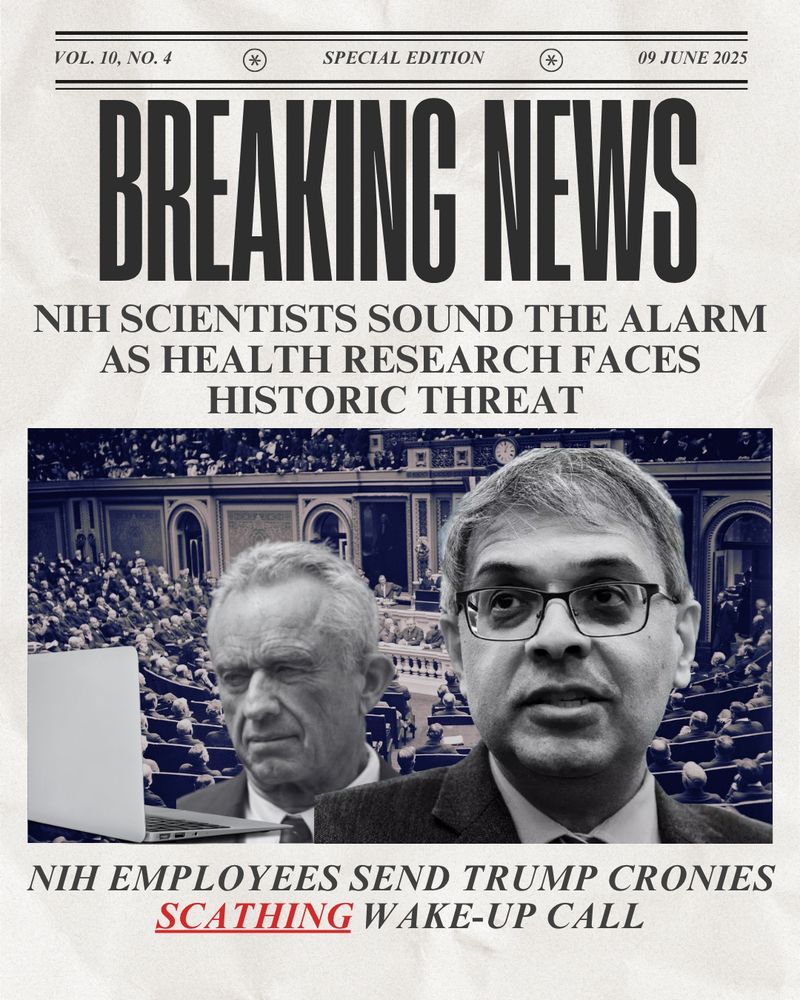
Front-page-style graphic titled “BREAKING NEWS” with photos of RFK Jr. and Dr. Bhattacharya in front of a government hearing chamber. Text reads: “NIH Scientists Sound the Alarm as Health Research Faces Historic Threat” and “NIH Employees Send Trump Cronies Scathing Wake-Up Call.”
🚨BREAKING: 300+ NIH employees call out the harm of censorship & politicized science in scathing email to Bhattacharya, demanding an end to political interference, a lift on funding freezes, & rehiring of fired staff whose work saves lives.
This is historic - insiders are blowing the whistle.
🧵(1/5)

Funding freeze at Northwestern from Emma Mairson at
grant-watch.us. Data from USAspending. Normally, ~$70 M per month. Now, bupkis.
Northwestern is keeping research moving and must be spending ~$40 M per month. Clearly not sustainable for too long.

Important piece by Drs. @jaepuckett.bsky.social and Paz Galupo
theconversation.com/our-trans-he...
Judge overseeing the NIH grant cuts lawsuit:
"I've just come across this database called Grant Watch which is rather intriguing. Everybody seems to look at [it] for the data concerning NIH grants... This is like a physician's desk reference."
👏 well done @scott-delaney.bsky.social @noamross.net
Heads up! APA is urging anyone who cares about health and science to let their reps/senators know now that they should oppose the admin's murder budget.
Easy to do here: www.votervoice.net/Shares/BAAAA...
APA is plugged in. If they say NOW, listen! #StandUpForScience

Sworn testimony & leaked emails: more proof DOGE is hand-picking which NIH grants live or die—screening awards, handing out kill lists, & canceling science in hours
🙌 Shout out to @maxkozlov.bsky.social at @nature.com for breaking the story (again), in part due to brave NIH insiders

