📣📅 ABSTRACT DEADLINE EXTENDED!
Submit your work by the 27th February!
A huge thank you to everyone who was already submitted their abstracts - we‘re looking forward to seeing you in April ☺️ #matrixbiology #DGMB2026
13.02.2026 06:36
👍 1
🔁 1
💬 0
📌 0
Have a look at our preliminary program, which is now available via the meeting website! 👇 In addition to our fantastic invited speakers, there are lots of slots for presentations selected from abstracts! We‘re looking forward to seeing the matrix community in Heidelberg!
05.02.2026 11:53
👍 0
🔁 1
💬 0
📌 0
Registration & abstract submission are now open, and we’re already looking forward to lots of exciting and excellent science - see you all in April 🥳
19.01.2026 15:51
👍 0
🔁 0
💬 0
📌 0
We are already looking forward to hosting the wonderful matrix community in Heidelberg next year! Thanks for your patience while we update the website - in the meantime, don’t hesitate to get in touch with us if you have any questions! #DGMB2026
12.09.2025 05:40
👍 1
🔁 0
💬 0
📌 0
Had a great couple
of days in Copenhagen, with so many interesting talks and wonderful scientific exchange! Hopefully we’ll see many of you in April at #DGMB2026!
09.09.2025 19:26
👍 4
🔁 0
💬 1
📌 0

Young Investigator Spotlight Sven Schmidt.
My scientific drive stems from a deep curiosity about the unknown, and a strong belief that creativity and collaboration are essential to exploring it. I hold a Bachelor’s/Master's degree in Biomedicine from the Julius-Maximilians University of Würzburg, where I gained hands-on experience in developing, maintaining, and perfusing human induced pluripotent stem cell (hiPSC)-derived organoids. In the group of Prof. Ruohola-Baker (University of Washington, Seattle, USA), I worked at the intersection of hiPSC biology, CRISPR/Cas9 gene editing, and in silico-designed proteins provided by Prof. David Baker. Starting my PhD (2022) in the lab of PD Dr. Diederichs at Heidelberg University Hospital, I have finally found my passion for hiPSC- and mesenchymal stromal cell-based cartilage regeneration.
Scientific facts about Sven:
Favorite tissue/cell: Induced pluripotent stem cells.
Favorite ECM protein: Type X collagen (tempestuous relationship).
Most evil method in lab: Western blotting.
Best methodological skills: Click chemistry.
Favorite smell in lab: A freshly cleaned cell culture incubator.
Personal facts about Sven:
Secret superpower: Always picking the slowest checkout lane.
Bad habit: Working long hours.
Favorite Disney film: NOT Disney’s Star Wars movies :)
Most embarrassing/or all-time celebrity crush: Rick Sanchez.
How do you recharge after a busy day in the lab?
Sports, literature, food, quality sleep.
Time for another #YoungInvestigatorSpotlight, before we all head into the weekend to enjoy [or escape] the sunshine! Meet doctoral researcher Sven Schmidt @nefiew.bsky.social. His publication www.sciencedirect.com/science/arti...
reveals chondroprotective effects of PGE2 during MSC chondrogenesis.
27.06.2025 06:19
👍 2
🔁 2
💬 0
📌 0


Bit sad to leave Davos today after a great #EORS2025. Super grateful to the #on_foundation for awarding me an education grant to help with travel costs! Now to go through my notes and think through some new ideas… 😎
19.06.2025 16:35
👍 3
🔁 0
💬 0
📌 0
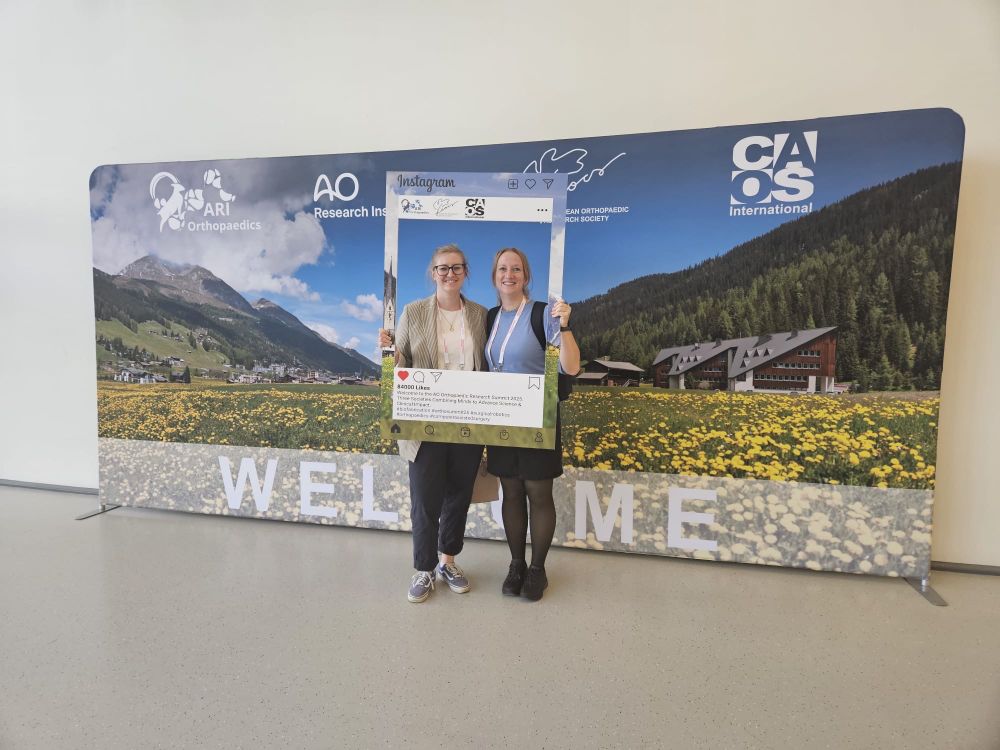
Team #ExCarBon at #EORS2025 - a great opportunity to present some of our work, with some thought-provoking questions from the audience!
17.06.2025 09:47
👍 2
🔁 0
💬 0
📌 0
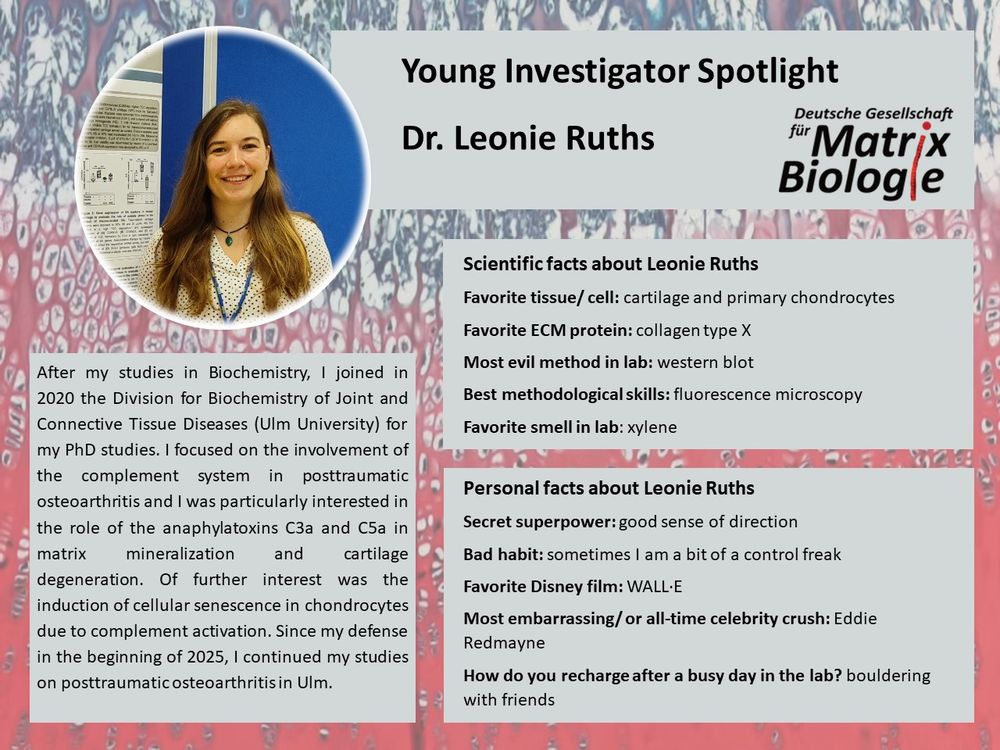
Young Investigator Spotlight of the German Society for Matrix Biology: Dr. Leonie Ruths.
After my studies in Biochemistry, I joined in 2020 the Division for Biochemistry of Joint and Connective Tissue Diseases (Ulm University) for my PhD studies. I focused on the involvement of the complement system in posttraumatic osteoarthritis and I was particularly interested in the role of the anaphylatoxins C3a and C5a in matrix mineralization and cartilage degeneration. Of further interest was the induction of cellular senescence in chondrocytes due to complement activation. Since my defense in the beginning of 2025, I continued my studies on posttraumatic osteoarthritis in Ulm.
Scientific facts about Leonie Ruths:
Favorite tissue/ cell: cartilage and primary chondrocytes.
Favorite ECM protein: collagen type X.
Most evil method in lab: western blot.
Best methodological skills: fluorescence microscopy.
Favorite smell in lab: xylene.
Personal facts about Leonie Ruths:
Secret superpower: good sense of direction.
Bad habit: sometimes I am a bit of a control freak.
Favorite Disney film: WALL·E.
Most embarrassing/ or all-time celebrity crush: Eddie Redmayne.
How do you recharge after a busy day in the lab? bouldering with friends.
Happy Monday! We're starting the week with another #YoungInvestigatorSpotlight - this time it's Leonie Ruths' profile & publication, which you can find here: www.oarsijournal.com/article/S106....
Well done to all the participants of this year's Young Investigator Award session! #matrixbiology
02.06.2025 07:01
👍 3
🔁 2
💬 0
📌 0
Congrats everyone! 🥳
29.05.2025 10:24
👍 1
🔁 0
💬 0
📌 0
Don’t miss this!! Sign up - it’s FREE - now 👇👇👇
19.05.2025 10:52
👍 0
🔁 1
💬 0
📌 0
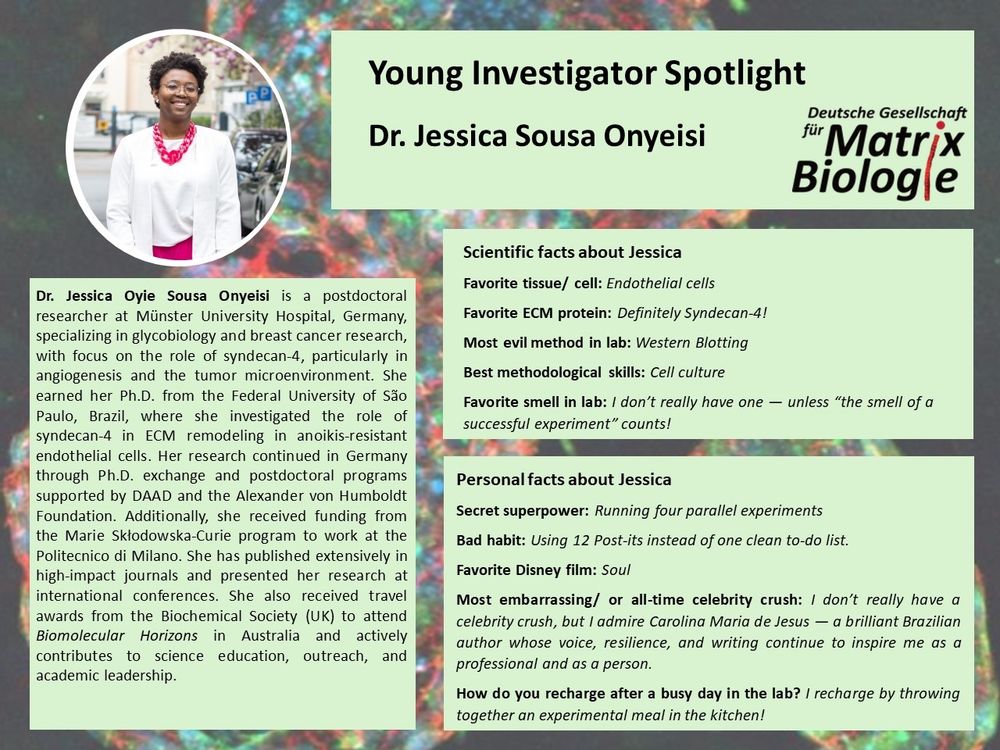
New week, new young investigator spotlight! This week it’s Dr. Jessica Sousa Onyeisi - find her recent publication on Syndecan-4 in breast cancer here: www.sciencedirect.com/science/arti...
19.05.2025 10:56
👍 2
🔁 2
💬 1
📌 0
📣Attention PhD students and post-docs! Attending the collagen GRC this year? Our society offers a limited number of travel grants for early career researchers: www.matrixbiologie.de/travel-grant...
and don't forget to apply to the collagen GRC by June 8th! www.grc.org/collagen-con...
16.05.2025 13:24
👍 0
🔁 2
💬 0
📌 0
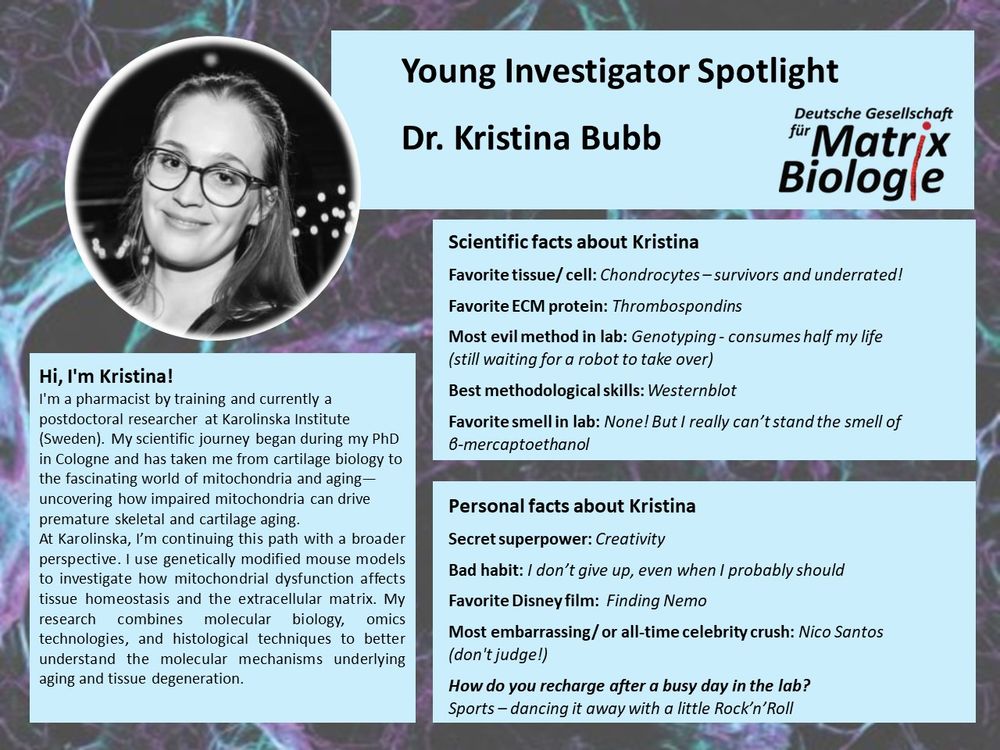
Young Investigator Spotlight of the German Society for Matrix Biology: Dr. Kristina Bubb.
Hi, I'm Kristina! I'm a pharmacist by training and currently a postdoctoral researcher at Karolinska Institute (Sweden). My scientific journey began during my PhD in Cologne and has taken me from cartilage biology to the fascinating world of mitochondria and aging—uncovering how impaired mitochondria can drive premature skeletal and cartilage aging.
At Karolinska, I’m continuing this path with a broader perspective. I use genetically modified mouse models to investigate how mitochondrial dysfunction affects tissue homeostasis and the extracellular matrix. My research combines molecular biology, omics technologies, and histological techniques to better understand the molecular mechanisms underlying aging and tissue degeneration.
Scientific facts about Kristina:
Favorite tissue/ cell: Chondrocytes – survivors and underrated!
Favorite ECM protein: Thrombospondins.
Most evil method in lab: Genotyping - consumes half my life (still waiting for a robot to take over).
Best methodological skills: Westernblot.
Favorite smell in lab: None! But I really can’t stand the smell of β-mercaptoethanol.
Personal facts about Kristina:
Secret superpower: Creativity.
Bad habit: I don’t give up, even when I probably should.
Favorite Disney film: Finding Nemo.
Most embarrassing/ or all-time celebrity crush: Nico Santos (don't judge!).
How do you recharge after a busy day in the lab? Sports – dancing it away with a little Rock’n’Roll.
Let's start this week with a spotlight on @kristinabubb.bsky.social, this year's winner of our society's Young Investigator Award. You can find her recent publication on mitochondrial dysfunction in skeletal ageing here: www.science.org/doi/10.1126/...
12.05.2025 12:00
👍 4
🔁 2
💬 1
📌 0
Submit your abstract now!! 👇👇👇
11.02.2025 06:44
👍 3
🔁 1
💬 0
📌 0

Flyer for the annual meeting of the German Society for Matrix Biology: Matrix Nexus - The Extracellular Matrix: From Molecular Foundations To Life. The flags of Germany, Belgium, Denmark, Sweden and Finland are shown on the outline of Germany, three intertwined snakes/dragons in red, yellow, and blue are looking up to the title, and a pin indicates the location of Freiburg, where the meeting will be held 26.03.-28.03.2025.
Come and join us at our annual meeting in Freiburg! There is still time to submit your abstract! Deadline 21.02.! 👇
www.matrixbiologie.de/annual-meeti...
10.02.2025 08:39
👍 7
🔁 6
💬 0
📌 1