
Multifunctional Guest-Hosting Triple-Stranded Helicates: From Anion Recognition to Quantum Information Applications
ConspectusThe growing field of coordination supramolecular chemistry constitutes a fruitful avenue for accessing a variety of multifunctional materials with a range of applications. Their versatility is enhanced if they have the ability to encapsulate guest molecules, opening opportunities for host/guest synergies. One of the most paradigmatic categories of such assemblies is coordination supramolecular helicates, which exhibit a central cavity for the potential allocation of small species, provided that their symmetry and volumes are compatible. The presence of noncovalent interactions (NCIs) between host and guest strongly contributes to the thermodynamic stability of these edifices, sometimes giving rise to a template effect. All those features are exploited for the case of triple-stranded helicates, which are predictably obtained from reactions of metal ions that adopt an octahedral coordination geometry with ligands made of two chelating moieties sufficiently separated by a spacer. The properties of the cavity of the helicate can be tuned by adjusting the central spacer of the ligand, which in turn, may incorporate functionalities facilitating NCIs with potential guests, such as hydrogen bonds. In this manner, a collection of pyrazolylpyridine (or -quinoline) ligands (L) has given rise to a large family of (G@[M2L3])n+ species (where G represents various guests), in which the encapsulated entities are firmly held in place by [N–H···G] hydrogen bonds. These assemblies can thus be employed for the selective recognition of anions or small coordination complexes, capitalizing on the specific architecture of the ligand strands. Furthermore, they have opened a plethora of possibilities for the investigation of synergic multifunctionality. The host can be made to exhibit molecular switching behavior (for example, spin-crossover, SCO, if M = FeII) or single-ion magnet (SIM) behavior (if M = CoII) while the guest has been exploited to tune these properties or to incorporate new ones. More recently, anionic coordination complexes such as these from the series [M(ox)3]3– (“ox” being the oxalate anion and M = Fe, Cr, Al, Ru) have been efficiently trapped inside the metallo-helices. This has unveiled unprecedented phenomena resulting from encapsulation, such as the first manifestation of SIM behavior for CrIII or the enhancement of the quantum coherence of a molecular qubit when acting as the guest. This family has been expanded with the inclusion of the anilate analogues of oxalates, opening unlimited options for multiproperty explorations (such as photophysical, redox chemistry, radical generation, etc.). More recently, within this group of systems, the guest has been employed as a template to selectively assemble specific combinations of two different ligands in the form of G@[M2LxL′(3–x)]m+ heteroleptic helicates, thus leading to a further opportunity of function tunability and enhancement. In this Account, we survey this and other related types of host/guest assemblies and place them in the general context of triple-stranded supramolecular helicates while assessing their impact in fields like molecular magnetism, quantum technologies, or anion recognition.
Our recent accounts on Triple-stranded supramolecular helicates enable host–guest synergy, tunable spin-crossover, single-ion magnetism, anion recognition, and quantum coherence advances. Cheers to All 😇😊 @labmoldesign-ub.bsky.social @hymat-inma.bsky.social
pubs.acs.org/doi/10.1021/...
27.02.2026 08:52
👍 3
🔁 2
💬 0
📌 0
Come join me in Ireland @ucddublin.bsky.social @ucdchemistry.bsky.social! Help us understand the messiness of cross-talk in metal-ion batteries!
#BattChat #NewPI #sustainability #electrochem
13.11.2025 14:24
👍 10
🔁 5
💬 0
📌 0
Vacancies - Human Resources - Trinity College Dublin
Come join our team at Trinity College Dublin's @tcddublin.bsky.social School of Physics, where we are hiring two new Assistant Professors, one in Physics (experimental) and one in Astrophysics.
See www.tcd.ie/hr/vacancies/ and www.tcd.ie/physics/
Please share! #physics #academicjobs #physicsjobs
25.11.2025 17:51
👍 2
🔁 2
💬 0
📌 0
Until we are able to fairly assess the quality of our own work without the need of surrogates like journals' prestige, we won't be able to fix the way peer recognition and faculty hiring/promotion is managed and we remain stuck in this loop.
17.11.2025 07:10
👍 0
🔁 0
💬 0
📌 0
I think a big change in mentality by researchers and faculty would also be needed to stop all this. I have often the feeling that we are incapable of judging the merit of literature if it doesn't come with a rubber stamp of an IF or similar.
17.11.2025 07:07
👍 0
🔁 0
💬 1
📌 0
I guess having funders to directly pay the society to support their publishing branch would in the end be the same as giving money to researchers to pay APCs but with the advantage of having a much bigger negotiating power, is that what you are suggesting?
17.11.2025 07:04
👍 0
🔁 0
💬 0
📌 0
Very interesting, what's your take on non-profit publishers charging APCs for OA? Is that justified?
16.11.2025 21:49
👍 1
🔁 0
💬 1
📌 0
I knew you'd say that 😆
13.10.2025 17:04
👍 0
🔁 0
💬 0
📌 0
Now we want to know the answer
13.10.2025 16:57
👍 0
🔁 0
💬 1
📌 0

Spin decoherence in molecular crystals: Nuclear vs electronic spin baths
The loss of information about the relative phase between two quantum states, known as decoherence, strongly limits resolution in electron paramagnetic spectrosc
What really drives electron spin decoherence in molecular crystals at low-T? Nuclear or Electron spins?
Turns out you have do magnetically dilute your samples quite a bit if you want to really remove electron-electron dipolar interactions...
pubs.aip.org/aip/jcp/arti...
01.10.2025 14:44
👍 2
🔁 0
💬 0
📌 0

So happy this piece is finally out! A tremendous collaborative effort of colleagues and friends from 8 institutions all over Europe. Thank you! doi.org/10.1038/s414...
Photochemistry and photophysics in a single crystal @jagiellonskiuni.bsky.social @cleracr.bsky.social @natcomms.nature.com
29.09.2025 23:52
👍 11
🔁 6
💬 0
📌 1

This Friday is #EuropeanResearchersNight ⚗️🧪Come visit us and other research groups @TCD_Chemistry
in @tcdTBSI @TCD_Chemistry @tcddublin.bsky.social . Everyone is welcome 📢! Great science and fun people 👨🔬👩🔬😀#porphyrins #chlorophyll #cubane #BODIPY #PDT #bicyclopentane @researchireland.ie
23.09.2025 15:15
👍 5
🔁 2
💬 0
📌 0
🤤
17.08.2025 12:05
👍 0
🔁 0
💬 0
📌 0
A Multireference Picture of Electronic Excited States in Vanadyl and Copper Tetraphenyl Porphyrin Molecular Qubits
Now published in JPC A
Excellent job by @arups.bsky.social 👏👏
@erc.europa.eu and MSCA
pubs.acs.org/doi/10.1021/...
29.07.2025 11:29
👍 7
🔁 1
💬 0
📌 0

Mariano teaching us how to compute vibronic coupling
25.07.2025 14:36
👍 4
🔁 0
💬 0
📌 0
Loosely quoting a synthetic coordination chemist friend of mine: Same ingredients, tools and recipe in the hands of a michelene star chef or a random person will lead to very different results
26.06.2025 16:47
👍 0
🔁 0
💬 0
📌 0


Great taste of Irish food, beer and music at @ecmols2025.bsky.social dinner at #merryploughboypub
03.06.2025 19:49
👍 5
🔁 2
💬 0
📌 0


Here we go with our first speaker in the final session of day2 with Prof. Elke Scheer from University of Konstanz #ECMOLS2025
03.06.2025 15:30
👍 3
🔁 1
💬 0
📌 0


The second day of #ECMolS2025 concluded with the final session, featuring a compelling talk by Prof. Pascal Gehring from Université catholique de Louvain
03.06.2025 16:16
👍 2
🔁 1
💬 0
📌 0
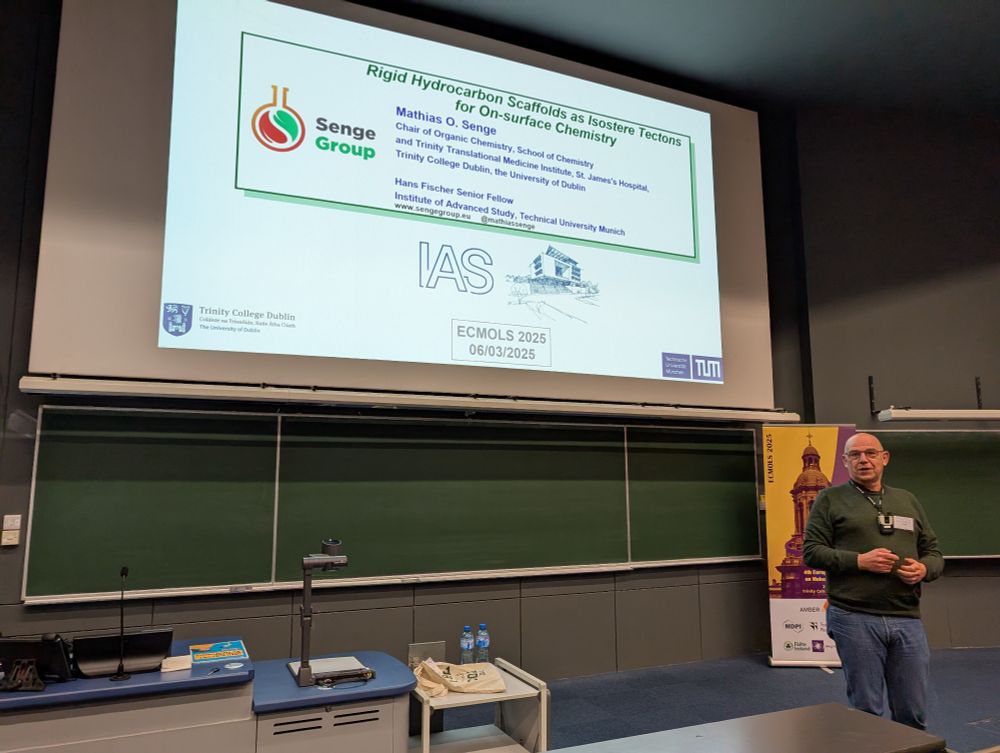
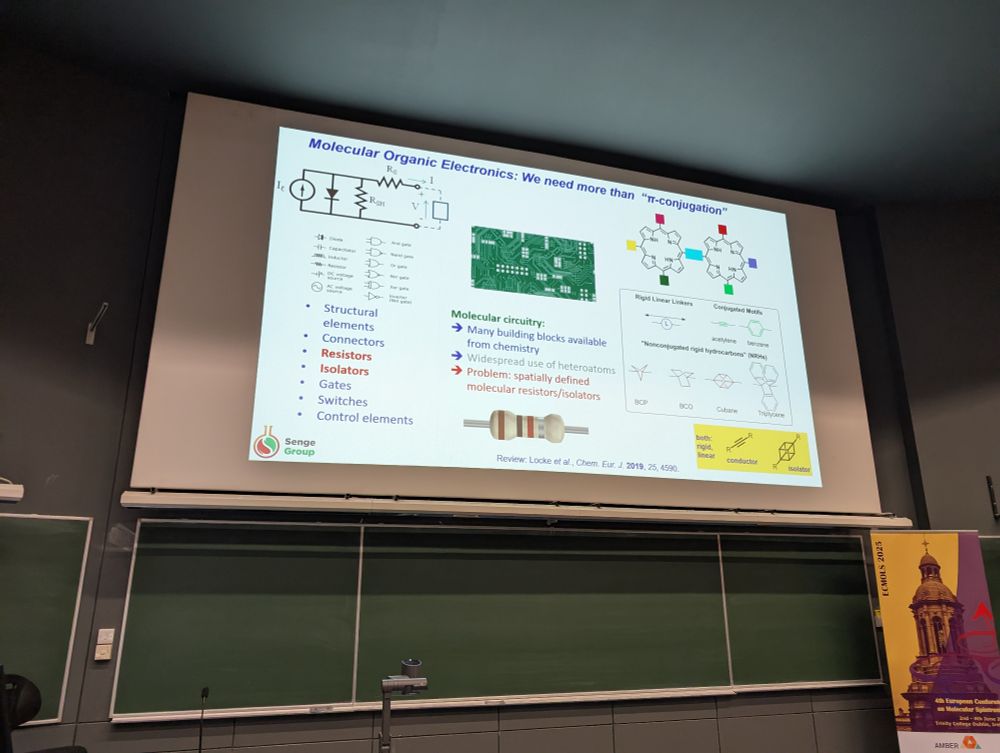
Third speaker from the 2nd session on Day2 is delivered by Prof. Mathias O. Senge from @tcddublin @TCD_Chemistry #ECMolS2025
03.06.2025 11:14
👍 4
🔁 2
💬 1
📌 0


Our first speaker (tutorial speaker) for the morning session on Day2 is Prof. Fernando Luis from the University of Zaragoza #ecmols2025
03.06.2025 08:10
👍 1
🔁 1
💬 0
📌 0


