Join us for the LOVE REPLICATIONS WEEK from March 2 - 6 with talks on reproductions, replications, how to find them, how to conduct them, how to have them conducted on your study, where to publish them, and much more!
30.01.2026 11:44
👍 21
🔁 16
💬 3
📌 1
"Grassroots networks can help implement and harmonize open research efforts", by @agataboch.bsky.social, @tkalan.bsky.social, @maxkorbmacher.bsky.social, Lewend Mayiwar, @julienmayor.bsky.social & @dsquintana.bsky.social - doi.org/10.7557/11.8....
23.12.2025 14:24
👍 4
🔁 4
💬 0
📌 0

ISLE Online Forum 2025
Teaching with Impact: Linguistics in the Classroom
Wednesday, 12 November 2025 | 6:00 PM CET (Berlin)
Featured Presentations:
Julia Schlüter (University of Bamberg)
Introducing KorPLUS
KorPLUS is an open, interactive learning package designed to build corpus and AI literacy among non-native English-speaking language professionals. Through hands-on activities and real-world data, it empowers learners to engage critically with language data and emerging technologies.
Katharina Deckert (University of Bamberg)
Core Collaborator on KorPLUS
Joining Julia to discuss the development and implementation of the project.
Elen Le Foll (University of Cologne)
Presenting: Data Analysis for the Language Sciences
This open textbook, recognized with an Honourable Mention, offers an accessible and inclusive introduction to statistics and data visualization in R for students and researchers in the language sciences. Designed for diverse learners, it supports both standalone study and integration into blended learning environments.
How can open educational resources make corpus linguistics more accessible?
What role does data literacy play in empowering language professionals?
How can digital tools support inclusive and innovative teaching in English linguistics?
Event Details:
Register & Learn More: https://www.isle-linguistics.org/events/outreach
Revisit recordings of previous ISLE Online Forums on our YouTube channel: www.youtube.com/@isle2008
Join us next Wed 6 pm CET to talk about teaching linguistics, the creation of Open Educational Resources, and teaching innovations in higher education: https://uni-koeln.zoom.us/j/4799217418
#OpenEducation #OER #linguistics #HigherEd
04.11.2025 18:02
👍 6
🔁 7
💬 0
📌 0

Join our upcoming webinars “Peer Review and its Diversification”!
📅 15-16 October 2025 on Zoom
👉 Registration: forms.gle/1R4Y3d33W8bQ...
📄 Full programme: docs.google.com/document/d/1...
#PeerReview #PeerReviewWeek #PRW2025 #metasci #academicsky
18.09.2025 15:41
👍 27
🔁 19
💬 3
📌 1

At the FORRT Replication Hub, our mission is to support researchers who want to replicate previous findings. We have now published a big new component with which we want to fulfill this mission: An open access handbook for reproduction and replication studies: forrt.org/replication_...
03.09.2025 06:54
👍 60
🔁 36
💬 2
📌 2
For those interested, here's our full preprint on the call for more transparent pilot study reporting: osf.io/preprints/ps...
@ihandleyminer.bsky.social #OpenScience #PilotStudies
03.09.2025 09:05
👍 5
🔁 3
💬 0
📌 0
"Don't seat the baby near the door" 👶 Thanks to @infantstudies.bsky.social for the chance to discuss our task force work on making pilot study insights more transparent to improve psyc science!
@agataboch.bsky.social #OpenScience #DevPsySky #PilotStudies #PsychScience #Transparency
03.09.2025 09:01
👍 6
🔁 2
💬 0
📌 1
OSF
As part of the Pilot Reporting Task Force, founded at @improvingpsych.org conference 2023, I would like to share a preprint with you: osf.io/preprints/ps.... We are looking for feedback on our perspective piece, promoting more transparency in the reporting of piloting in psychological science. 1/4
03.09.2025 16:07
👍 10
🔁 9
💬 1
📌 0

We are creating an academic journal and *you* can shape it!
Make comments and suggest changes to replicationresearch.org 's
- Constitution
- TOP guidelines
- article types
- and reviewer guidelines
until September 5 and be credited as a contributor: docs.google.com/document/d/1...
31.07.2025 07:44
👍 35
🔁 19
💬 2
📌 0

There is much enthusiasm, in principle, for adversarial collaborations (ACs), a scientific conflict resolution technique that encourages investigators with clashing models to collaborate in designing studies that test competing predictions. Adversarial collaborations offer the promise of breaking deadlocked debates, resolving disputes, and providing a deeper, more comprehensive understanding of a research domain. In practice, however, adversarial collaborations are more the exception than the rule, and there is almost no evidence on how scholars who have ventured into ACs assess the experience. To understand these perspectives, we surveyed and interviewed 29 scholars who participated in 13 AC projects. The data revealed that interpersonal conflicts were generally minor, that these projects required more upfront effort than typical collaborations, but benefited from high-quality results and more thoughtful post-publication debates. Rather than producing a clear “winner,” the most common outcome was a deeper understanding of the problem space through the integration of opposing perspectives. Although the generalizability of these findings is limited by a sample consisting only of scholars who completed an AC, they nonetheless highlight the value of ACs as a tool for advancing scientific inquiry and offer practical guidance for scholars and journals exploring this approach.
29 scholars reflect on their participation in adversarial collaborations:
“Rather than producing a clear 'winner,' the most common outcome was a deeper understanding of the problem space through the integration of opposing perspectives”
Open Access: doi.org/10.1007/s111...
#MetaSci #Methodology 🧪
15.07.2025 13:40
👍 49
🔁 18
💬 3
📌 1
Are you an early-career researcher (or someone hoping to help ECRs) working in #openscience or #metascience? The @reproducibilitea.org podcast is looking for guests for our next season of episodes! We'd love to feature ECR voices foremost – the next generation of scientists should be heard the most!
09.07.2025 04:12
👍 31
🔁 24
💬 3
📌 1

Reproducibility and replicability of qualitative research: an integrative review of concepts, barriers and enablers
🖇Today, we look at a paper whose "authors examine reproducibility and replicability in qualitative research". According to the assessment, "both reviewers found the article to be technically sound, interesting, and of likely value to the field."
👇 Read the assessment, reviews & full text on MetaROR
03.07.2025 13:59
👍 7
🔁 5
💬 1
📌 0

"Science is not, and has never been, a neutral endeavour... the notion that researchers can or should cleanse themselves of bias is untenable, potentially intellectually dishonest, and ethically fraught."
New preprint with the (brilliant) Sarahanne Field #Metascience2025
osf.io/preprints/os...
02.07.2025 13:27
👍 101
🔁 32
💬 2
📌 8

Programme - Metascience
Take a look over the Metascience 2025 timetable.
If you are at #Metascience2025 and would like to hear more about other grassroots networks and their metascientific work, join our session today at 11:30
on the role of grassroots networks for reproducibility and reform (at SOAS S110) metascience.info/programme/#1...
02.07.2025 09:06
👍 2
🔁 0
💬 0
📌 0

Presenter on the stage pointing at a slide listing different open science initiatives and organizations in Africa
Are we doing #OpenScience just because everybody else is doing Open Science? Is it going to help us solve our local problems? How can metascience help? - thought-provoking questions from Emmanuel Boakye presenting African Reproducibility Network at #Metascience2025
02.07.2025 08:57
👍 24
🔁 0
💬 1
📌 0
How transparent is epidemiological secondary data research? How transparent could it be?
This was a project that originated in NORRN’s @norrepro.bsky.social metascientific work in collaboration with fantastic researchers at @uio.no and FHI in Norway 🇳🇴 Check out Timo’s thread below! 👇🏻
02.07.2025 08:36
👍 2
🔁 1
💬 0
📌 0

Experimentology cover: title and curves for distributions.
Experimentology is out today!!! A group of us wrote a free online textbook for experimental methods, available at experimentology.io - the idea was to integrate open science into all aspects of the experimental workflow from planning to design, analysis, and writing.
01.07.2025 18:25
👍 534
🔁 228
💬 9
📌 15
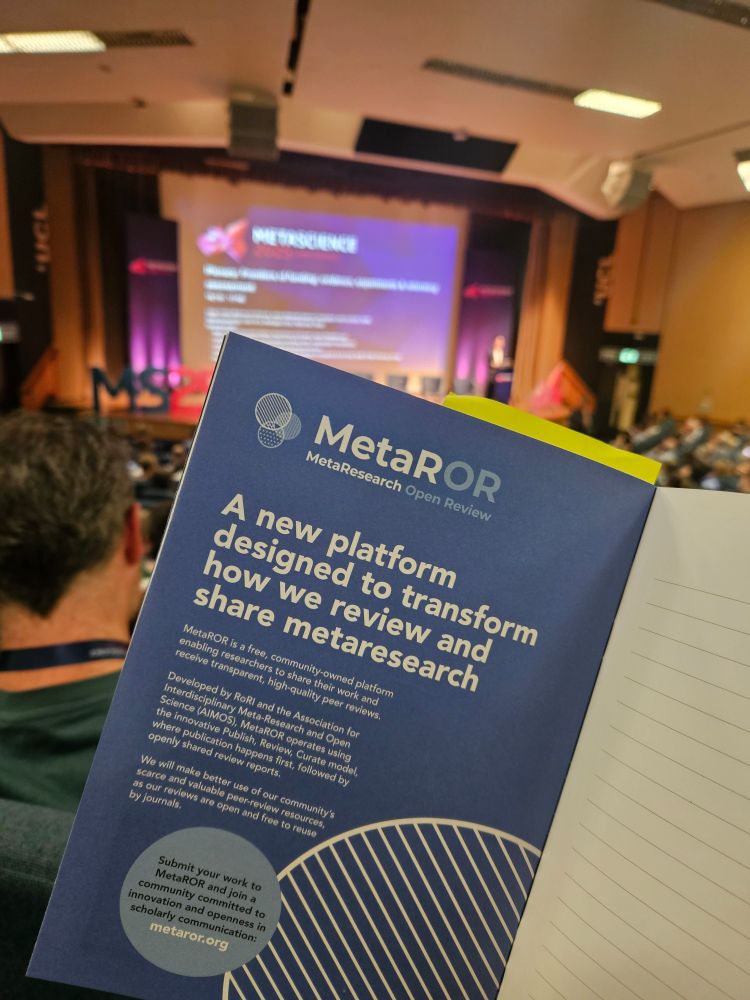
@metaror.bsky.social is a scholar-controlled peer review service for metascience research. Check us out! Metaror.org
#metascience2025 (I am an associate editor at MetaRoR) @ludowaltman.bsky.social @aidybarnett.bsky.social
30.06.2025 15:27
👍 35
🔁 18
💬 0
📌 0

Basic research funding ‘must be protected and grown’ - Vallance
Funding for curiosity-driven research ‘easiest area’ for governments to cut, warns science minister
Science minister Patrick Vallance has warned that “curiosity-driven” research is one of the “easiest” areas for governments to cut, but stressed it must be “protected and grown” alongside improving the UK’s applied research base
#Metascience2025
www.timeshighereducation.com/news/basic-r...
30.06.2025 14:49
👍 6
🔁 7
💬 0
📌 1
Thank you so much for an incredible closing panel discussion. It was an honor to moderate it. @lspitzer.bsky.social @leesplez.bsky.social @martonkovacs.bsky.social @agataboch.bsky.social A. Sarafoglou
One Q. we discussed: How can ECRs contribute to protecting academic freedom? Thoughts? #SIPS2025
28.06.2025 06:23
👍 21
🔁 4
💬 0
📌 1

Always down for more analog conference sessions. Thanks to all our hackathon attendees for a super productive session - - looking forward to more testing of our pilot reporting templates!
#SIPS2025
27.06.2025 11:54
👍 6
🔁 2
💬 0
📌 0
FOR 2026 Conference – A Philosophy of Open Science for Diverse Research Environments
#OpenScience lobbyists, skeptics and everything in between: consider coming to Munich in May 2026 (gorgeous time to visit..) to discuss the future of Open Research!
FOR2026 is open for submissions: opensciencestudies.eu/for-2026-con... pls help spread the word 🙏 #philsci #sts #methods #policy 🧪
25.06.2025 05:49
👍 48
🔁 33
💬 0
📌 2

Auditorium room with the audience photographed from the back, the speaker on the stand and slides displayed on the projector screen
Presidential address from @priyasilverstein.com at #SIPS2025: “Improving psychological science is hard”
It is, but SIPS is also the best community I could ever imagine to work on that improvement with 🥹 Join and support! 🙏🏻 improvingpsych.org
25.06.2025 14:30
👍 20
🔁 8
💬 1
📌 0
This is genuinely wild
24.06.2025 16:48
👍 0
🔁 1
💬 0
📌 0
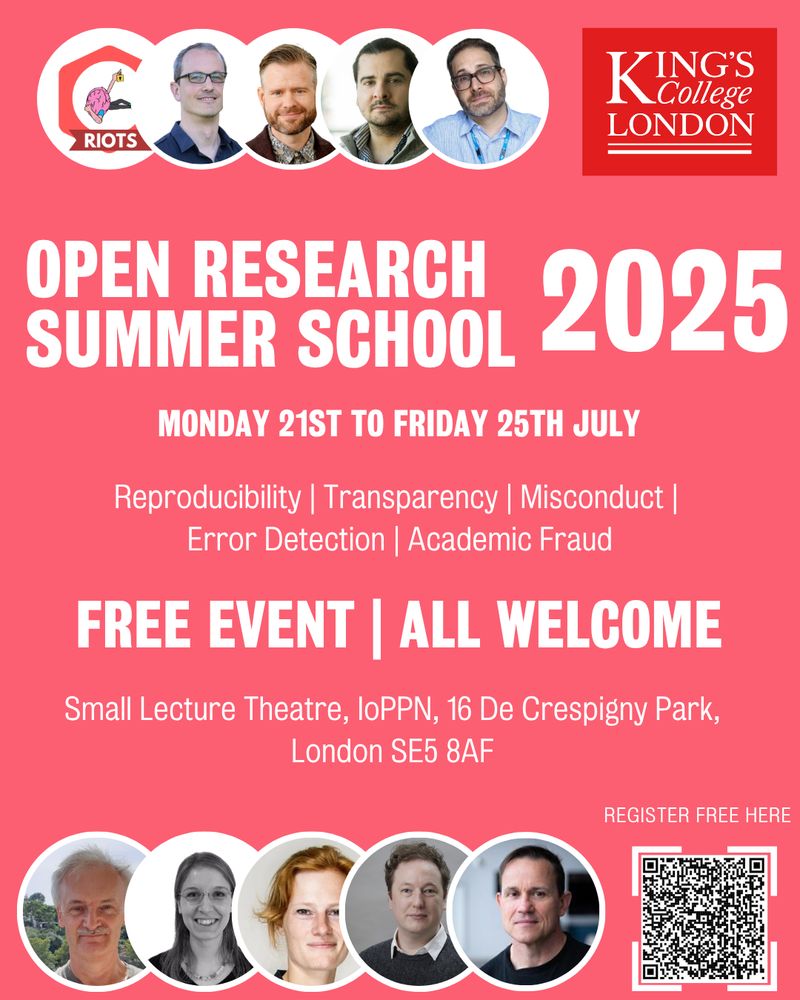
We're back, with a fresh new lineup of talks and workshops!
Get your place while you still can to learn about how to make your research more robust and how to deal with scientific fraud!
This event is free and open to all: tinyurl.com/3ewaduvm
11.06.2025 09:43
👍 49
🔁 31
💬 0
📌 4

National symposium on
Responsible Open Science
June 16th, 2025, 09:00 – 15:30 CET
Morning:
§ Responsible Open Science: presentation of the ROSiE guidelines
§ Keynotes on Ethical and epistemic responsibility: trust, integrity, and knowledge diversity
Afternoon:
§ Panel on Social and existential responsibility: fairness, inclusivity, AI, and big data
§ Co-creation of national recommendations for Responsible Open Science
More information and registration: https://nettskjema.no/a/514733
The event is hybrid with online sessions and possibility to
participate in-person in Oslo, Bergen and Tromsø.
We're very pleased to announce that the theme for this year's NORRN annual meeting will be "Responsible Open Science".
This event will be held in person (Oslo, Bergen and Tromsø) and online on June 16th. Register for the event here: nettskjema.no/a/514733#/pa...
12.05.2025 10:40
👍 10
🔁 5
💬 0
📌 0

Some really interesting presentations coming up at the Metascience 2025 conference in late June early July. Here's four that take a step back to consider the discipline of metascience, question some of its assumptions, and reimagine its approach...
02.06.2025 07:05
👍 25
🔁 12
💬 2
📌 0