
Want to know how oceanography shapes coral reef ecosystems from microbes to sharks and how climate change will impact these vital links?
See our interdisciplinary review on ocean-reef connections!
Download here: tinyurl.com/jbah3cjx
@remotereefs.bsky.social
@eco-oce-lab.bsky.social
24.11.2025 08:45
👍 5
🔁 3
💬 1
📌 2
If you have a chance, try to catch a show at Ronnie Scott's Jazz Club. They do blues, jazz, funk, etc. and it's a really cozy venue - not a bad seat in the house!
03.10.2025 16:40
👍 2
🔁 1
💬 0
📌 0

New paper!
‘Climate change impacts to upwelling and shallow reef nutrient sources across an oceanic archipelago’
Out now in Limnology and Oceanography @aslo.org
aslopubs.onlinelibrary.wiley.com/doi/10.1002/...
⬇️🧵
08.09.2025 08:58
👍 15
🔁 11
💬 1
📌 1

Join our team as a KAUST global fellow! An amazing postdoctoral program for early career researchers.
We study ocean-reef connections and their influence on reef function and persistence under climate change. Reach out to discuss opportunities! 🌊🧪
kgfp.kaust.edu.sa
24.07.2025 12:23
👍 9
🔁 6
💬 0
📌 2

A cartoon titled ‘The Life of a Scientist’.
(The life is depicted as a set of steps, three up then three down with a character on each)
Baby: Such a mysterious world!
Child: I must search for answers
Young adult: Each answer leads me to more questions
Middle age: ... At least I've got lots of questions
Old age: Ok, I guess questions are my thing now
From grave: Such a mysterious world!
My latest @newscientist.com cartoon
14.06.2025 10:50
👍 1988
🔁 584
💬 21
📌 39
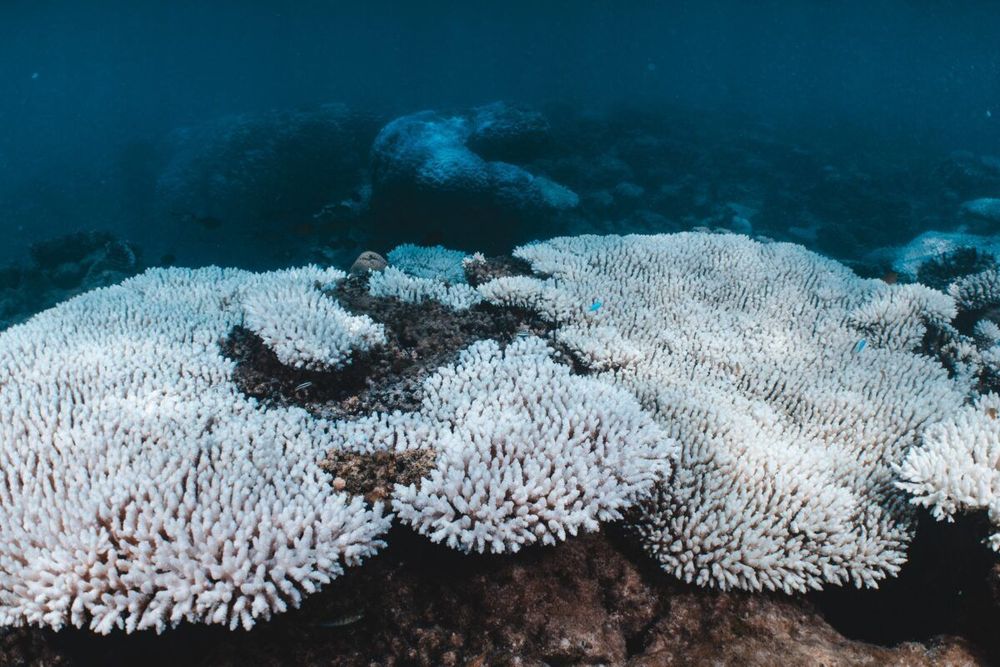
Ongoing global coral bleaching event affects 84% of world’s reefs
Coral reefs around the world have been subjected to unprecedented heat stress since early 2023. A new report finds heat-related coral bleaching has damaged corals in more than 80 countries, making it…
Coral reefs around the world have been subjected to unprecedented heat stress since early 2023. A new report finds heat-related coral bleaching has damaged corals in more than 80 countries, making it the most extensive bleaching event ever recorded, with no clear end in sight.
24.04.2025 08:18
👍 28
🔁 25
💬 0
📌 2

Screenshot of an article title that says "the impact of neotectonics on the geomorphology of the northern Great Barrier Reef"
What happens when an entomologist-turned-marine biologist skims the latest articles in Coral Reefs: I read this as "the impact of NEONICOTINOIDS on the geomorphology of the northern Great Barrier Reef" and thought surely there can be no connection 😅
20.03.2025 10:13
👍 4
🔁 0
💬 0
📌 0
Just in case you haven’t seen the most recent paper from our group, @reefwally.bsky.social investigated solar bias in commonly used temperature loggers. Long story short, the accuracy of your in situ measurements depends on your deployment method and you should always shade your loggers! 🧪🌊
19.03.2025 07:36
👍 11
🔁 3
💬 0
📌 0
The U.S. NWS is a truly world-class meteorological predictive service, perhaps singularly so. Its cost of operation is only ~$3-4/yr per taxpayer—equivalent to a single cup of coffee—and yields a truly remarkable return on investment (at least 10 to 1, and perhaps 100 to 1).
3/11
28.02.2025 00:28
👍 928
🔁 242
💬 4
📌 10
Read about our new paper on temperature logger best practices in the Latitude blog post! 🌊🦑
31.01.2025 08:52
👍 6
🔁 1
💬 0
📌 0
That being said, I think there's a lot of interesting work to be done on how a coral colony thermoregulates...I know some research has looked at how different morphologies can disapate heat more effectively. We still have lots to learn!
20.01.2025 06:04
👍 0
🔁 0
💬 1
📌 0
To your point about measuring "what the coral feels", I think the physical properties of the coral are going to heat up in a different way than the plastic housing of a logger. The easiest way to measure across different habitats is to measure the water column itself, so long as we do it correctly
20.01.2025 06:01
👍 1
🔁 0
💬 1
📌 0
Thanks for pointing this out! This is something we've mulled over as well. The problem with the models that overestimate temperature is that they are measuring temperature inside the housing, which acts like a greenhouse. Models that have a thermistor outside the housing are much more accurate.
20.01.2025 05:58
👍 0
🔁 0
💬 1
📌 0
I had the privilege of visiting Palmyra Atoll in 2023 and learned about these plans for releasing the Guam kingfisher. Exciting to see that the birds have arrived!
16.01.2025 07:05
👍 2
🔁 0
💬 0
📌 0

A view of a coral reef with a logger deployed inside a white PVC pipe.
There's much more in the paper, including modelling to estimate the amount of bias one can expect under different irradiance levels and with different shading methods. We hope this serves as a reminder to the coral reef research community to think carefully about how you deploy loggers!
28.12.2024 18:37
👍 3
🔁 0
💬 0
📌 0

A view of a coral reef with a white PVC pipe of about 20 cm length deployed horizontally on the reef. A temperature logger is inside, shaded from direct sunlight.
Fortunately, there is a cheap and easy way to improve data accuracy: shade your loggers! We recommend putting them inside a PVC pipe, which shades them enough from the sun but allows water to flow freely around them. With proper calibration, even cheap logger models can give reliable data.
28.12.2024 18:37
👍 4
🔁 0
💬 1
📌 0
Moreover, if you want to directly compare temperature stress from your study site to previously-published data, you want to be sure you're comparing apples to apples. What if one logger was shaded and calibrated and the other wasn't? Clearly stating deployment details can improve data comparibility.
28.12.2024 18:37
👍 1
🔁 0
💬 1
📌 0
This has implications for research and management...if your logger is reading 2-3ºC above reality because it's in direct sunlight, you are overestimating heat stress at your study site. Remember, 1ºC above normal summer temps is enough to cause coral bleaching and mortality!
28.12.2024 18:37
👍 1
🔁 0
💬 1
📌 0
To summarize: more and more people are deploying loggers on coral reefs, but not many of us are explicitly stating whether they are properly shaded or calibrated. What's more, different models have different degrees of bias...some suffer bias even under low light, while others were unaffected!
28.12.2024 18:37
👍 1
🔁 0
💬 1
📌 0

An 8-panel figure showing the effect of irradiance on temperature bias. Each panel shows an unshaded and a shaded treatment for each model. The unshaded treatment tends to linearly increase with increasing irradiance, while the shaded treatment shows no relationship - it's a straight horizontal line.
Another way to visualize this is to plot the offset from the "true" temperature against irradiance on the x-axis. Here you can see the relationship is linear - as irradiance increases, the offset does too. But luckily, when you shade all models, this relationship disappears!
28.12.2024 18:37
👍 1
🔁 0
💬 1
📌 0

A figure showing the solar bias of 8 different loggers compared to a shaded, calibrated logger. Points are color coded to irradiance levels, and brighter points (higher irradiance) have a higher offset from the true temperature than darker points (lower irradiance).
Below you can see that most loggers suffer solar bias - but some are much worse than others! In general, the brighter it is, the higher the error (that is, the logger overestimates the true temperature more when it's sunny).
28.12.2024 18:37
👍 1
🔁 0
💬 1
📌 0

A SCUBA diver installs a temperature logger on a stake hammered into a coral reef. Fish swim in the background and the entire scene is backlit by the sun.
We then performed field trials to see how much solar bias affects loggers. First, we determined that one model (SBE-56, pictured below) is unaffected by sunlight. We compared unshaded loggers to a SBE-56 on a shallow reef flat. We also measured irradiance to relate light levels with solar bias.
28.12.2024 18:37
👍 1
🔁 0
💬 1
📌 0

A figure showing the mean offset of three replicate loggers from the calibration temperature. Some logger models never deviate from the true temperature while others have consistent offsets of 0.2-0.5⁰C.
Our next task was to compare the "out of the box" accuracy of newly-purchsed loggers in a high-accuracy calibration bath. Accuracy varied among models, as well as a function of response time - some are spot on and others are off by 0.2-0.5ºC. Lesson 1 is calibrate your loggers before deployment!
28.12.2024 18:37
👍 1
🔁 0
💬 1
📌 0

Figure from the paper showing only 5% of papers stated that loggers were shaded, despite >40% of them deploying loggers shallower than 5 meters.
Out of 329 coral reef studies we surveyed since 2013, we were surprised to see that less than 5% of papers mentioned shading loggers. This is despite >40% deploying loggers in less than 5 meters of water, where the potential for solar bias is high!
28.12.2024 18:37
👍 1
🔁 0
💬 1
📌 0

A black plate rests on the bottom of a shallow reef flat. Underneath are a variety of temperature loggers, which are shaded from the sun.

A variety of temperature logger models are fastened to a clear acrylic plate that's deployed on the bottom of a shallow reef flat. The loggers are in full sunlight.
We revisited the problem of "solar bias" and surveyed recent literature to see how often researchers mentioned shading or calibrating loggers. We then assessed 10 logger models for accuracy and whether different models are affected differently by direct sunlight in shading trials.
28.12.2024 18:37
👍 1
🔁 0
💬 1
📌 0
However, this all assumes loggers are collecting accurate data! It has been shown in the past that loggers exposed to the sun can heat up, causing falsely elevated temperature readings. What's more, the inherent accuracy of many new models haven't been evaluated yet in real world conditions.
28.12.2024 18:37
👍 1
🔁 0
💬 1
📌 0
Over the past few decades, more brands and models of loggers have appeared on the market, and there's an increasing number of loggers deployed on coral reefs globally. This has huge potential for researchers to gain a better understanding of how corals respond to temperature worldwide.
28.12.2024 18:37
👍 1
🔁 0
💬 1
📌 0


