
An exciting PhD on biological invasions …
08.11.2025 01:24
👍 4
🔁 1
💬 0
📌 0
An exciting PhD on biological invasions …

Pirri-Pirri Bur, Pampas grass, Wireweed: all plants from the S Hemisphere that are establishing in the UK. Can we explain current and predict future invasions by S Hemisphere plants? Apply for this NERC ACCE+ PhD project to find out: tinyurl.com/374ty2b7
Please Repost! @acce-dla.bsky.social


The first Workshop for IPBES #GlobalAssessment2 is taking place this week in Windsor, Canada!
The workshop is focused on enhancing methods for working with Indigenous and local knowledge. 🏡🌍
📚🧪 Learn more: https://www.ipbes.net/second-global-assessment
That is correct - they are mildew-feeding
It’s always wonderful to celebrate insects together - thank you - I loved being with you all

A distinctively coloured and marked Ladybird is shown in the image. The elytra are yellow in colour with twenty-two black spots. The pronotum is yellow with five black spots.Just the tiniest Ladybird, now moved off the path to avoid it being trodden on. A Psyllobora vigintiduopunctata (often abbreviated to Psyllobora 22-punctata), the 22-spot Ladybird. We read it is the only Ladybird species in Britain & Ireland where the three life stages have very similar colouring & pattern.
Just the tiniest Ladybird, now moved safely off the path. A Psyllobora vigintiduopunctata (often abbreviated to Psyllobora 22-punctata), 22-spot Ladybird. We read it is the only species in Britain & Ireland where the three life stages have similar colouring & pattern... @ukladybirds.bsky.social

Very bright 22 spot ladybird @ukladybirds.bsky.social

A little Tytthaspis sedecimpunctata, 16 Spot Ladybird, from #RSPBMiddletonLakes, 01/08/25 @ukladybirds.bsky.social #ladybird

Exciting bycatch from last night’s catch: 18-spot Ladybird (Myrrha octodecimguttata), a species associated with Scots Pine. Three records from Sutton Park, where this individual probably came from. @ecorecord.bsky.social @ukladybirds.bsky.social #ladybirds


Very sorry I missed this bunch and that I could not be in Athens to hear @ukladybirds.bsky.social
Plenary for ICZEGAR wonderful to see the Darwin Plus fellows from Cyprus presenting their work!

The larva of the 14-spot Ladybird, Propylea quattuordecimpunctata, seen 15/06/25 at #RSPBMiddletonLakes @ukladybirds.bsky.social @colsocbi.bsky.social #ladybird

Need reading material? 📖
📢 The new issue of #RESAgForestEnt is now available!
See contents of the journal's August 2025 issue here ⬇️
resjournals.onlinelibrary.wiley.com/toc/14619563...
@jordancuff.bsky.social @chrisranger.bsky.social @ukladybirds.bsky.social @wiley.com @royentsoc.bsky.social


A quick pause and recharge at the @ipbes.net meetings! ⏸️
Sometimes the most insightful conversations happen between sessions. Fueling up for more discussions on our work #ForNature. 🌍
Great energy here in Bonn as experts and Bureau members connect. 🧪
📅 Deadline this Sunday 🪲
Just a few days left for you to take advantage of our earlybird discount.
Register by 13 July to take advantage of significant discounts with our #earlybird rate for #Ento25 🔽
buff.ly/USVdMQz
@unistrathclyde.bsky.social #StrathLife

🛖 The ILK approach adopted by @IPBES.net offers a framework for effectively engaging #IndigenousPeoples and local communities and recognizing and working with traditional knowledge.
This is crucial for effective biodiversity assessments & ensuring sustainable resource management.
Learn how. 👇

Halyzia sedecimguttata, the Orange Ladybird, seen at #RSPBMiddletonLakes, 28/06/25 @ukladybirds.bsky.social @colsocbi.bsky.social #ladybird

14-spot ladybird seen on the side of a concrete post, in the evening sun at Sheringham, 04/07/25. Ladybird is yellow with black dashes on its' elytron. Facing toward the top of the photo. Beach and sea faintly visible in the background.

Seven-spot ladybird on the underside of a junction where vertical and horizontal railings meet along the seafront at Sheringham, 04/07/25. I found a lot of the ladybird on the underside at points where the vertical and horizontal intersected. A lot like ladybirds would do when over-wintering.

A group of 7-spot ladybirds making the fencing around the East Slope by Sheringham Museum there own adventure playground. Five ladybirds visible in shot.
10-spot ladybird (decempustulatus form) with brown elytron and white spots on the sunny side of a pole along the prom at Sheringham, 04/07/25.
A few ladybirds found on the front at Sheringham this evening, between The Crown and the Tank. 100+ 7-spot, 10, 14 and Adonis' also found. @ukladybirds.bsky.social 04/07/25. Most ladybirds I think I've ever seen down the front.

Macro photo of a seven-spot ladybird on a tamarisk bush on the Esplanade at Sheringham in the morning sun, 04/07/25. The wind was blowing the ladybird about, so I was lucky to capture at the top of the frame.
Macro photo of a seven-spot ladybird on a tamarisk bush on the Esplanade at Sheringham in the morning sun, 04/07/25. The wind was blowing the ladybird about, so I was lucky to capture at the top of the frame. @ukladybirds.bsky.social

Seven-spot ladybird on a nettle leaf.

Five seven-spot ladybirds seen on a nettle alongside the Norfolk Coastal Path as it approached the top of Skelding Hill, Sheringham in the morning sunshine, 12/06/25. Three ladybirds are visible on leaves along the right edge of the photo. The other two are mostly obscured by a mettle leaf in the just above middle at the left edge.

Seven-spot ladybird on the underside of the ledge that runs along the north side of the Sheringham Coastwatch building.
A lot of ladybirds found alongside the top of the path leading up to Skelding Hill, Sheringham, first thing, 12/06/25. Counted at least 180 7-spots, the most I have seen in a long time. Found on grasses, nettles, Alexanders' and gorse. @ukladybirds.bsky.social

Brown with yellow spots decempustulatus form 10-spot ladybird on gorse in the morning sunshine, Skelding Hill, Sheringham, 18/06/25.

Cream-streaked ladybird on gorse, Skelding Hill, Sheringham, 18/06/25. Facing the camera, red elytra with salmon pink streaks. Black spots of various sizes and shapes.

Larch ladybird found on gorse, Skelding Hill, Sheringham, 18/06/25. Facing downward, pale brown elytra, with darker line where the two elyton meet. Markings on pronotum resemble an upper-case W.

7-spot ladybird on gorse, Skelding Hill, Sheringham, 18/06/25.
A good variety of ladybirds found on Skelding Hill, Sheringham, 18/06/25. @ukladybirds.bsky.social


Third time in a week I've seen Harlequin Ladybird larvae preying upon sawfly larvae (Euura poecilonota here). We've had so many aphids in E. Yorkshire this spring that Harlequins are in huge numbers and after whatever they can find apparently. @ukladybirds.bsky.social #yorkshiresawflies #symphyta
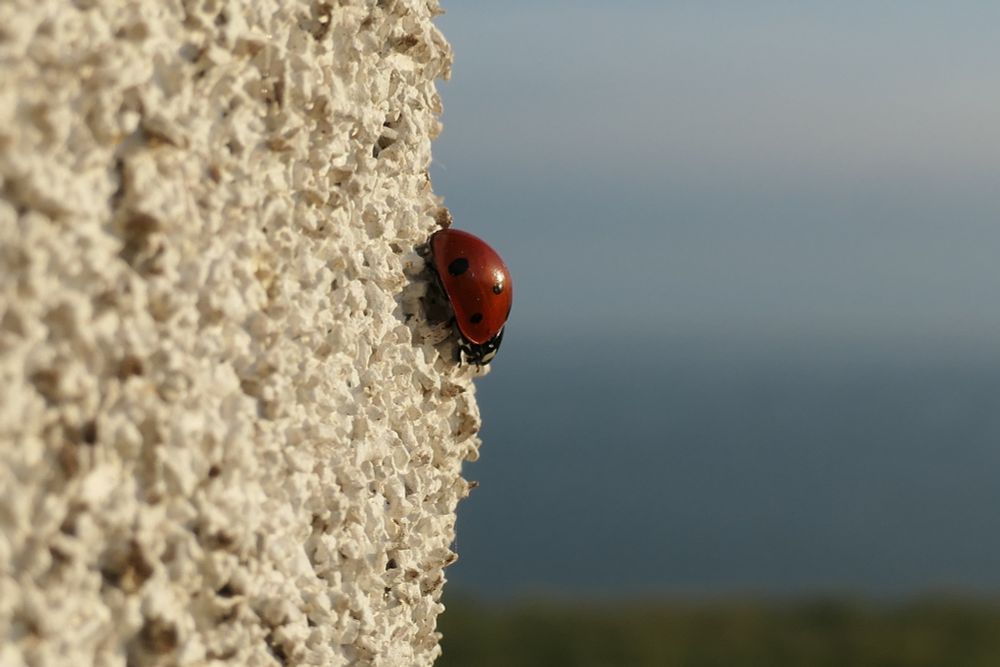
Seven-spot ladybird on the corner of the east and north walls of Sheringham Coastwatch building. The building is white and behind the ladybird in the blurred blue waters of the North Sea and the green grass leading to the edge of the cliff.

Seven-spot ladybird on a wooden bench by the Sheringham Coastwatch building on Skelding Hill in the early morning sunshine, 31/05/25. The bench has a dedication to a benefactor of Sheringham Coastwatch and the ladybird is straddling the letters o and a of Coastwatch that have been carved into the wooden bench.

Seven-spot ladybird on the leaves of a gorse bush.
Some seven-spot ladybirds found early on Saturday morning, Skelding Hill, Sheringham, in the early morning sunshine @ukladybirds.bsky.social

A pair of Adonis' ladybirds mating on a gorse bush on Skelding Hill, Sheringham, 31/05/25.

An Adonis' ladybird on a leaf of a gorse bush, Skelding Hill, Sheringham, 31/05/25. The ladybird is likely to have recently emerged as it has indentations on both elytra.

Adonis' ladybird partly obscured by the spines of the head of a grass, found on the corner of St. Nicholas Place and The Esplanade, Sheringham, 31/05/25. Adonis' ladybirds are quite often found on a tamarisk bush nearby when it is in full bloom.
Saturday was also a good day for finding Adonis' ladybirds around Sheringhahm. 31/05/25. @ukladybirds.bsky.social

Spread from illustrated children's book with lots of ladybirds around tree roots and text called Where to sleep in winter

Front cover of illustrated book called How to be a ladybird

Prof Helen Roy using a sweep net to look for ladybirds along a woodland path
🐞 Scientific expertise from Prof Helen Roy @ukladybirds.bsky.social brings accuracy to How to be a Ladybird—a fun new graphic novel out today!
By Lauren Knowles & Steven Wood, from DK & @royentsoc.bsky.social, it's full of facts, illustrations & tips for young insect fans.
#ScienceCommunication
The loss of diversity, including genetic diversity in crops like potatoes, poses a serious risk to global food security by undermining the resilience of many agricultural systems to pests, pathogens & climate change. 🥔
.— @ipbes.net #GlobalAssessment
🎥 For #InternationalDayOfPotato w/ @fao.org

An infographic depicting a selection of pollinator species, including a bumble bee, bat, hummingbird, butterfly and beetle. The text on the infographic relays some of the key messages from the IPBES Assessment Report on Pollinators, Pollination and Food Production
🐝 #Pollinators are responsible for much more than food-crops. From biofuels to medicines, we rely on pollinators in much of our daily lives.🧪
Check out a few facts about pollinators from the IPBES #PollinationAssessment 🌏
Read the Report here: https://www.ipbes.net/assessment-reports/pollinators

A 14-spotted Ladybird, sometimes called P-14 (Propylea quatuordecimpunctata) in the garden. Fascinating how small it is, to see the almost rectangular spots on the elytra, and a shape almost resembling an anchor as part of the markings. This one is yellow with black markings, though they can come in a great variety of colour forms apparently.
A 14-spotted Ladybird, sometimes called P-14
(Propylea quatuordecimpunctata) in the garden. Fascinating how small it is, to see the almost rectangular spots on the elytra, and a shape almost resembling an anchor as part of the markings.... @ukladybirds.bsky.social
Love this framing by @ipbes.net . But in many places “living with nature” also means facing danger and loss. For some, nature isn’t just sacred, it’s a real threat. That experience needs space. See this news item for instance. 🌍🧪 www.bbc.com/news/article... #ValuesAssessment #biodiversity

Montserrat Vilà, @ebdonana.bsky.social summarises results from the 2023 IPBES report on #InvasiveAlienSpecies at #EEI2025

A data table titled "Top 10 most widespread invasive alien species worldwide." The table shows the number of regions where species have been recorded as invasive, based on GRIIS (2022). The table has three columns: Organism group, Taxon, and Number of regions. Water hyacinth (Pontederia crassipes) leads with 74 regions, followed by lantana (Lantana camara) with 69 regions. Among mammals, the black rat (Rattus rattus) ranks third with 60 regions. Other notable species include leucaena (55 regions), house mouse (49 regions), brown rat (48 regions), castor bean (47 regions), tree-of-heaven (46 regions), black locust (45 regions), and Siam weed (43 regions).
#DYK 7 out of the top 10 most widespread invasive species are plants, while the rest are rodents? 🌱🐀
Data from the @ipbes.net #InvasiveAlienSpecies Assessment shows water hyacinth dominates in 74 regions worldwide. 🌍🧪
Full details: www.ipbes.net/ias
