This new year starts a new chapter for me: I’ve moved back to Canada and made the jump from academia to engineering consulting. Today was my first day in the office, bringing my different experiences together in my new role as a coastal engineer.
06.01.2026 04:41
👍 7
🔁 0
💬 1
📌 0

The U.S. Is Funding Fewer Grants in Every Area of Science and Medicine (Gift Article)
A quiet policy change means the government is making fewer bets on long-term science.
The impacts of this decrease in both the number and amount of NIH and NSF funding will be felt for generations, but props to the NIH and NSF program managers and support staff who got this many grants and this much funding out the door under very difficult circumstances.
02.12.2025 20:49
👍 77
🔁 27
💬 3
📌 2
Caltech has recommended that international scholars on H-1B visas (like myself) not leave the US.
20.09.2025 19:17
👍 14
🔁 2
💬 1
📌 1
I'm very grateful to @earthsciencewomen.bsky.social and the volunteers that moderate the list, and the community members that contribute. Thanks to all of you!
16.09.2025 18:28
👍 2
🔁 0
💬 0
📌 0
I haven't looked into whether there are differences based on location, subject area, etc. (and I'm not currently planning to)
16.09.2025 18:28
👍 1
🔁 0
💬 1
📌 0
That said, I think this figure is instructive. It might be too early to say whether the 2025-2026 job cycle is going to be "normal" or not, but so far it seems to be within the general range of other cycles. But, to me, it is clear that the 2024-2025 job cycle was not normal.
16.09.2025 18:28
👍 1
🔁 0
💬 1
📌 0
Since everything is crowd-sourced, year-to-year variability reflects not just the job market, but also people's interaction with the list, visibility of postings, moderation choices (e.g., when to rollover to a new year-cycle, etc.), and other factors—so I wouldn't read much into direct comparisons.
16.09.2025 18:28
👍 1
🔁 0
💬 1
📌 0
Here, I'm just plotting the dates jobs were added to the "Tenure Track/Permanent jobs" for each of the job-search cycles going back to 2019-2020.
16.09.2025 18:28
👍 2
🔁 0
💬 1
📌 0
The list is a really excellent community resource of crowd-sourced Tenure Track/Permanent jobs, Non-Tenure Track Faculty, and Postdoc positions hosted by @earthsciencewomen.bsky.social. It contains postings worldwide, but is mostly US-centric.
16.09.2025 18:28
👍 2
🔁 1
💬 1
📌 0

Line chart showing the cumulative number of Earth and Environmental Science faculty job postings by date added to the ESWN Jobs List for each hiring cycle from 2019–2020 through 2025–2026. The x-axis shows dates from April to August of the following year, and the y-axis shows the number of jobs (0–450). Each hiring cycle is represented by a line: earlier years (2019–2020 through 2024–2025) appear in progressively darker shades of blue, and 2025–2026 in red. Most years show rapid growth in postings from September to December, with totals levelling off by spring. The line for 2024–2025 shows a decreased growth after mid-November
As a postdoc on the job market, I've been worried about the impact of ongoing funding/policy uncertainties on faculty positions. So I decided to compare the progression of faculty jobs this cycle to previous years based on positions posted to eswnonline.org/online/earth...
16.09.2025 18:28
👍 9
🔁 2
💬 1
📌 0
Does anyone have good suggestions for where to find these foreign research jobs? The job search email listservs I am already on tend to be somewhat (though not entirely) US-centric, so I wonder if there are others I should subscribe to to cast a wider net?
14.05.2025 21:00
👍 0
🔁 0
💬 1
📌 0
Saw this article on my feed today, and had to come back and find your post so I could share:
www.scientificamerican.com/article/the-...
The article claims that it's not about harder hits (fitting with your point re moment of inertia), it's about better aim.
02.04.2025 18:03
👍 0
🔁 0
💬 1
📌 0
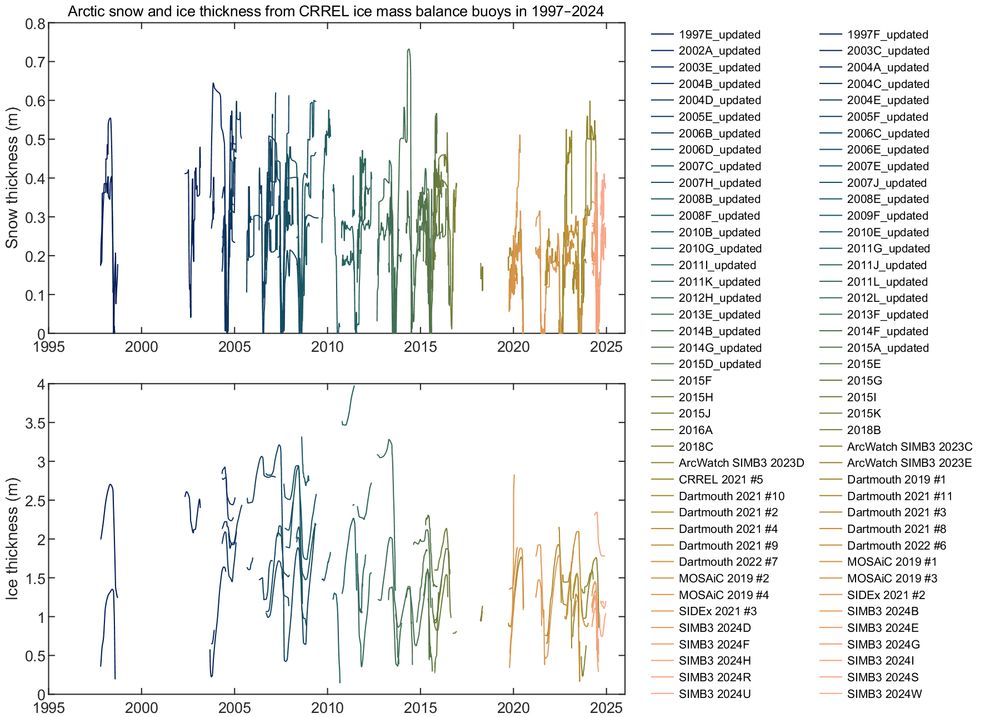
Two panels show the temporal evolution of snow (top) and sea ice (bottom) thickness from various ice mass balance buoys listed in the legend (right).
If you are into Arctic sea ice thermodynamics, here is our new dataset of 82 CRREL ice mass balance buoys deployed in 1997–2024 with estimates of snow and ice thickness and their interface evolution: doi.org/10.5281/zenodo.15096485
28.03.2025 08:30
👍 21
🔁 9
💬 1
📌 0
Casual final sentence here, way to bury the lede CBC!
"Carney is expected to call an election by the end of the week, to take place in late Apr or early May."
If you're out of the country and you want to vote, here's what you need to do as soon as the election is announced ⬇️
17.03.2025 19:19
👍 237
🔁 77
💬 7
📌 2

AGU joins suit supporting fired federal employees
The case brought by federal employee unions and nonprofit organizations asserts that OPM’s directive to fire probationary employees at the National Science Foundation and other agencies was illegal.
Sharing as a member of AGU's pubs committee:
AGU is joining a lawsuit in support of federal workers. They need stories/examples of how loss of federal jobs is affecting society. Please share this request with your colleagues & communities. Deadline is this week.💧🧪🌲
forms.monday.com/forms/f553b2...
06.03.2025 18:22
👍 44
🔁 18
💬 0
📌 0
Petition e-5359 - Petitions
If you haven't already done so, sign the House of Commons petition urging the Government of Canada to move off of Twitter/X:
www.ourcommons.ca/petitions/en...
(Canadian citizens or residents only)
26.02.2025 19:19
👍 0
🔁 0
💬 0
📌 0

Smoother sea ice with fewer pressure ridges in a more dynamic Arctic
Nature Climate Change - Pressure ridges, a characteristic feature of Arctic sea ice, play an important role in the ecosystem but pose challenges to shipping. Here the authors use aircraft...
Sea ice paper alert, congratulations to my colleagues!
Krumpen, T., von Albedyll, L., Bünger, H.J. et al. Smoother sea ice with fewer pressure ridges in a more dynamic Arctic. Nat. Clim. Chang. (2025). doi.org/10.1038/s415...
#Arctic #climate 🌊 🥼❄️
rdcu.be/d5rtv
06.01.2025 18:51
👍 35
🔁 16
💬 0
📌 2
Hello from the JGR:Oceans team 🌊🌊🌊
We're very happy to be the first AGU journal on Bluesky!
I guess that also makes us the best AGU journal on Bluesky 😆
Our Editors will be posting here about our latest news & views, message/tag us if you'd like us to highlight your science 👍
04.12.2024 23:17
👍 57
🔁 11
💬 1
📌 0
Welcome @agu.org! It’s great to have the American Geophysical Union here!
03.12.2024 03:02
👍 70
🔁 15
💬 1
📌 1
Hi all! I've seen an uptick in follows from fellow Federal #Canadian #scientists over the last while, so I figured I'd create a starter pack!
Check here to follow federal Canadian science & scientists!🧪
Reply here if you want to be added; DM me if you want to be removed.
go.bsky.app/Cjr4wAD
21.11.2024 11:18
👍 54
🔁 19
💬 9
📌 1
Please welcome the @ametsoc.bsky.social to Bluesky!
AMS advances the atmospheric & related sciences (including of course climate), applications, and services for the benefit of society.
I've added them to this starter pack of scientific organizations that do climate-related work ⬇️
22.10.2024 20:27
👍 216
🔁 77
💬 9
📌 4

The image shows the title and introduction of a lecture paper, reading:
Once Again—Tidal Friction
Walter Munk
(Harold Jeffreys Lecture delivered at Burlington House, 29 March 1968)
1. Introduction
In 1920 it appeared that Jeffreys had solved the problem of tidal dissipation. We have gone backwards ever since.
That somewhat recalls the one-sentence introduction section from a Walter Munk paper
02.10.2024 18:17
👍 2
🔁 0
💬 0
📌 0
Call for Participation: R/V Langseth Research Cruise
🧪📍 🌊 🦑 Applications are now being accepted from undergraduate students, graduate students, post-docs, and early-career scientists to participate in an NSF-funded research cruise aboard the R/V Marcus G. Langseth mailchi.mp/ldeo/langset...
01.10.2024 15:26
👍 12
🔁 11
💬 0
📌 1

The image is a screenshot of a website featuring a navigation menu on the left side with sections: "home," "about me," "research," "publications," "curriculum vitae," and "'ocean robots' posters." Below these, icons link to email, GitHub, Bluesky, Instagram, and LinkedIn.
On the right, there's a profile photo of me wearing a bright orange Mustang survival suit during Arctic research. Below my name, "samuel d. brenner," I'm identified as a "post-doctoral research associate at Caltech." A section titled "research" follows, describing my work on studying processes in the Arctic.
I finally got around to adding a Bluesky profile link to my personal research website.
30.09.2024 05:49
👍 7
🔁 0
💬 0
📌 0
I definitely understand the whole "only candidates who are selected to move on in the process will be contacted" thing. But if I have to make a government/state/provincial account to even submit an application, there should be a portal where I can check application status.
26.09.2024 19:57
👍 13
🔁 1
💬 2
📌 1
AGU 2022 Cryosphere Is For All (talk C12A-06) -- The NSF PQ Process
YouTube video by Michael MacFerrin
I’m talking to another person who was barred from the US Antarctic Program because they go to “mental health counseling” (thus, USAP doesn’t consider them “stable”). The NSF has done nothing—nada—to reform that program. My rage is incandescent. 🔥
If you’ve no idea what I’m talking about, a primer:
13.09.2024 16:58
👍 2
🔁 2
💬 2
📌 2


