How dynamics arise from the structure is my biggest interest. In this study, we started with a small step and asked how structure constrains dynamics. Spoiler: would that it were so simple… (1/6)
27.02.2026 10:13
👍 30
🔁 23
💬 1
📌 2

Our paper is out in @natneuro.nature.com!
www.nature.com/articles/s41...
We develop a geometric theory of how neural populations support generalization across many tasks.
@zuckermanbrain.bsky.social
@flatironinstitute.org
@kempnerinstitute.bsky.social
1/14
10.02.2026 15:56
👍 273
🔁 100
💬 7
📌 1

𝗛𝗼𝘄 𝗱𝗼 𝗯𝗿𝗮𝗶𝗻 𝗮𝗿𝗲𝗮𝘀 𝗿𝗲𝗹𝗮𝘁𝗲𝗱 𝘁𝗼 𝗳𝘂𝗻𝗰𝘁𝗶𝗼𝗻?
"High-resolution activity maps of PFC did NOT align with cytoarchitecturally defined subregions."
Key tenet in neuroscience is that cytoarchitectonic boundaries correspond to functional ones.
NB: study in the mouse
#neuroskyence
doi.org/10.1038/s415...
22.01.2026 17:34
👍 80
🔁 29
💬 6
📌 3
With some trepidation, I'm putting this out into the world:
gershmanlab.com/textbook.html
It's a textbook called Computational Foundations of Cognitive Neuroscience, which I wrote for my class.
My hope is that this will be a living document, continuously improved as I get feedback.
09.01.2026 01:27
👍 585
🔁 237
💬 16
📌 10

Happy to share our new paper in @nathumbehav.nature.com: t.co/Ciq7AKvle5. Using 500k+ behavioral trials, we show that #serialdependence deviates from #Bayesian predictions, pointing to a new narrative about how recent experience shapes perception. @aozkirli.bsky.social @achetverikov.bsky.social
22.12.2025 11:09
👍 24
🔁 8
💬 2
📌 2
Doing a PhD is - at heart - one long discussion with your mentor. The discussion changes over time - with unexpected turns and ups & downs - but through it all is a pair of people discussing a topic endlessly to make sense of it.
PhD students: choose someone you like to talk to!
19.12.2025 16:35
👍 192
🔁 43
💬 1
📌 8

BOLD signal changes can oppose oxygen metabolism across the human cortex, Nature Neuroscience
fMRI signals “up,” but neural metabolism might be going “down.”
In our @natneuro.nature.com paper, we demonstrate that about 40% of voxels with robust BOLD responses exhibit opposite oxygen metabolism, revealing two distinct hemodynamic modes.
rdcu.be/eUPO8
funds @erc.europa.eu
#neuroskyence 🧵:
16.12.2025 15:43
👍 176
🔁 80
💬 4
📌 8
🚨 new preprint alert! biorxiv.org/content/10.1...
what is the architecture of an individual working memory?
1/n
11.12.2025 08:56
👍 18
🔁 7
💬 2
📌 2
Thanks to co-authors @YangJiarui2002 (X/twitter), Ying Zhou, @hannah-chu.bsky.social, @neurograce.bsky.social and @sreenivasanlab.bsky.social for their contributions to this work! 🎉
10.12.2025 08:06
👍 1
🔁 0
💬 0
📌 0
We found behaviorally relevant orthogonal subspaces during the retention period—replicating prefrontal intracranial results in non-human primates—but no evidence of sequential replay. This suggests the brain maintains sequences by transforming time into space!
10.12.2025 08:06
👍 1
🔁 0
💬 1
📌 0

Using broadband MEG with dimensionality reduction and multivariate decoding, we asked whether sequential items are preserved by replaying them in order or by organizing them into a low-dimensional neural manifold.
10.12.2025 08:06
👍 1
🔁 0
💬 1
📌 0
It is actually an incredibly frustrating time to be a theoretical neuroscientist right now imo, for this reason
17.11.2025 01:23
👍 135
🔁 24
💬 9
📌 1
To those who access published (nonhuman) neurophysiology data & analysis code: what’s your favorite place to find it?
26.10.2025 12:01
👍 3
🔁 1
💬 3
📌 0

mitochondria from bipolar patients are closer to the nucleus in these images; control patients' are spread out further
15 years in the making, we confirmed that mitochondria - the powerhouse of the cell - have an unusual localization in patients who experience psychosis (including schizophrenia and bipolar disorders). You’ll never guess what kind of patient cells we used to make this discovery… 🧵
10.10.2025 16:47
👍 419
🔁 155
💬 25
📌 26

One mother for two species via obligate cross-species cloning in ants - Nature
In a case of obligate cross-species cloning, female ants of Messor ibericus need to clone males of Messor structor to obtain sperm for producing the worker caste, resulting in males from the same mother having distinct genomes and morphologies.
It's never occurred to me that it IS an assumption. This is the most astonishing start to a paper I've read in years:
"Living organisms are assumed to produce same-species offspring. Here, we report a shift from this norm in Messor ibericus, an ant that lays individuals from two distinct species."
24.09.2025 17:26
👍 452
🔁 103
💬 19
📌 22
"Cognition is emergent" by Earl Miller
YouTube video by Neuroscience & Philosophy Salon
Talk: Cognition is Emergent - Earl K. Miller
Neuroscience and Philosophy Salon, 9-12-25
youtu.be/Sk4ehOcsDmM?...
13.09.2025 12:38
👍 146
🔁 26
💬 13
📌 5
Will try!
But I'll say in advance that I view the mouse brain as very different. Their anatomical connectivity is very high, with almost the entire cortex interconnected. Something like 97% if the Kennedy figures are right. Experiments in primates and humans are needed but obvly cannot be done now.
10.09.2025 18:27
👍 1
🔁 1
💬 0
📌 0
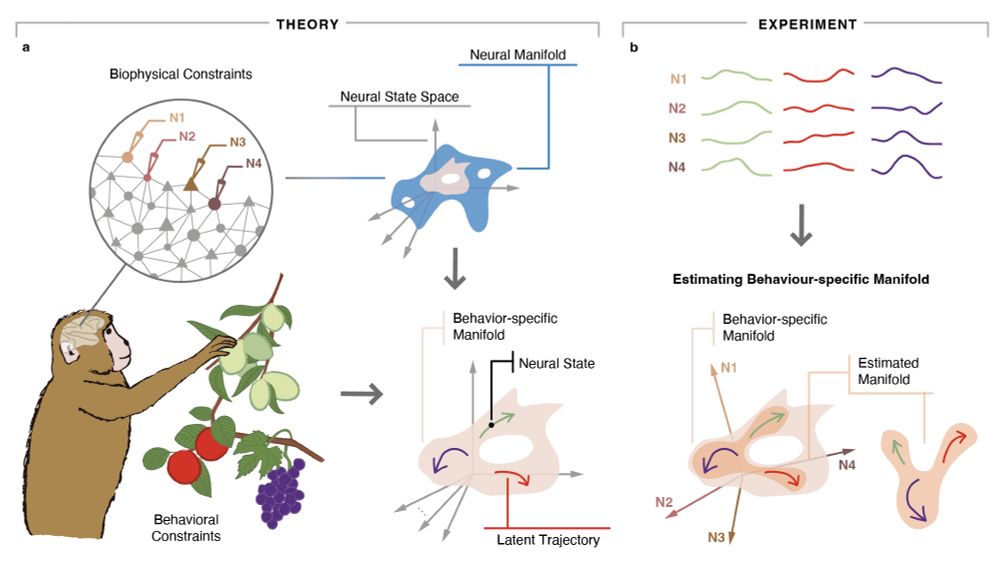
🚨New paper🚨
Neural manifolds went from a niche-y word to an ubiquitous term in systems neuro thanks to many interesting findings across fields. But like with any emerging term, people use it very differently.
Here, we clarify our take on the term, and review key findings & challenges rdcu.be/ex8hW
01.08.2025 09:57
👍 155
🔁 46
💬 2
📌 1
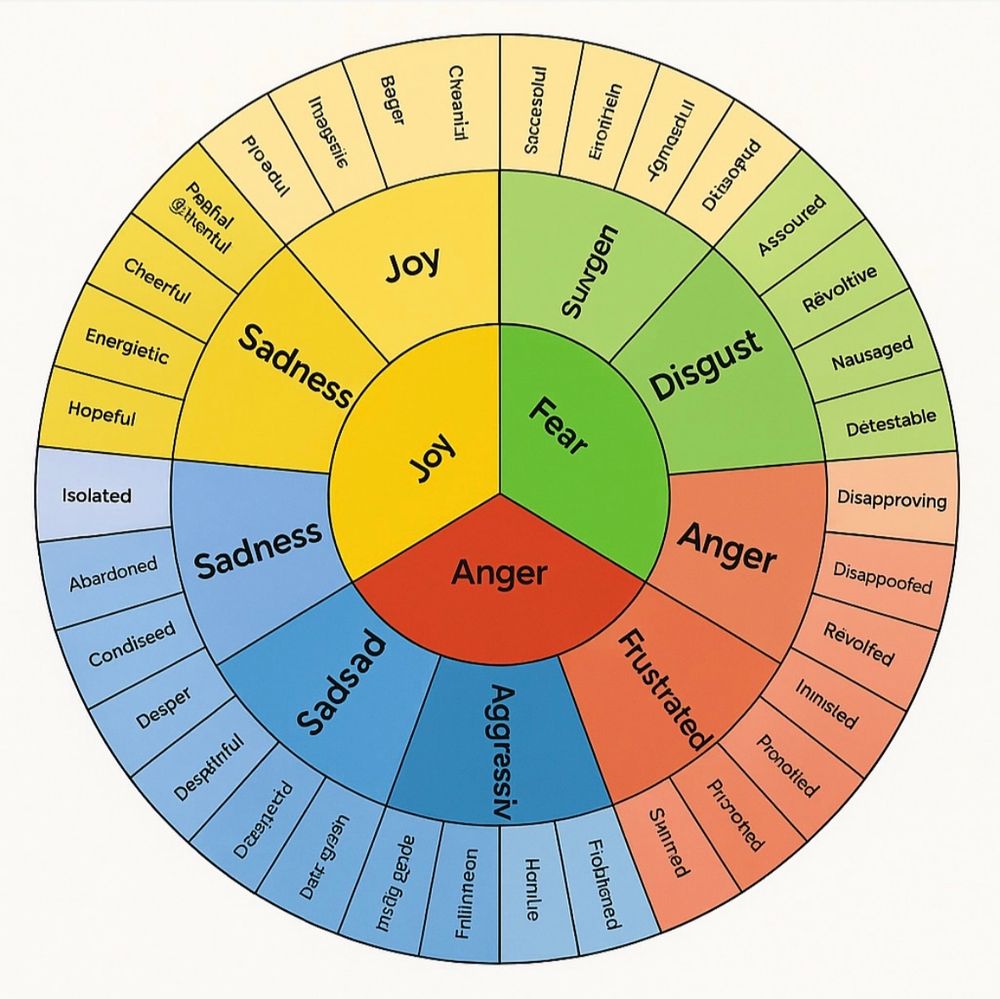
emotion wheel starting with "joy, fear, anger" in the center and then lapsing into gibberish
a friend of mine shared this ai-generated "emotion wheel" and unfortunately i have been laughing my ass off at it for like 15 minutes now. today i am feeling Fnliinneon
05.06.2025 14:46
👍 5169
🔁 1330
💬 241
📌 1290

Because we must build good things while we scream about the bad, I have started a "Data for Good" team @data-for-good-team.bsky.social that partners with organizations needing short-term data science help. We have three projects ongoing & will add more as our capacity grows.
data-for-good-team.org
10.05.2025 15:33
👍 152
🔁 68
💬 8
📌 1
Depressed individuals often experience a profound slowing/standstill of time. Northoff argues this is due to a desynchronization between “self-time” (inner) and “world-time” (external); inner sense of time becomes abnormally slow, making external events feel overwhelmingly fast or unmanageable. This
03.05.2025 19:51
👍 6
🔁 1
💬 1
📌 0
It's kinda obvious. #AGIComics has already figured out which brain region is the most important. 😇
27.04.2025 20:56
👍 25
🔁 5
💬 3
📌 0

screenshot of preprint title
High-Dimensional Dynamics in Low-Dimensional Networks.
New preprint with a former undergrad, Yue Wan.
I'm not totally sure how to talk about these results. They're counterintuitive on the surface, seem somewhat obvious in hindsight, but then there's more to them when you dig deeper.
21.04.2025 17:00
👍 71
🔁 17
💬 4
📌 2