
📍Excited to share that our paper was selected as a Spotlight at #NeurIPS2025!
arxiv.org/pdf/2410.03972
It started from a question I kept running into:
When do RNNs trained on the same task converge/diverge in their solutions?
🧵⬇️
24.11.2025 16:43
👍 108
🔁 27
💬 5
📌 6
RL Debates 4: Adam "I literally measured value in the brain" Lowet
YouTube video by Sensorimotor AI
RL Debates 4: Adam "I literally measured value in the brain" Lowet
Adam's talk covered a lot of ground — from his recent work on distributional RL (nature.com/articles/s41...) to a broader discussion of RL & the brain.
📽️ Watch the full meeting here: www.youtube.com/watch?v=Xe7B...
🧠🤖🧠📈
10.11.2025 03:37
👍 14
🔁 3
💬 1
📌 0

Our next paper on comparing dynamical systems (with special interest to artificial and biological neural networks) is out!! Joint work with @annhuang42.bsky.social , as well as @satpreetsingh.bsky.social , @leokoz8.bsky.social , Ila Fiete, and @kanakarajanphd.bsky.social : arxiv.org/pdf/2510.25943
10.11.2025 16:16
👍 70
🔁 24
💬 4
📌 5
If you're interested in dynamical systems analysis for neuroscience, definitely check out @oliviercodol.bsky.social 's revised version of our RL paper! Very cool results in the new Fig 6, worth it regardless of if you saw our previous version or if it's all new.
www.biorxiv.org/content/10.1...
06.11.2025 17:58
👍 37
🔁 11
💬 0
📌 0
Excited to share that our work ‘Simultaneous detection and estimation in olfactory sensing’ with @mattyizhenghe.bsky.social, @neurovenki.bsky.social , @cpehlevan.bsky.social, @jzv.bsky.social and @paulmasset.bsky.social has been launched!
1/7
04.11.2025 05:25
👍 12
🔁 4
💬 1
📌 1
The framework thus offers a path towards circuit models—for olfactory sensing and beyond—that both perform well in naturalistic environments and make experimentally-testable predictions for neural response dynamics.
04.11.2025 16:20
👍 2
🔁 0
💬 0
📌 0
Overall, our model separately infers odor concentration and presence, achieving faster and more robust inference. At the same time, our model is itself a recurrent circuit that demonstrates rich cell-type-specific neural dynamics resembling those that have been observed in the OB.
04.11.2025 16:20
👍 2
🔁 0
💬 1
📌 0
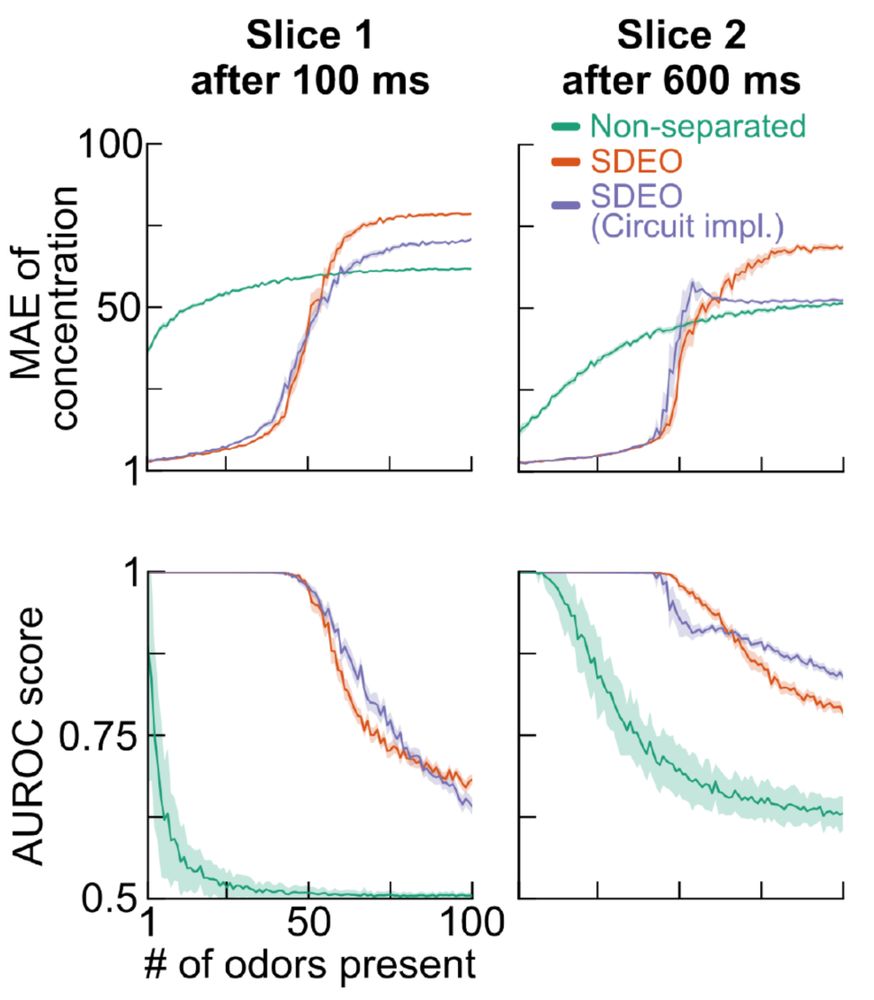
Two simulations were developed: one quantifying the model’s inference ability on a timescale of hundreds of milliseconds, while the other examining how the required number of OSNs scales with the size of the potential odorant dictionary.
04.11.2025 16:20
👍 2
🔁 0
💬 1
📌 0
Lastly, we evaluate how our model scales with increasing network size and odor dimensionality and how its performance varies with different affinity matrices and priors.
04.11.2025 16:20
👍 2
🔁 0
💬 1
📌 0

Next, we mapped the model’s inference dynamics on the circuit architecture of the olfactory bulb. Notably, SDEO naturally gives rise to two classes of projection neurons resembling mitral and tufted cells and providing experimentally testable predictions.
04.11.2025 16:20
👍 2
🔁 0
💬 1
📌 0

We then built a biologically plausible recurrent neural network implementing these sampling dynamics. Through simulations, we demonstrated that our SDEO accurately tracks the presence and concentration of changing odorants.
04.11.2025 16:20
👍 3
🔁 0
💬 1
📌 0

MLD performs sampling in an unconstrained dual space and projects samples back to the constrained primal space via an invertible mirror map, therefore obtaining samples from a constrained distribution.
04.11.2025 16:20
👍 3
🔁 0
💬 1
📌 0
To enable rapid inference of binary odor presence in a biologically plausible recurrent network, our model leverages the framework of Mirror Langevin Dynamics (MLD).
04.11.2025 16:20
👍 2
🔁 0
💬 1
📌 0

We proposed “SDEO”, a model for olfactory compressed sensing inspired by simultaneous localization and mapping (SLAM) algorithms in navigation: the set of odors that are present in a given scene, and the concentration of those present odors, are inferred separately.
04.11.2025 16:20
👍 2
🔁 0
💬 1
📌 0
Thrilled to share our new preprint, now on bioRxiv!! Huge thanks to all collaborators!
For those interested, here’s a bit more about the work:
04.11.2025 16:20
👍 3
🔁 0
💬 1
📌 0
First paper from the lab!
We propose a model that separates estimation of odor concentration and presence and map it on olfactory bulb circuits
Led by @chenjiang01.bsky.social and @mattyizhenghe.bsky.social joint work with @jzv.bsky.social and with @neurovenki.bsky.social @cpehlevan.bsky.social
04.11.2025 15:40
👍 36
🔁 13
💬 2
📌 1
The framework thus offers a path towards circuit models—for olfactory sensing and beyond—that both perform well in naturalistic environments and make experimentally-testable predictions for neural response dynamics.
7/7 b
04.11.2025 05:25
👍 3
🔁 0
💬 0
📌 0
Our model, which separately infers odor concentration and presence, performs faster and more robust inference of odorants. At the same time, our model is itself a recurrent circuit that demonstrates rich cell-type-specific neural dynamics resembling those that have been observed in the OB.
7/7 a
04.11.2025 05:25
👍 4
🔁 0
💬 1
📌 0
Two simulations were developed: one quantifying the model’s inference ability on a timescale of hundreds of milliseconds, while the other examining how the required number of OSNs scales with the size of the potential odorant dictionary.
6/7 b
04.11.2025 05:25
👍 3
🔁 0
💬 1
📌 0
Lastly, we evaluate how our model scales with increasing network size and odor dimensionality and how its performance varies with different affinity matrices and priors.
6/7 a
04.11.2025 05:25
👍 3
🔁 0
💬 1
📌 0
Next, we mapped the model’s inference dynamics on the circuit architecture of the olfactory bulb. Notably, SDEO naturally gives rise to two classes of projection neurons resembling mitral and tufted cells and providing experimentally testable predictions.
5/7
04.11.2025 05:25
👍 3
🔁 0
💬 1
📌 0
We then built a biologically plausible recurrent neural network implementing these sampling dynamics. Through simulations, we demonstrated that our SDEO accurately tracks the presence and concentration of changing odorants.
4/7
04.11.2025 05:25
👍 3
🔁 0
💬 1
📌 0
MLD performs sampling in an unconstrained dual space and projects samples back to the constrained primal space via an invertible mirror map, therefore obtaining samples from a constrained distribution.
3/7 b
04.11.2025 05:25
👍 3
🔁 0
💬 1
📌 0
To enable rapid inference of binary odor presence in a biologically plausible recurrent network, our model leverages the framework of Mirror Langevin Dynamics (MLD).
3/7 a
04.11.2025 05:25
👍 3
🔁 0
💬 1
📌 0
We proposed “SDEO”, a model for olfactory compressed sensing inspired by simultaneous localization and mapping (SLAM) algorithms in navigation: the set of odors that are present in a given scene, and the concentration of those present odors, are inferred separately.
2/7
04.11.2025 05:25
👍 3
🔁 0
💬 1
📌 0
Excited to share that our work ‘Simultaneous detection and estimation in olfactory sensing’ with @mattyizhenghe.bsky.social, @neurovenki.bsky.social , @cpehlevan.bsky.social, @jzv.bsky.social and @paulmasset.bsky.social has been launched!
1/7
04.11.2025 05:25
👍 12
🔁 4
💬 1
📌 1
Simultaneous detection and estimation in olfactory sensing https://www.biorxiv.org/content/10.1101/2025.11.01.686013v1
03.11.2025 23:15
👍 15
🔁 6
💬 0
📌 2
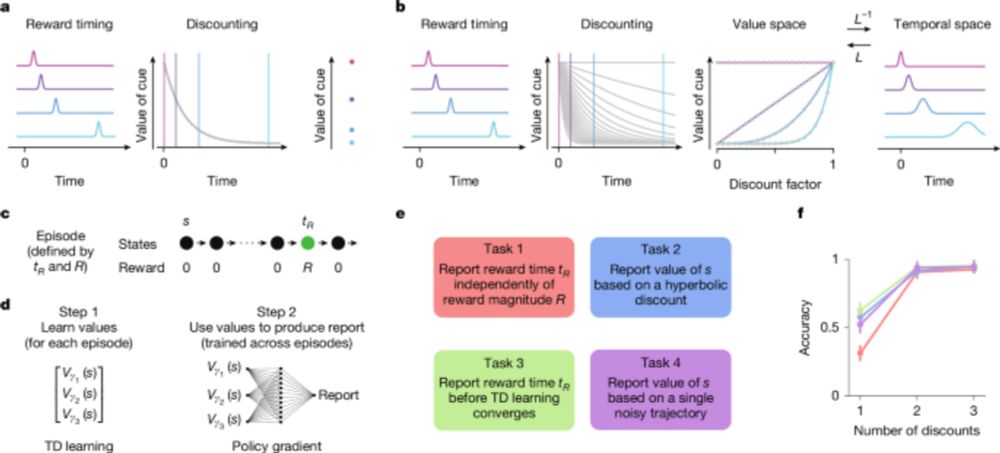
Multi-timescale reinforcement learning in the brain - Nature
Individual dopaminergic neurons encode future rewards over distinct temporal horizons.
Our work with Pablo Tano, @hyunggoo-kim.bsky.social Athar Malik, Alexandre Pouget and @naoshigeuchida.bsky.social exploring how dopamine neurons could enable multi-timescale reinforcement learning in the brain is out in @nature.com
www.nature.com/articles/s41...
04.06.2025 18:11
👍 111
🔁 45
💬 8
📌 2

