
Good luck. Book sounds brilliant and I really want to read it.
10.02.2026 07:19
👍 0
🔁 0
💬 1
📌 0
Good luck. Book sounds brilliant and I really want to read it.


Great time at Peter Doig today.
We always did this when I was growing up in Scotland in the 80s and my mum seemed to think it was quite normal. Would never do it now, though!

From The Dangling Man by Saul Bellow: “In the old days, when we had a flat of our own, I read constantly. I was forever buying new books, faster, admittedly, than I could read them. But as long as they surrounded me they stood as guarantors of an extended life, far more precious and necessary than the one I was forced to lead daily. If it was impossible to sustain this superior life at all times, I could at least keep its signs within reach. When it became tenuous I could see them and touch them.”
Saul Bellow nailing* the importance of physical media (cf:, lps, cds, dvds, etc) from The Dangling Man, 1944.
* for me, anyways


The Road Runner his nemesis Wile E. Coyote made their debut on September 17, 1949 with the release of Chuck Jones’s FAST AND FURRY-OUS, a Warner Bros. Looney Tunes cartoon.

International is out! Happy release day to us. Thank you to West Riding Arts Research for creating such a beautiful sleeve to house our last album.
‘Can’t recall’ is a funny answer to this question. Although it’s a funny question all round, I suppose
@prepressprojects.bsky.social
We dropped by Dynamic Earth, venue for our Fringe event House of Hormones, to film a short video 🎥
Join us Thu 21 Aug, 1.15pm for this FREE session on what happens when puberty and perimenopause collide at home.
🎟️ Book: www.edfringe.com/tickets/what...
Telling Colin about the pigeon show
Last year in Scotland 5,000 young people presented as homeless because of relationship breakdown within their family - the most common cause of teenagers leaving home to sleep rough or sofa surf.
@cyrenians.bsky.social


Brilliant week at Il Cinema Ritrovato in Bologna. Sholay in Piazza Maggiore a highlight, but saw so many great films.

A FareShare Cyrenians branded van outside the Seafield Depot. Curved text above the van reads: We need you!
URGENT CALL FOR VOLUNTEERS!
Can you be the vital link between our FareShare depot and the charities we deliver to? We're looking for volunteer drivers to help distribute quality surplus food to people who need it most.
If you have some free time during the week, can you help?
buff.ly/u9WBv6o

The one act that unifies *everyone* I am friends with, whoever and wherever they are. Not The Beatles. Not Kraftwerk. Not New Order.
Saint Etienne.
Our group.
What a 35 years it has been

We're hiring!📨
Prepress is looking for senior editors with substantial copy-editing experience and proven project management skills.
Find out more about applying to become part of our independent, Perth-based publishing services company here: www.prepress-projects.co.uk/2025/03/25/w...
Funny, I was in the bank with the starry dome yesterday wondering what it would look like from above (and if you’d be able to see it from the new concert hall).

A double image of David Lynch sitting at monitors in front of red velvet curtains. In the top half, the subtitle reads: “Look how beautiful those curtains look.” In the lower half, the subtitle reads: “Look at that, so beautiful.”
We had a question earlier about whether we’d be keeping our cinema one red velvet curtains. We love ours as much as Mr Lynch loved his, so the answer’s yes!
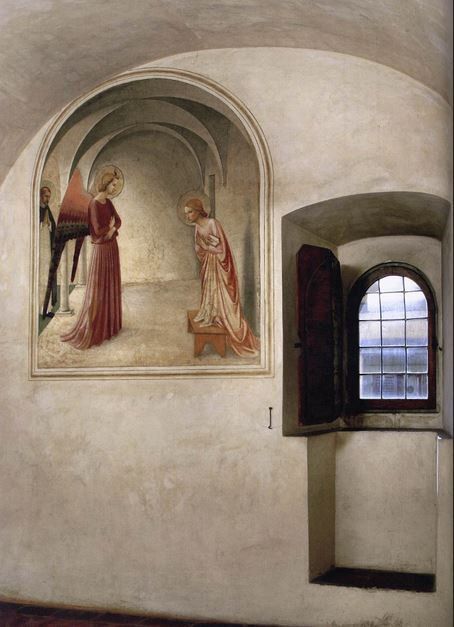
3/3 Annunciation in the monk's cell. Window, and window onto another world.
Oh, also, ‘highs, lows and inbetweens’ 🙂 👍 🎶
This sounds great, Dan. Fingers crossed for further news soon.

An empty cinema auditorium with a bare concrete floor and dismantled blue seats piled up against the wall.
Cinema three may have no seats, but we do have JOBS JOBS JOBS!
Finance Manager, Programme Manager and Marketing Manager roles all live now: filmhouse.org.uk/jobs

COLLEGE College Student STUDENT @CollegeStudent using microsoft word *moves an image 1 mm to the left* all text and images shift. 4 new pages appear. in the distance, sirens.


Marianne Faithfull, photographed by Jean-Claude Deutsch at the Paris Flea Market, 1966
Farewell, Queen Marianne.
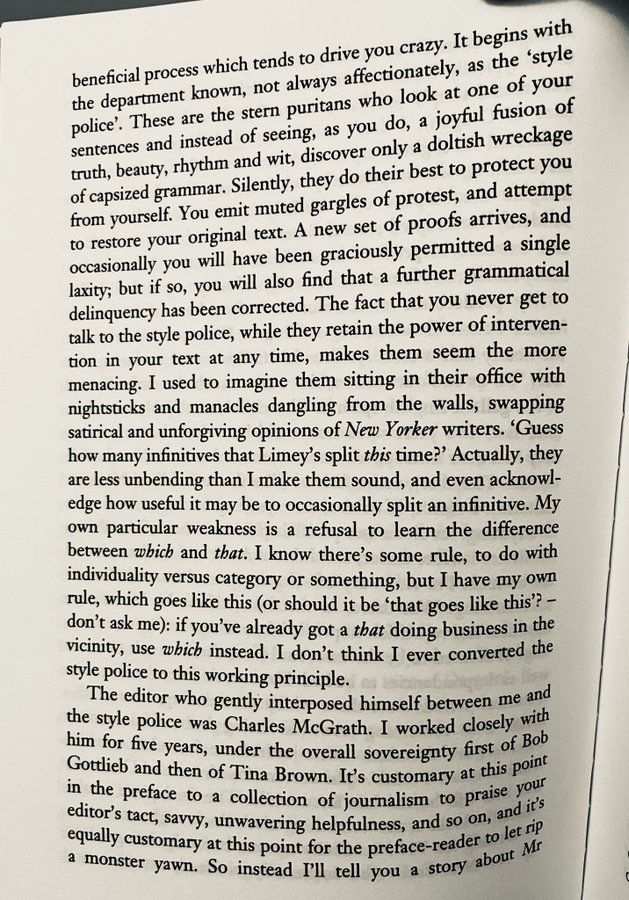
It begins with the department known, not always affectionately, as the 'style police'. These are the stern puritans who look at one of your sentences and instead of seeing, as you do, a joyful fusion of truth, beauty, rhythm and wit, discover only a doltish wreckage of capsized grammar. Silently, they do their best to protect you from yourself. You emit muted gargles of protest, and attempt to restore your original text. A new set of proofs arrives, and occasionally you will have been graciously permitted a single laxity; but if so, you will also find that a further grammatical delinquency has been corrected. The fact that you never get to talk to the style police, while they retain the power of intervention in your text at any time, makes them seem the more menacing. I used to imagine them sitting in their office with nightsticks and manacles dangling from the walls, swapping satirical and unforgiving opinions of New Yorker writers. Guess how many infinitives that Limey's split this time?' Actually, they are less unbending than I make them sound, and even acknowledge how useful it may be to occasionally split an infinitive. My own particular weakness is a refusal to learn the difference between which and that. I know there's some rule, to do with individuality versus category or something, but I have my own rule, which goes like this (or should it be 'that goes like this? - don't ask me): if you've already got a that doing business in the vicinity, use which instead. I don't think I ever converted the style police to this working principle. The editor who gently interposed himself between me and the style police was Charles McGrath. I worked closely with him for five years, under the overall sovereignty first of Bob Gotdieb and then of Tina Brown. I's customary at this point in the preface to a collection of journalism to praise your editor's tact, savvy, unwavering helpfulness, and so on, and ite equally customary at this point for the preface-reader to let M a mo…
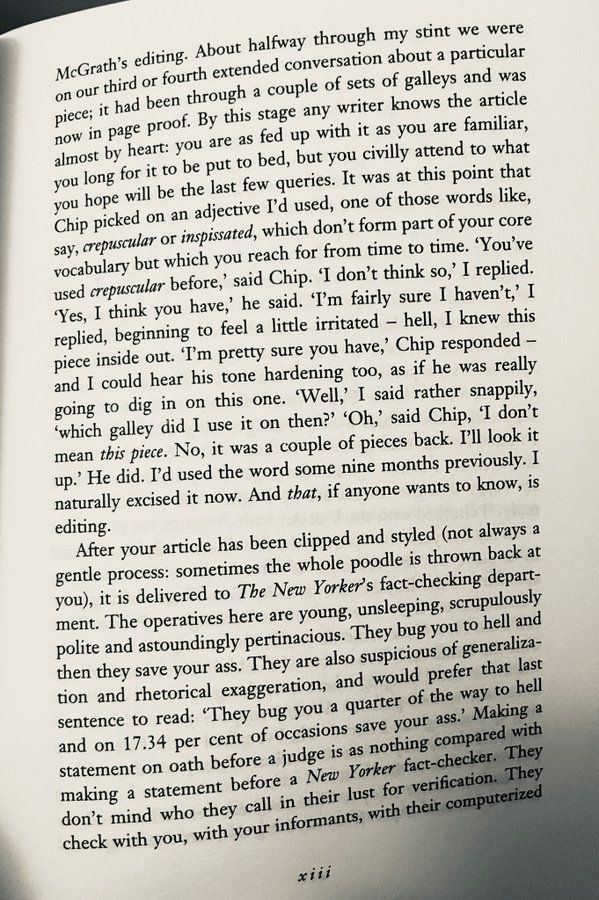
McGrath's editing. About halfway through my stint we were on our third or fourth extended conversation about a particular piece; it had been through a couple of sets of galleys and was now in page proof. By this stage any writer knows the article almost by heart: you are as fed up with it as you are familiar, you long for it to be put to bed, but you civilly attend to what you hope will be the last few queries. It was at this point that Chip picked on an adjective I'd used, one of those words like, say, crepuscular or inspissated, which don't form part of your core vocabulary but which you reach for from time to time. 'You've used crepuscular before,' said Chip. 'I don't think so,' I replied. "Yes, I think you have,' he said. 'T'm fairly sure I haven't, I replied, beginning to feel a little irritated - hell, I knew this piece inside out. 'T'm pretty sure you have,' Chip responded - and I could hear his tone hardening too, as if he was really going to dig in on this one. 'Well,' I said rather snappily, 'which galley did I use it on then?' 'Oh,' said Chip, I don't mean this piece. No, it was a couple of pieces back. I'll look it up.' He did. I'd used the word some nine months previously. I naturally excised it now. And that, if anyone wants to know, is editing. After your article has been clipped and styled (not always a gentle process: sometimes the whole poodle is thrown back at you, it is delivered to The New Yorker's fact-checking depart-ment. The operatives here are young, unsleeping, scrupulously polite and astoundingly pertinacious. They bug you to hell and then they save your ass. They are also suspicious of generalization and rhetorical exaggeration, and would prefer that last sentence to read: 'They bug you a quarter of the way to hell and on 17.34 per cent of occasions save your ass.' Making a statement on oath before a judge is as nothing compared with making a statement before a New Yorker fact-checker. They don't mind who they call in their lust for veri…
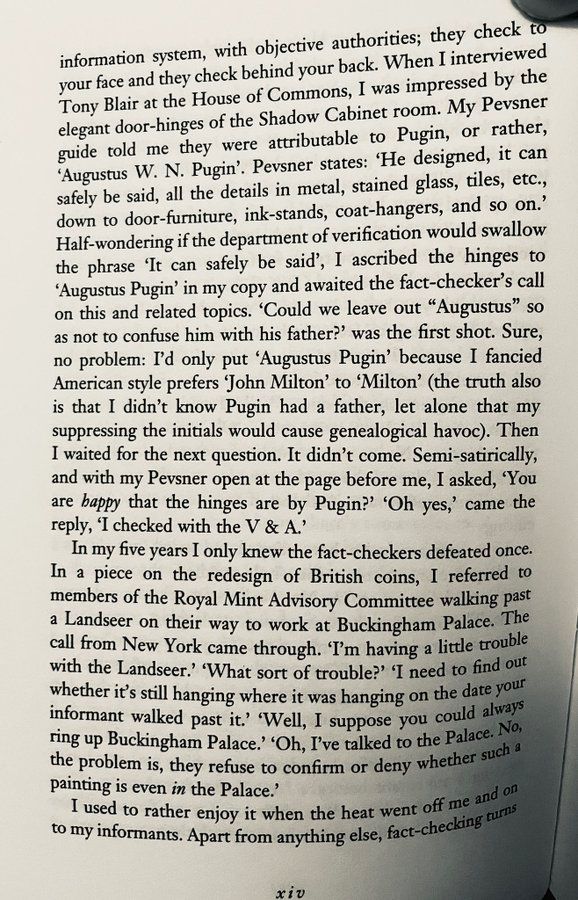
information system, with objective authorities; they check to your face and they check behind your back. When I interviewed Tony Blair at the House of Commons, I was impressed by the elegant door-hinges of the Shadow Cabinet room. My Pevsner guide told me they were attributable to Pugin, or rather, 'Augustus W. N. Pugin'. Pevsner states: 'He designed, it can safely be said, all the details in metal, stained glass, tiles, etc., down to door-furniture, ink-stands, coat-hangers, and so on.' Half-wondering if the department of verification would swallow the phrase 'It can safely be said', I ascribed the hinges to 'Augustus Pugin' in my copy and awaited the fact-checker's call on this and related topics. 'Could we leave out "Augustus" so as not to confuse him with his father?' was the first shot. Sure, no problem: I'd only put 'Augustus Pugin' because I fancied American style prefers 'John Milton' to 'Milton' (the truth also is that I didn't know Pugin had a father, let alone that my suppressing the initials would cause genealogical havoc). Then I waited for the next question. It didn't come. Semi-satirically, and with my Pevsner open at the page before me, I asked, 'You are happy that the hinges are by Pugin?' 'Oh yes,' came the reply, 'I checked with the V & A.' In my five years I only knew the fact-checkers defeated once. In a piece on the redesign of British coins, I referred to members of the Royal Mint Advisory Committee walking past a Landseer on their way to work at Buckingham Palace. The call from New York came through. T'm having a little trouble with the Landseer.' "What sort of trouble?" I need to find out whether it's still hanging where it was hanging on the date your informant walked past it. Well, I suppose you could always ring up Buckingham Palace? *Oh, I've talked to the Palace. No, the problem is, they refuse to confirm or deny whether such a painting is even in the Palace? I used to rather enjoy it when the heat went off me and on to my informants. A…
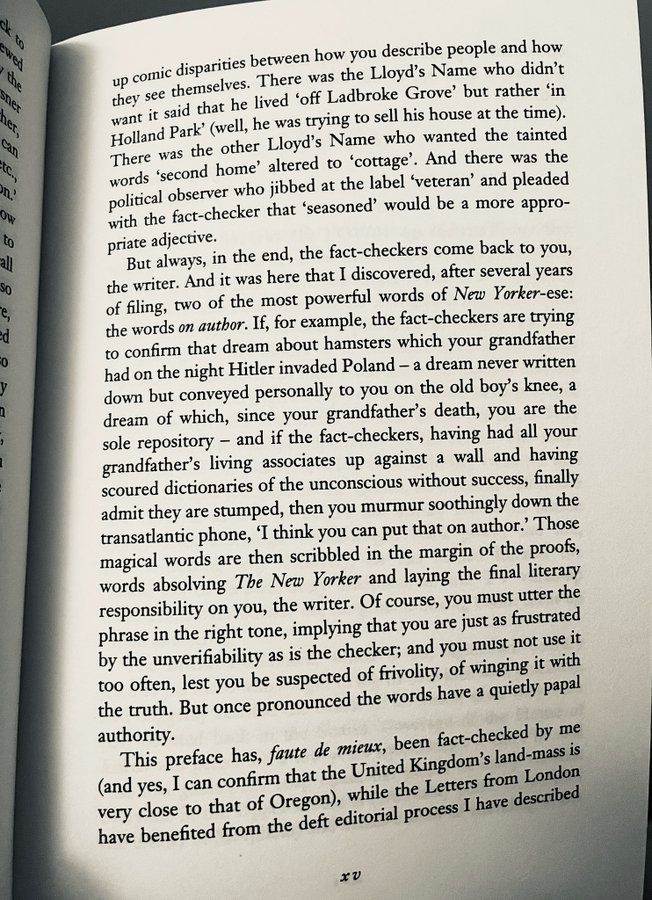
to all So e, up comic disparities between how you describe people and how they see themselves. There was the Lloyd's Name who didn't want it said that he lived 'off Ladbroke Grove' but rather in Holland Park' (well, he was trying to sell his house at the time). There was the other Lloyd's Name who wanted the tainted words second home' altered to 'cottage'. And there was the political observer who jibbed at the label 'veteran' and pleaded with the fact-checker that 'seasoned' would be a more appropriate adjective. But always, in the end, the fact-checkers come back to you, the writer. And it was here that I discovered, after several years of filing, two of the most powerful words of New Yorker-ese: the words on author. If, for example, the fact-checkers are trying to confirm that dream about hamsters which your grandfather had on the night Hitler invaded Poland - a dream never written down but conveyed personally to you on the old boy's knee, a dream of which, since your grandfather's death, you are the sole repository - and if the fact-checkers, having had all your grandfather's living associates up against a wall and having scoured dictionaries of the unconscious without success, finally admit they are stumped, then you murmur soothingly down the transatlantic phone, 'I think you can put that on author.' Those magical words are then scribbled in the margin of the proofs, words absolving The New Yorker and laying the final literary responsibility on you, the writer. Of course, you must utter the phrase in the right tone, implying that you are just as frustrated by the unverifiability as is the checker; and you must not use it too often, lest you be suspected of frivolity, of winging it with the truth. But once pronounced the words have a quietly papal authority. This preface has, faute de mieux, been fact-checked by me (and yes, I can confirm that the United Kingdom's land-mass is very close to that of Oregon), while the Letters from London have benefited from the d…
“My own particular weakness is a refusal to learn the difference between ‘which’ and ‘that’.”
Julian Barnes on being edited by The New Yorker (from Letters from London):
My favourite London cinema. Signed.
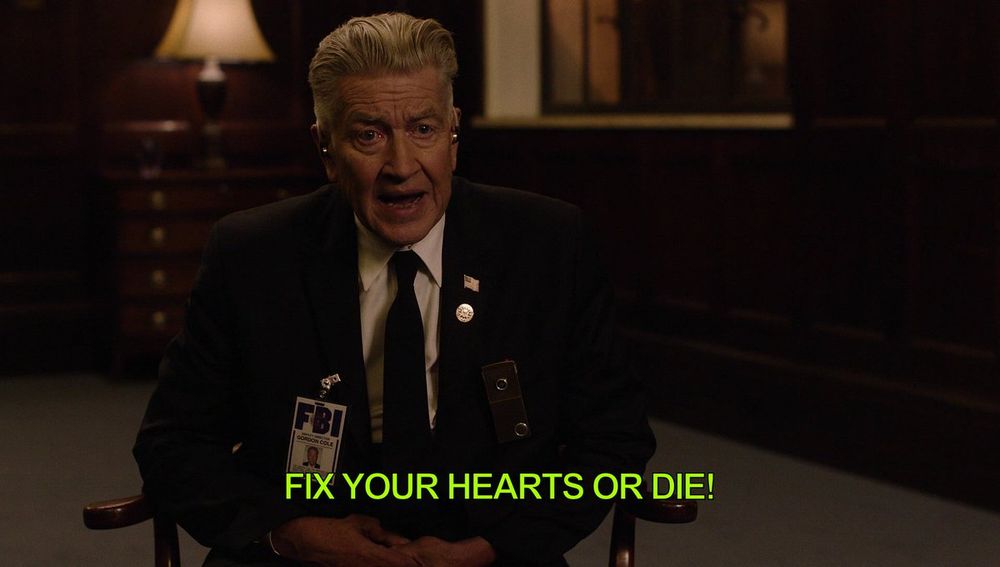
Lynch, as Gordon, saying "Fix your hearts or die!"
As always.

We’re looking for an experienced editor to join our team. Do you have the experience and skills we need? Apply by 7 February.
#editing #publishingjobs #copyediting #jobsinpublishing
www.prepress-projects.co.uk/2025/01/14/s...
