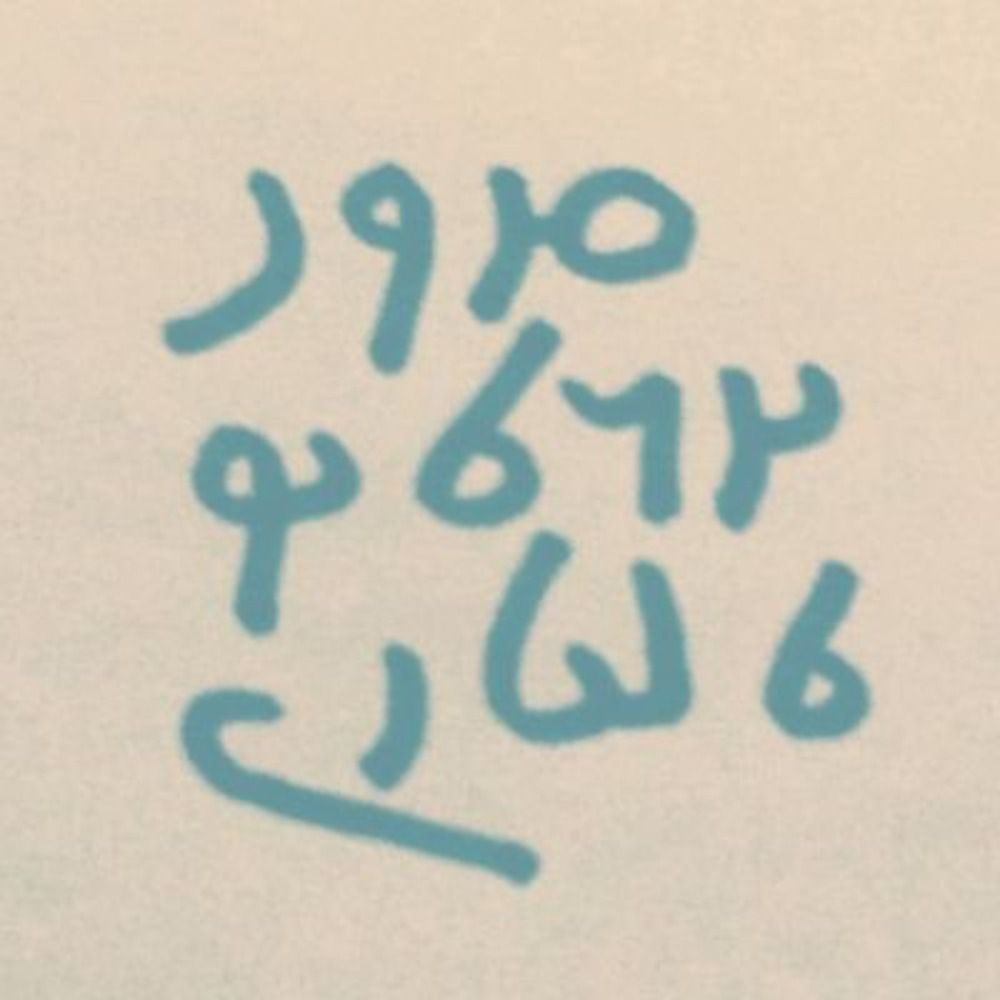
"Gistradagis" is a Gothic word, attested once, that perfectly corresponds to English 'yesterday' – except that it means 'tomorrow'.
Old Norse is flexible with this word too ('í gær' means 'yesterday/tomorrow'), perhaps due to a common stage when it came to refer to a day on either side of today.
05.03.2026 18:36
👍 44
🔁 10
💬 7
📌 1

Correct, it's done a couple more times throughout the manuscript, which I get to look at about once a year during my Islamic manuscripts summer school class!
27.02.2026 12:57
👍 6
🔁 0
💬 1
📌 0

#TIL "the LORD of Hosts" (𐡉𐡄𐡄 𐡑𐡁𐡀𐡕, [yh]h ṣbʾt) is attested as a divine name on an #Aramaic ostracon from Elephantine. (First line, starting with the second 𐡄.)
27.02.2026 09:09
👍 27
🔁 4
💬 0
📌 0
Where are we getting these pictures from? :D
25.02.2026 14:50
👍 0
🔁 0
💬 1
📌 0
What's the "more or less" about? My Spanish is pretty poor, is there something awkward about grammatically in this context?
25.02.2026 06:36
👍 0
🔁 0
💬 1
📌 0

Fixed again (more or less).
24.02.2026 21:22
👍 4
🔁 3
💬 1
📌 0

Interestingly, even though the Taysir purportedly transmits from al-'Akhfash (tilawatan) and al-Taghlibi (riwayatan), al-Dani neglects to mention these variants attributed to (among others) al-Taghlibi's transmission even though he does mention it in his big book!
24.02.2026 20:39
👍 1
🔁 0
💬 1
📌 0
Despite this overwhelming evidence (literally from the Horse's mouth) that this was Ibn Dhakwan's practice, his student al-'Akhfash did not transmit that, and "the common practice" (al-ʿamal) follows al-'Akhfash's transmission.
24.02.2026 20:39
👍 1
🔁 0
💬 1
📌 0

An interesting report from al-Dani's Jami`: Basically every transmitter of Ibn Dhakwan reported and even Ibn Dhakwan's own book say explicitly that Q51:60 and Q83:31 break with the general rule, and have an unharmonized -humu pronoun rather than his regular -himu.
24.02.2026 20:39
👍 1
🔁 0
💬 1
📌 0
This article is actually a topic I happened onto as I was preparing my translation of the Taysir (published with @openbookpublish.bsky.social). As I was translating the text, I ran into the many places where the Taysir cited transmitters of Abu Amr other than the "canonical" ones.
24.02.2026 19:53
👍 3
🔁 0
💬 1
📌 0

"They do not ??? them, they do not fast for him, they do not feed [the poor] for him"
wel-ten yesmeṯri, wel_fell-as etẓumun, wel_fell-as esseččen
24.02.2026 17:31
👍 9
🔁 2
💬 4
📌 0

En busca de Dūrī: la transmisión comunitaria de Abū ʿAmr entre las gentes del ʿIrāq | Al-Qanṭara
al-Dānī, Abū ʿAmr, Mufradat Abī ʿAmr Al-ʿAlāʾ al-Baṣrī, edited by Ḥātim Ṣāliḥ al-Ḍāmin, Damascus, Dār al-Bašāʾir, 2008.
New Open Access article: Finding Dūrī: Communal Transmission of Abū ʿAmr among the People of ʿIrāq
===
The proofs still had the title's pun working in Spanish, but between final proofs and publication someone who didn't get it, changed it. :-(
al-qantara.revistas.csic.es/index.php/al...
24.02.2026 18:39
👍 6
🔁 1
💬 2
📌 0

"Is it okay to fast before the moon-seeing, or not?"
"Ma yeggur wuẓum qbel teẓra n uyur, neɣ min?"
24.02.2026 18:04
👍 7
🔁 1
💬 1
📌 0
ah yes, the RaSnBaSt
15.01.2025 19:06
👍 5
🔁 1
💬 0
📌 0

A cover page that says 'The Katabasis Book Nook', with a Lego book nook on a shelf surrounded by mythology and Underworld-related books.

Side view of the book nook, with text that says, 'This year, for International Lego Classicism Day 2026, I'm building an Underworld Book Nook.

View of the Lego book nook in the dark, with light-up Lego pieces providing illumination.

Full side view of the book nook, with windows and characters.
It's #InternationalLEGOClassicismDay! 🎉
This year I've been building a LEGO Katabasis Book Nook, which has been a ridiculous amount of fun! Here are a few pictures - and you can find the whole thing on my website: classicalstudies.support/2026/02/20/i...
#ILCD10 #BCEPantheon
20.02.2026 09:27
👍 27
🔁 8
💬 5
📌 0
Very apt to put it next to Katabasis :-)
20.02.2026 13:48
👍 2
🔁 0
💬 1
📌 0

I have a new blog post out, looking into material that shows how people tried to sell private collections to public institutions in the Weimar Republic, what prices they were asking, and how librarians rejected offers due to fishy provenance.
medisi.hypotheses.org/8489
@dehypotheses.bsky.social
19.02.2026 11:46
👍 13
🔁 9
💬 0
📌 0
Western Amazigh
Tetserret / Zenaga :
- əskorək = askarag = i did
- əskorad = askaraḏi = i did it
- ǝnnak = ǝnnag = i said
- ǝnnad = ǝnnaḏi = i said it
19.02.2026 10:10
👍 4
🔁 1
💬 0
📌 0
Wehr is pretty old by now of course, so perhaps norms have shifted. Though who knows what Wehr based his decision to make thulth 'a third' and thuluth 'the calligraphic style' on... these things are so untransparent (and poorly studied).
19.02.2026 11:53
👍 4
🔁 0
💬 0
📌 0
Rather, people uncritically seem to impose what they happen to have learned in class in university onto the whole of the Islamic era with zero critical reflections as to what they learned in the 20th/21st century is actually an accurate reflection of the past 1400 years.
19.02.2026 10:44
👍 3
🔁 0
💬 0
📌 0
I hope you will find this article useful and illuminating, and I hope the tone is not too grumpy, but as should be clear: I strongly feel that we need to recallibrate our starting assumptions. The history of Islamic-era Arabic is not actually based on any material evidence.
19.02.2026 10:44
👍 1
🔁 0
💬 1
📌 0
The paper collects many more examples of variation, some of which has been explicitly called "non-Classical" without a clear definition of "Classical". Others features don't suffer the same fate but are hardly ever acknowledged as existing in Classical Prose.
19.02.2026 10:44
👍 0
🔁 0
💬 1
📌 0
Sure, some modern diactionaries of Modern Standard Arabic (like Wehr) only list the form ṯulṯ-, and my sense is that this is the more typical form in Modern Standard Arabic speech as well... but why would we project that situation onto the past 1400 years of Arabic history?
19.02.2026 10:44
👍 0
🔁 0
💬 2
📌 0
This is a rather bizarre conclusion. After all, ṯuluṯ is the *only* canonical form of the fraction in the Quran reading traditions. If the existence of this form indicates the loss of case vowels, then how do we account for the fact that the reading traditions have both?
19.02.2026 10:44
👍 2
🔁 0
💬 1
📌 0
For some reason, which I cannot reconstruct, they assume that ṯulṯ and ONLY ṯulṯ is the "Classical" form, and that the form ṯuluṯ could only have arisen by anaptyxis after the loss of case vowels. This then is brought as an argument for the loss of case in Judeo-Arabic.
19.02.2026 10:44
👍 2
🔁 0
💬 1
📌 0
A second striking case is the conclusions drawn by Blau & Hopkins from the form תולות <twlwt> for "a third" in Judeo-Arabic manuscripts. They correctly conclude that this must represent /ṯuluṯ/. However, they conclude that this form proves that case vowels have been lost...
19.02.2026 10:44
👍 1
🔁 0
💬 1
📌 0
So by what definition is this form excluded from Classical Arabic if it is recognised by Arabic grammarians, recited in the Quran, and used from (at least) the 8th century up until the 20th in texts that are perfectly recognisable as Classical Arabic? This is pure imposition.
19.02.2026 10:44
👍 1
🔁 0
💬 1
📌 0


The form is well-attested in Classical Arabic documents, not just in the Quran, but also in other (especially North-African) texts. This use, in fact, continues into the modern period. The great modern exegete Ibn ʿĀšūr used the form النبيء.
19.02.2026 10:44
👍 1
🔁 0
💬 1
📌 0