It seems to me, whether we make it official or not, things will slowly start working this way: editors will only desk accept papers that they saw presented at a conference/seminar. We might as well make the rules of the game transparent to all.
04.03.2026 13:50
👍 0
🔁 0
💬 0
📌 0
Then of course it introduces a big barrier to entry (like a high submission fee), detrimental to researchers based in low income countries. But you could imagine regional conferences, like the ones the Econometrics Society organizes.
04.03.2026 13:49
👍 1
🔁 0
💬 2
📌 0
There are scientific fields (like computational linguistics) where conference proceedings are the main way of disseminating research. It seems like a good filter for slop, as you can verify that the researcher presenting understands the content of the paper presented.
04.03.2026 13:45
👍 1
🔁 0
💬 2
📌 0
So, something we got into a bit for the space book is the idea of resources as the source of wealth, because (a) it's widely believed, and (b) it's a claim used to justify all sorts of outlandish space ideas.
The short version is that resources are a teeny tiny fraction of wealth.
06.01.2026 16:33
👍 195
🔁 57
💬 6
📌 12
I'd like to propose the following norm for peer review of papers. If a paper shows clear signs of LLM-generated errors that were not detected by the author, the paper should be immediately rejected. My reasoning: 1/ #ResearchIntegrity
28.12.2025 06:23
👍 115
🔁 28
💬 4
📌 6
I just reviewed my first LLM written paper, with prompts left in the text and invented citations. LLMs are making the (unpaid) job of reviewer much harder. Of course, I could just have the paper reviewed by an LLM, and me and the authors and the other reviewers could go have a drink on the beach!
17.10.2025 10:45
👍 2
🔁 0
💬 0
📌 0
New working paper out: A Century of Language Barriers to Migration in India, with Latika Chaudhary and James Fenske. warwick.ac.uk/fac/soc/econ...
08.10.2025 11:11
👍 1
🔁 1
💬 0
📌 0

By creating an Account with Academia.edu, you grant us a worldwide, irrevocable, non-exclusive, transferable license, permission, and consent for Academia.edu to use your Member Content and your personal information (including, but not limited to, your name, voice, signature, photograph, likeness, city, institutional affiliations, citations, mentions, publications, and areas of interest) in any manner, including for the purpose of advertising, selling, or soliciting the use or purchase of Academia.edu's Services.
I'm sorry, worldwide, irrevocable, non-exclusive, transferable permission to my voice and likeness? For what now? In any manner for any purpose???
This is in academia/.edu's new ToS, which you're prompted to agree to on login. Anyway I'll be jumping ship. You can find my stuff at hcommons.org.
17.09.2025 17:16
👍 1681
🔁 858
💬 58
📌 171
I am looking for a specialist in the Akkadian language. It is for a good cause: a friend has a daughter called Ishtar after the Akkadian goddess (Inanna in Sumer). He wants to confirm the graphic symbols in Akkadian for Ištar. (Yes it is for a tattoo, to avoid tattooing "lentil soup" in Akkadian).
13.08.2025 14:36
👍 0
🔁 0
💬 0
📌 0

Citizen and Subject
All this to say that Citizen and Subject is a must read for anyone interested in the economic development and economic history of African countries. press.princeton.edu/books/paperb...
25.06.2025 14:49
👍 3
🔁 0
💬 0
📌 0
I saw that Mamdani was in the news and initially though "oh! Ugandan political scientist Mahmood Mamdani is in the news!", but then I realized that the Mamdani in the news was Zohran Mamdani, American politician. But then I checked and one is the son of the other
25.06.2025 14:47
👍 0
🔁 0
💬 1
📌 0
Pinson
19.04.2025 11:34
👍 1
🔁 0
💬 0
📌 0
The third: it is clearer what the paper is about
20.03.2025 06:29
👍 2
🔁 0
💬 0
📌 0
#StandUpForScience Les attaques contre la science aux Etats-Unis ont déjà des répercussions sur la science en Europe, et pourraient préfigurer ce qui nous attends. Il y a des événements organisés un peu partout en France 👉https://standupforscience.fr/tous-les-evenements/
05.03.2025 11:08
👍 1
🔁 3
💬 0
📌 0
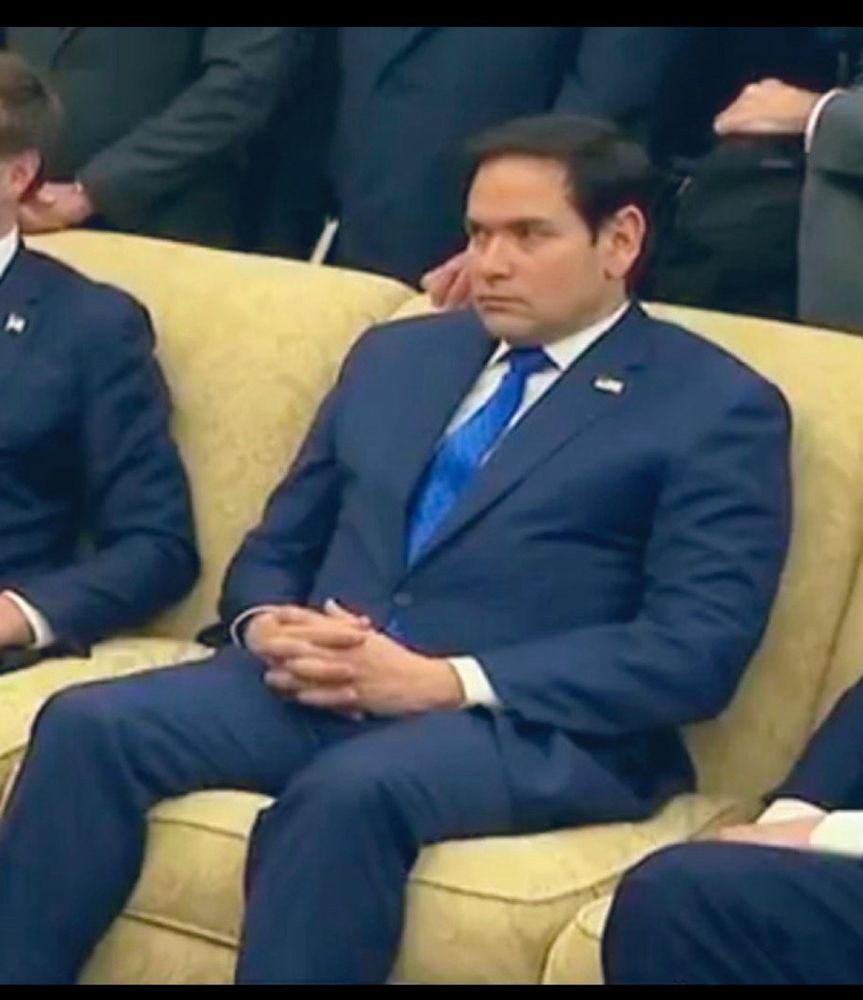
As of today, a new term has entered our language. A “rubio” is a spineless lump of nothing. Example: Don’t be such a rubio.
01.03.2025 04:03
👍 67652
🔁 14432
💬 3079
📌 1207
Beautiful pictures! and a brilliant weather. My mum's hometown. Do take the Eggs to the Bastille if you have time, astonishing view. If you have even more time, you can hike down back to town.
24.01.2025 09:52
👍 0
🔁 0
💬 0
📌 0
Thanks! Writing to you in dm!
20.01.2025 19:05
👍 0
🔁 0
💬 0
📌 0
The problem is very common in economic history. I assume it is also common in many other fields. I'd love to see the different approaches people have to tackle the problem. Please RT! Thanks! 3/3
20.01.2025 16:01
👍 1
🔁 0
💬 1
📌 0
So for example you are working with data for a country, organized in admin units that are slightly different in each year because some units are split, and other are united. Often you can find an aggregation giving ou a consistent map in all time years. 2/3
20.01.2025 16:01
👍 1
🔁 0
💬 1
📌 0
Dear Bluesky community, I am looking for examples of empirical papers working with data organized in changing geographical admin units in two (or more) time periods and needing to aggregate the data up to consistent geographic units, in order to build panel data. 1/3
20.01.2025 16:01
👍 1
🔁 0
💬 1
📌 0
Thank you so much for the reference!
08.01.2025 14:53
👍 1
🔁 0
💬 0
📌 0
Picture a middle aged man waking up one morning in sweat, realizing he knows practically nothing on the history of China before the 20th century. What books should this man read first?
08.01.2025 09:46
👍 2
🔁 1
💬 1
📌 0
In a similar spirit, though not in metrics, there is the Unjournal @unjournal.bsky.social founded by @daaronr.bsky.social
21.11.2024 07:18
👍 1
🔁 0
💬 0
📌 0
Such an interesting read!
19.10.2024 06:13
👍 1
🔁 0
💬 0
📌 0
Haha! Yes!
17.06.2024 05:43
👍 1
🔁 0
💬 0
📌 0
In the end, French colonialism was cheap, except perhaps in the very last decades, mostly because of independence wars, and colonies received very little public aid.
13.06.2024 13:41
👍 2
🔁 0
💬 0
📌 0
The soldiers sent by France to fight in Indochina & Algeria received wages paid by the French government. They used their wage to consume goods, a large share of which were imported. This alone goes a long way into accounting for the trade deficits of French colonies.
13.06.2024 13:41
👍 1
🔁 0
💬 1
📌 0
We show that the deficits were compensated not by French public or private transfers of capital, but by military expenditure spent locally in the colonies, notably during the independence wars.
13.06.2024 13:41
👍 1
🔁 0
💬 1
📌 0
But, Jacques Marseille would reply, what about the trade deficits? how were they compensated? For the paper, we (painfully) tried to reconstruct as many items as we could of the balance of payments of French colonies.
13.06.2024 13:41
👍 2
🔁 0
💬 1
📌 0
If we use the OECD definition of aid to compute the development aid given by France to its colonies, we find a figure of 0.21% of GDP on average. This is lower than French development aid today (0.55% of French GDP), and less than a third of the 0.7% UN target.
13.06.2024 13:41
👍 1
🔁 0
💬 1
📌 0