Biomechanical limits of hopping in the hindlimbs of giant extinct kangaroos - Scientific Reports
The locomotor abilities of animals depend upon their body size. Today, kangaroos are the largest hopping mammals, but some of their Pleistocene relatives were larger still—more than twice as heavy as any modern kangaroo. So, is there an upper size limit of bipedal hopping? Previous analyses have recovered an upper limit of ~ 140–160 kg based on allometry, but have suggested that incorporating changes in hindlimb scaling patterns among giant species would alter these conclusions. Here, we test this proposal by integrating scaling data from modern kangaroos with direct observation of the hindlimb bones of giant fossil kangaroos. We test two potential limiting factors on hopping—bone strength, and tendon size. We find that (a) the metatarsals of giant kangaroos would be capable of resisting the bending moments involved in hopping, and (b), the calcanea (heel bones) of giant kangaroos could accommodate tendons large enough to resist the loads generated during hopping. While hopping may not have been their primary mode of locomotion, our findings suggest that it may have formed part of a broader locomotor repertoire, for example for short bursts of speed.
Giant ancestors of modern-day kangaroos — which previous research has estimated could weigh up to 250 kilograms — may have been able to hop in short bursts, according to research published in Scientific Reports: spklr.io/633258xjaX
#Palaeontology 🧪
22.01.2026 19:47
👍 21
🔁 7
💬 1
📌 0

“New technologies will come along to save the environment.” What they said versus where we are:
From the new Private Eye, in shops now.
08.01.2026 09:37
👍 5331
🔁 1734
💬 123
📌 59
Happened to my capsicums too 😓
08.01.2026 13:13
👍 1
🔁 0
💬 1
📌 0
New research takes us inside the brain of a 230-million-year-old animal! Scientists used 3D technology and mathematical modeling to reconstruct the brains of pterosaurs and their pre-flight ancestors, the lagerpetids.
03.01.2026 15:53
👍 47
🔁 7
💬 1
📌 0

doi.org/10.1098/rsos...
new paper out now with @royalsociety.org on limb structure & function of the #fossil #kangaroo, Dorcopsoides fossilis, from central Australia. The oldest known macropodine (subfamily of all but one of living roos) & a fun glimpse into the great Late Miocene kangaroo radiation
12.11.2025 06:26
👍 6
🔁 2
💬 0
📌 0

A cornucopia of tiny, bizarre whales used to live in Australian waters – here’s one of them
If alive today, these tiny whales would be as iconically Australian as kangaroos.
A few years in the making, but I can finally share my first PhD paper and my first ever first-authored whale paper. In it, we name a new species of toothed baleen whale: Janjucetus dullardi. You can find our conversation article here: tinyurl.com/dullardi
13.08.2025 01:39
👍 53
🔁 20
💬 1
📌 1

Seen from the side, a four-legged mammal with a unique horn at the tip of its snout. Displayed as though walking; positioned in the middle of the room with fossil displays of other species on either side.
#FossilFriday Megacerops robustus, 38-34 mya, #SouthDakota, at the Yale Peabody Museum
01.08.2025 01:54
👍 30
🔁 12
💬 0
📌 0
A close relative of the strange and very cute dorcopsins (forest-wallabies), today found only in New Guinea. They are very under-studied - we don't even know what they eat, much about how they move, etc.
31.07.2025 02:45
👍 0
🔁 0
💬 0
📌 0
This would be such a huge loss to the biology community......
04.07.2025 05:37
👍 2
🔁 0
💬 0
📌 0

Once more some mammoths
26.06.2025 15:23
👍 2224
🔁 465
💬 14
📌 10
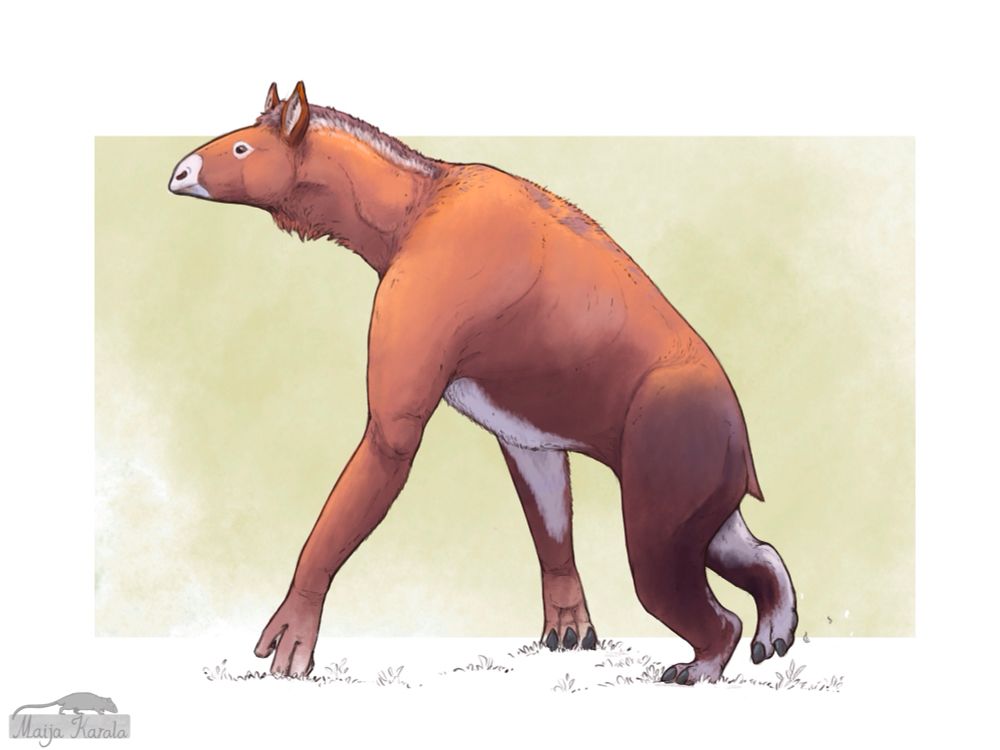
Digital drawing of Anisodon grande, a species of chalicothere. It is a mammal with a somewhat horselike head, very long arms with large claws and very short hind limbs, giving it a sloping back and gorilla-like shape. The animal is coloured orange-brown with a white belly and has a small mane and a beard-like tuft of fur on its throat.
Midsummer cottage doodle: Anisodon grande, a wonderfully weird gorilla-horse from the Miocene of Europe.
I gave her a pacing gait as in camels and other animals with short torsos and long legs, where ordinary walking gait might cause the front and hind limbs to collide.
23.06.2025 09:52
👍 79
🔁 14
💬 1
📌 1
Hit submit on two #fossil papers in two days, it feels goooood to have some fun new #research out soon(ish) on the funny little ancestral #kangaroo that is Dorcopsoides...
07.05.2025 02:33
👍 4
🔁 0
💬 0
📌 0
I agree though, we still know very little. Especially with regards to the variation within Sthenurinae, which often gets treated as a unit when talking about locomotion etc but is surely very varied. I'd be very keen to chat about them sometime!
30.04.2025 04:36
👍 2
🔁 0
💬 1
📌 0
You make very good points, I just can't see how they wouldn't topple forwards! Strange animals.
30.04.2025 04:35
👍 1
🔁 0
💬 1
📌 0
Looks great! I love their crazy hands.
If I had a note it would be that it's hard to see them leaning so far forward without a big tail to counterbalance, and the pelvic morphology would support a more upright stance...
29.04.2025 04:51
👍 1
🔁 0
💬 1
📌 0
New #evolution #research on dear little rat-kangaroos from Flinders Palaeos! (amongst distinguished others)
20.03.2025 02:15
👍 1
🔁 0
💬 0
📌 0
The “silent majority” of Australians support having more national parks, no matter who they vote for. Listen to the full interview and learn more about the study from @monashuniversity.bsky.social via our website: biodiversitycouncil.org.au/news/austral...
🌱 🐨 🦘 🐸 ⛺ 🥾 🌳
24.02.2025 08:49
👍 5
🔁 4
💬 0
📌 0

If ever you are displeased with a taxonomic description, I hope you can be comforted by the low bar set here by George Shaw in 1800 – still the taxonomic authority on the common wombat, Vombatus ursinus...
24.01.2025 04:20
👍 5
🔁 0
💬 0
📌 0