Home
Call for Submissions: AI for Social Science Methodology (Yale)
• Keynote: @nachristakis.bsky.social
• Panel with editors of leading journals on publishing AI research
• Mentoring roundtables for early-career scholars
• Generous travel support
Discussion-driven, high-quality research.
06.03.2026 16:30
👍 7
🔁 9
💬 1
📌 0
There’s one week left!
18.02.2026 18:18
👍 2
🔁 1
💬 0
📌 0

René Flores on Immigration Enforcement and ‘Social Illegality’
New episode of the inequality podcast w/ Rene Flores, where we discuss his research on some of the most pressing and troubling problems of our current moment.
open.spotify.com/episode/0vdU...
24.02.2026 15:25
👍 5
🔁 0
💬 0
📌 0
I am delighted that this great conversation with Ran Abramitzky and Leah Boustan has posted. Their extraordinary work on intergenerational mobility and immigrants speaks to essential dimensions of the extent of equality of opportunity and of the process of assimilation.
12.02.2026 17:33
👍 9
🔁 5
💬 0
📌 0
American Sociological Association 2026
Urban sociologists! I'm organizing a Community and Urban Sociology Section session at the 2026 ASA Annual Meeting titled "Housing as an Asset." Please submit extended abstracts or full papers related to topics on homeownership, house values, taxation, mortgages, etc. Deadline is 2/25. bit.ly/3Zx2eez
13.02.2026 16:14
👍 9
🔁 5
💬 0
📌 1


New working paper on recent trends in class mobility in the US: www.nber.org/papers/w34800
I learned a lot from an amazing team of collaborators at the @ucstonecenter.bsky.social while working on this propject: Weiqi Wang, @butaevak.bsky.social, and @durlauf.bsky.social
12.02.2026 16:46
👍 18
🔁 10
💬 0
📌 0
NEW: Geoffrey T. Wodtke, Kailey White, Xiang Zhou, "Poor Neighborhoods, Bad Schools? A High-Dimensional Model of Place-Based Disparities in Academic Achievement" sociologicalscience.com/articles-v13...
06.02.2026 18:04
👍 7
🔁 2
💬 0
📌 1

Legislators shape social policy impacting millions–but often with incomplete knowledge. This Friday, David Brady uncovers what lawmakers actually know, what they get wrong, and why it matters for real-world policy.
Join us → bit.ly/4q0E6f4
04.02.2026 16:31
👍 3
🔁 1
💬 0
📌 0
We rarely think of economics as scandalous, but maybe we should. Sam Bowles, in conversation with @durlauf.bsky.social & Ethan Bueno de Mesquita, argues that a core assumption in the field impedes moral reasoning about wealth redistribution. Watch "Why Economic Inequalities Endure"→ bit.ly/3Yj4F3B
03.02.2026 17:28
👍 18
🔁 4
💬 1
📌 4

Children face many challenges after a family separation. Moving homes? That can make it even harder, especially on academic outcomes. This Friday, Lucienne Disch discusses how residential stability may help keep kids test scores on track.
Register here → bit.ly/47z4qWg
03.12.2025 18:54
👍 4
🔁 1
💬 0
📌 0
When kids are ready to learn, Stephen Raudenbush thinks we should be ready to teach. On the latest Inequality Podcast, Raudenbush joins @gtwodtke.bsky.social to discuss how teaching and school structure shape outcomes, and why organizational change might be needed.
Listen → bit.ly/4rwytHh
02.12.2025 20:58
👍 4
🔁 2
💬 0
📌 0
Doug Downey on ‘How Schools Really Matter’
New episode of The Inequality Podcast w/ Doug Downey at Ohio State:
open.spotify.com/episode/3NhD...
17.11.2025 16:08
👍 6
🔁 0
💬 0
📌 0

Criminal justice institutions generate billions—but who benefits? This Friday, join Professor Joe Soss to discuss racial capitalism, legal plunder, and political resistance.
Register here to join the conversation → forms.gle/bbnp8ZgfBxE7NAJC8
19.10.2025 14:30
👍 1
🔁 1
💬 0
📌 0

Inequality persists not by accident, but by architecture. Join Samuel Bowles & @durlauf.bsky.social for Inequality Reconsidered: A Week with the Stone Center featuring insightful exchanges on research, policy, and the path forward.
Systems won't change themselves. Be a Part of It → cvent.me/aWXMPq
16.10.2025 23:00
👍 8
🔁 4
💬 0
📌 1

Announcing the 2025-2026 Inequality Workshop schedule!
Join us throughout the academic year for dialogue and critical commentary on some of today’s most pressing issues.
Want early access? Sign up for our newsletter → bit.ly/4pxC2fC
#InequalityResearch #AcademicWorkshops #UChicago
17.09.2025 15:44
👍 10
🔁 2
💬 0
📌 0

Measuring intergenerational educational and occupational mobility in China and Russia during the transition to market economies, using new Markov chain methods, from Kristina Butaeva, Lian Chen, Steven N. Durlauf, and Albert Park https://www.nber.org/papers/w34124
19.08.2025 15:00
👍 9
🔁 7
💬 0
📌 4

Differences in school quality are often blamed for academic achievement gaps between poor and affluent neighborhoods. A new paper uses ML to find that equalizing quality would reduce this gap by <10%, suggesting disparities stem mainly from structural factors.
Explore the findings → bit.ly/3VdIbQ1
22.08.2025 16:08
👍 5
🔁 1
💬 0
📌 1
Adam Smith is an economics legend, but what gets left out of modern conversations about this iconic thinker? Philosopher Eric Schliesser (@nescio13.bsky.social) unpacks Smith’s overlooked views on inequality and concentrated political power. Listen wherever you get your podcasts. bit.ly/3YdiCkj
12.08.2025 17:43
👍 39
🔁 9
💬 2
📌 2


Another new working paper w/ Kailey White and Xiang Zhou on differences in school quality across nhoods and their link to achievement gaps.
papers.ssrn.com/sol3/papers....
Check it out today at #ASA2025 session on "Place and Inequality"
11.08.2025 12:41
👍 10
🔁 2
💬 0
📌 0


New working paper w/ Jesse Zhou introducing flexible approach to mediation analysis with multiple mediators.
arxiv.org/abs/2506.140...
See Jesse present it this afternoon at #ASA2025.
09.08.2025 14:57
👍 10
🔁 1
💬 0
📌 0
How important are low tax rates when your life and career are rooted in one place? Cristobal Young challenges the idea that the wealthy are fleeing to tax havens in this week’s episode of The Inequality Podcast.
🎧 Listen here: bit.ly/3YdiCkj
#TaxFlight #MillionaireTax #InequalityResearch
28.07.2025 17:42
👍 8
🔁 8
💬 0
📌 2

Uneven Ground: Inequality and Planetary Health
Can we afford the consumption patterns of the super-rich? Or does human and planetary wellbeing require us to drastically reduce inequality?
The richest 1% emit 100x the greenhouse gas emissions of those in the world’s bottom 50%, notes @profkepickett.bsky.social. “Inequalities of income, wealth and political power sit at the heart of the environmental crisis” @equalitytrust.bsky.social #LSEInequalitiesBlog
🔗
26.07.2025 09:30
👍 28
🔁 25
💬 0
📌 2
In our latest book talk, we dive into the tensions between Universal Basic Income, technological innovation, AI, and ideology, framed through the lens of Karl Marx’s enduring relevance.
Watch now: bit.ly/3ZZAsI5
11.06.2025 17:26
👍 5
🔁 2
💬 1
📌 0

A book talk to bookend the school year!
Join us for a discussion on Marx, featuring UChicago Law Professors @brianleiter.bsky.social and Jaime Edwards, as they present a penetrating synthesis of Marx’s ideas and their relevance to contemporary work in the social sciences.
RSVP: bit.ly/4jieMyH
18.04.2025 18:26
👍 3
🔁 2
💬 0
📌 1
Today, host @gtwodtke.bsky.social and Professor @aldasky.bsky.social explore issues at the intersection of climate change, the housing crisis, and social inequality.
Listen every other Monday:
Website: bit.ly/3YdiCkj
Spotify: bit.ly/3qO0KhP
Apple: bit.ly/3phD0SP
#AffordableHousing #ClimateChange
07.04.2025 21:40
👍 7
🔁 1
💬 0
📌 0
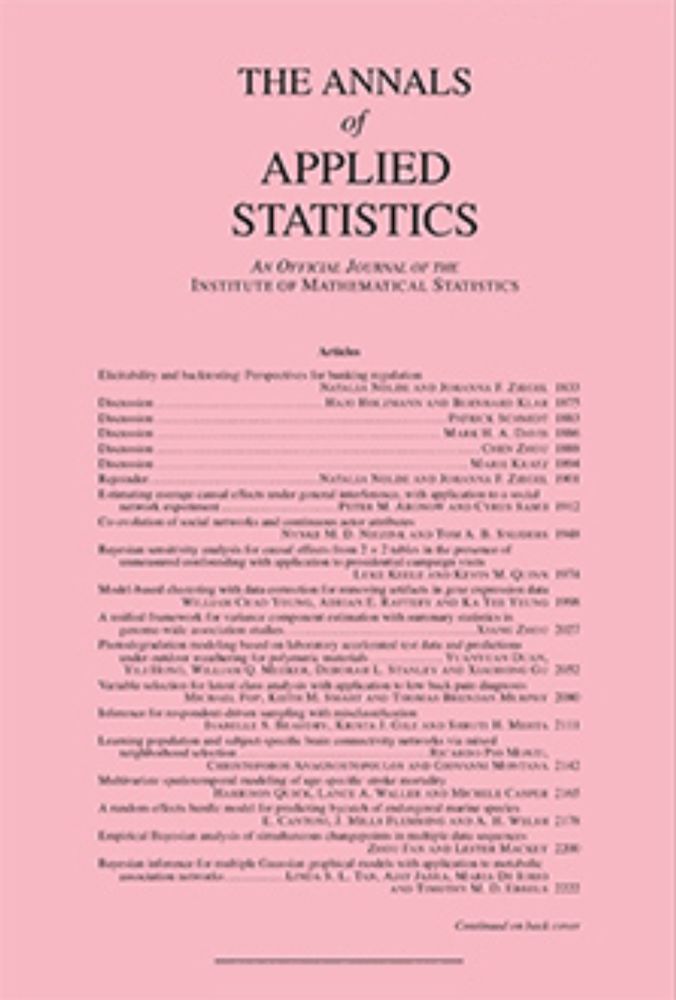
Nonparametric causal decomposition of group disparities
We introduce a new nonparametric causal decomposition approach that identifies the mechanisms by which a treatment variable contributes to a group-based outcome disparity. Our approach distinguishes three mechanisms: group differences in: (1) treatment prevalence, (2) average treatment effects, and (3) selection into treatment based on individual-level treatment effects. Our approach reformulates classic Kitagawa–Blinder–Oaxaca decompositions in causal and nonparametric terms, complements causal mediation analysis by explaining group disparities instead of group effects, and isolates conceptually distinct mechanisms conflated in recent random equalization decompositions. In contrast to all prior approaches, our framework uniquely identifies differential selection into treatment as a novel disparity-generating mechanism. Our approach can be used for both the retrospective causal explanation of disparities and the prospective planning of interventions to change disparities. We present both an unconditional and a conditional decomposition, where the latter quantifies the contributions of the treatment within levels of certain covariates. We develop nonparametric estimators that are n-consistent, asymptotically normal, semiparametrically efficient, and multiply robust. We apply our approach to analyze the mechanisms by which college graduation causally contributes to intergenerational income persistence (the disparity in adult income between the children of high- vs. low-income parents). Empirically, we demonstrate a previously undiscovered role played by the new selection component in intergenerational income persistence.
My paper on causal decomposition of group disparities is out in the Annals of Applied Statistics! If you are looking to explain group differences, this is likely the methodological framework for you! doi.org/10.1214/24-A...
20.03.2025 12:53
👍 12
🔁 3
💬 0
📌 1